
Resurrection of Jesus

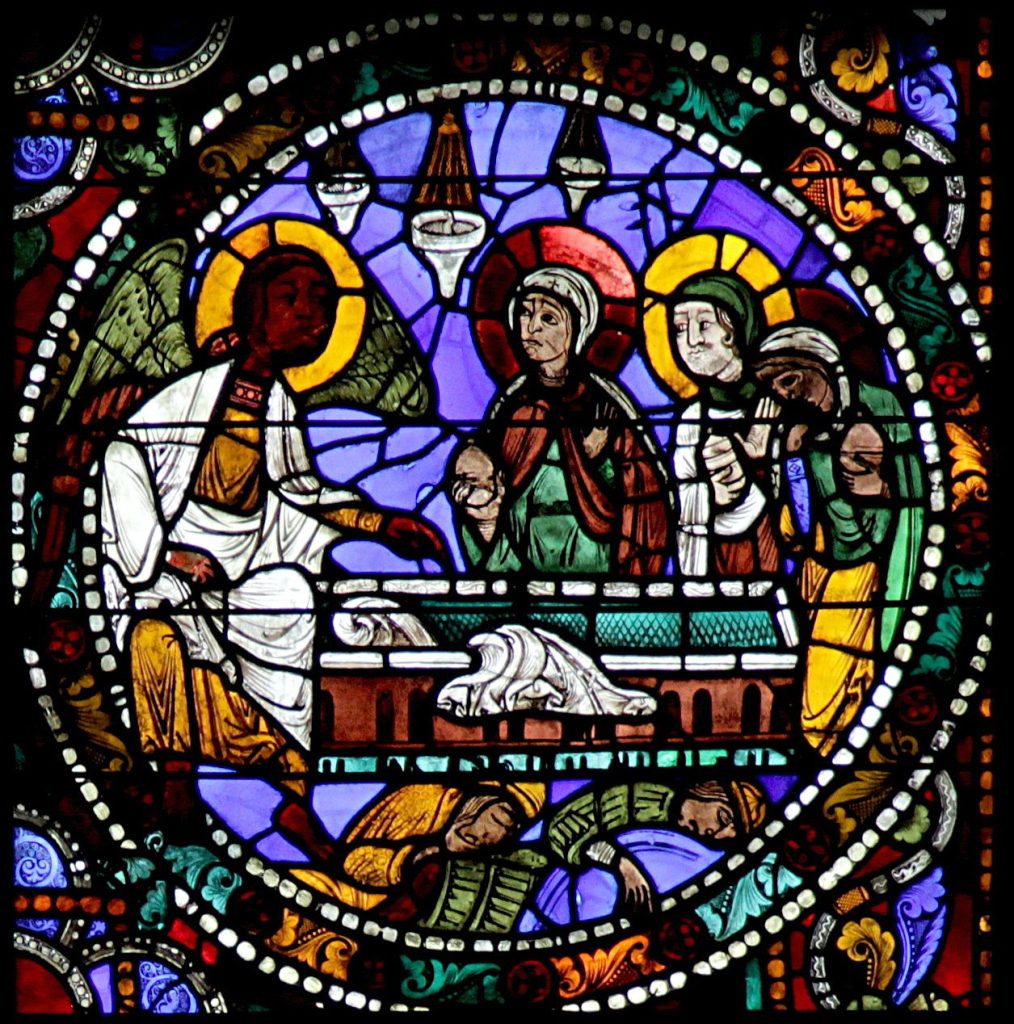
The following is a stained glass window from 1855 by artist H. Beiler over the altar of the Evangelische Stadtkirche Bad Rappenau, Bad Rappenau, Germany:

Photo by Llez, hosted by Wikimedia Commons under a Creative Commons Attribution-Share Alike 3.0 Unported license

Stained glass is not just highly decorative, it’s a medium which has been used to express important religious messages for centuries. Literacy was not widespread in the medieval and Renaissance periods and the Church used stained glass and other artworks to teach the central beliefs of Christianity. In Gothic churches, the windows were filled with extensive narrative scenes in stained glass — like huge and colorful picture storybooks — in which worshipers could ‘read’ the stories of Christ and the saints and learn what was required for their religious salvation. (Source: Victoria and Albert Museum )
complete verse (Luke 24:3)

Following are a number of back-translations of Luke 24:3:

  • Noongar: “so they went inside; but they did not see the body of the Lord Jesus.” (Source: Warda-Kwabba Luke-Ang)
  • Uma: “They entered into the grave, but they did not find the body of the Lord Yesus.” (Source: Uma Back Translation)
  • Yakan: “They went inside but they saw that the body/corpse of Isa was no longer there.” (Source: Yakan Back Translation)
  • Western Bukidnon Manobo: “They went inside and they looked around for the body of the Lord Jesus, and it wasn’t there.” (Source: Western Bukidnon Manobo Back Translation)
  • Kankanaey: “so then right-away they entered, but they didn’t find (lit. found nothing of) Jesus’ body.” (Source: Kankanaey Back Translation)
  • Tagbanwa: “They went in but the Lord Jesus was no longer lying-dead there.” (Source: Tagbanwa Back Translation)

Scriptures Plain & Simple (Luke 24:1-12)

Barclay Newman, a translator on the teams for both the Good News Bible and the Contemporary English Version, translated passages of the New Testament into English and published them in 2014, “in a publication brief enough to be non-threatening, yet long enough to be taken seriously, and interesting enough to appeal to believers and un-believers alike.” The following is the translation of Luke 24:1-12:

Before Sunday dawned, the women rushed to the tomb,
       carrying spices they had prepared.
The stone had been rolled away from the entrance,
       and they rushed right in.
Where was the body of the Lord Jesus?
It was nowhere to be seen,
       and they didn’t know what to think.

Two men there in shining white garments!
Where did they come from?

Shocked, the women fell to the ground, but the men said:

       “The living don’t dwell in tombs of the dead!
       Jesus has been raised to life,
              and now he’s long gone.
       While you were still in Galilee, don’t you remember
       he told you he’d be arrested, then executed on a cross,
              but three days later he’d rise to life?”

At that very moment, the women recalled
       what Jesus had said to them.

Quite a crowd of women had gone to the tomb,
among them: Mary Magdalene, Joanna,
       and Mary the mother of James.
They hurried off and informed others,
including the closest followers of Jesus,
       who refused to believe such nonsense.

However, Peter raced to the tomb,
but after stooping and looking carefully inside,
       he saw only burial clothes.
Still confused, he returned to the others.

Sung version of Luke 24

Living Water is produced for the Bible translation movement in association with Lutheran Bible Translators. Lyrics derived from the ESV® Bible (The Holy Bible, English Standard Version®).

For more information, see here .

Translation commentary on Luke 24:2 – 24:3

Exegesis:

heuron de ton lithon apokekulismenon apo tou mnēmeiou ‘but they found the stone rolled away from the grave.’ The article ton before lithon is best understood as identifying the stone as well known, cf. Plummer. apokulizō. mnēmeion is equivalent to mnēma.

(V. 3) eiselthousai de ‘but after going in,’ i.e. into the chamber of the tomb.

ouch heuron to sōma tou [kuriou] Iēsou ‘they did not find the body of the Lord Jesus.’ For sōma cf. on 23.52; for kuriou cf. on 1.6.

Translation:

For they found see on 7.10.

The stone rolled away, or, where an active construction is preferable, ‘that someone had rolled the stone away.’ The stone, or, making explicit what for the original receptor was too self-evident to need mentioning, ‘the closing stone,’ or, ‘the stone that served to close the tomb’ (if necessary shifting to pronominal reference in the following phrase).

From the tomb, i.e. ‘from before the tomb’ (Bible de Jérusalem), ‘from the entrance/mouth/outlet of the tomb’ (cf. Tae’ 1933, Low Malay, Balinese).

(V. 3) Went in, or, ‘entered it,’ ‘went inside the tomb (or, cave).’

They did not find. The verb refers to finding as a result of seeking (cf. on 2.12), as shown by v. 5c; cf. also The Four Gospels – a New Translation‘s “they looked in vain for”.

Quoted with permission from Reiling, J. and Swellengrebel, J.L. A Handbook on the Gospel of Luke. (UBS Handbook Series). New York: UBS, 1971. For this and other handbooks for translators see here . Make sure to also consult the Handbook on the Gospel of Mark for parallel or similar verses.