chicken / rooster / chick

There is considerable doubt about the meaning of the word sekwi. However, the rendering “cock” or “rooster” has support from the Vulgate and one of the Targums, as well as the majority of commentaries. In the context of Job 38:36 the reference seems to be to the way in which the ibis is able to announce the flooding of the Nile, and the rooster is able to announce the coming of the dawn. Both of these abilities are mentioned quite often in Egyptian literature.

The word zarzir is probably related to a word meaning “narrow waisted,” but most commentaries and translations interpret this as a reference to the rooster.

The Greek word ornis and the Latin word gallina mean “hen,” and the Greek words nossia and nossion mean “chick,” that is, a baby fowl.

All modern domestic fowls are descended from the jungle fowl of India, Southeast Asia, and China. These were domesticated very early in the history of that region, almost as soon as the farming of rice and other grains began. According to the Talmud, it was forbidden to keep domestic poultry in Jerusalem, but there is evidence from ancient Hebrew seals that chickens were known in the land as early as 600 B.C. The reference to the cock crowing on the night of the crucifixion would indicate that chickens were kept near, if not in, Jerusalem.

Ancient domestic fowls would still have looked very much like the Jungle Fowl Gallus gallus from which they were descended. Jungle fowl roosters are dark, brownish red, with orange-red neck hackles, a smallish red comb on the top of their heads, and red lappets on each side under the beak. They have a white spot on their backs near the base of their long glossy black and green tails. The hens are a lighter brownish red, have no white spot or long tail, and have a smaller comb on their heads.

Domestic fowl had connotations of fertility to the Egyptians and Persians. This seems to have been adopted later in Judaism, since it became the practice to carry a cock and a hen in front of the bride and groom at a wedding. However, their significance in the Bible seems related to the fact that cocks crow very early in the morning, thus announcing the coming dawn before humans are aware of it.

Domestic fowl have now spread around the world and are well-known, apart from some areas of the tundra region.

The words sekwi, zarzir, alektruōn, and alektōr are probably best translated as “rooster,” ornis as “hen,” and nossion and nossia as “chickens.” In some languages where roosters and hens are not normally differentiated, it may not be necessary to do so in the gospel passages, since the verb “crow” will usually be sufficient context to make the meaning clear. However, in the Job and Proverbs passages it may still be necessary in some languages to say something like “male chicken.”

Source: All Creatures Great and Small: Living things in the Bible (UBS Helps for Translators)

See also rooster.

rooster

The Greek that is translated in English as “rooster crowed” or “cock crowed” is translated in North Alaskan Inupiatun as “the bird called.” (Source: M. Larson / B. Moore in Notes on Translation February 1970, p. 1-125.)

See also chicken / rooster / chick.

Peter

Following is a Armenian Orthodox icon of Peter (found in the Ghazanchetsots Cathedral in Shusha, Azerbaijan).

Orthodox Icons are not drawings or creations of imagination. They are in fact writings of things not of this world. Icons can represent our Lord Jesus Christ, the Virgin Mary, and the Saints. They can also represent the Holy Trinity, Angels, the Heavenly hosts, and even events. Orthodox icons, unlike Western pictures, change the perspective and form of the image so that it is not naturalistic. This is done so that we can look beyond appearances of the world, and instead look to the spiritual truth of the holy person or event. (Source )

Following is a hand colored stencil print on momigami of Peter by Sadao Watanabe (1970):

Image taken with permission from the SadaoHanga Catalogue where you can find many more images and information about Sadao Watanabe. For other images of Sadao Watanabe art works in TIPs, see here.

In Finnish Sign Language it is translated with the sign signifying “key” (referring to Matthew 16:19). (Source: Tarja Sandholm)


“Peter” or “Cephas” in Finnish Sign Language (source )

In Swiss-German Sign Language it is translated with the sign for “rock,” referring to the meaning of the Greek word for “Peter.”


“Peter” in Swiss-German Sign Language, source: DSGS-Lexikon biblischer Begriffe , © CGG Schweiz

For more information on translations of proper names with sign language see Sign Language Bible Translations Have Something to Say to Hearing Christians .

See also Peter – rock.

Learn more on Bible Odyssey: Peter .

complete verse (Luke 22:60)

Following are a number of back-translations of Luke 22:60:

  • Noongar: “But Peter said, ‘Man, I don’t know what you are saying!’ At that moment, when Peter was speaking, a bird crowed.” (Source: Warda-Kwabba Luke-Ang)
  • Uma: “Petrus said: ‘I don’t even know what you are talking about!’ while Petrus was still speaking, the chicken crowed,” (Source: Uma Back Translation)
  • Yakan: “But Petros said, ‘Man, I don’t know what you are saying there.’ Immediately while he was still speaking the cock crowed.” (Source: Yakan Back Translation)
  • Western Bukidnon Manobo: “But Peter answered again, ‘I don’t know what you’re talking about.’ And while Peter was still talking, the chicken crowed.” (Source: Western Bukidnon Manobo Back Translation)
  • Kankanaey: “‘I absolutely don’t know what you (sing.) are saying,’ answered Pedro. He was still speaking and the rooster crowed.” (Source: Kankanaey Back Translation)
  • Tagbanwa: “But Pedro answered him saying, ‘Expl., I don’t know what you mean by that!’ Pedro was still speaking when at the same time a rooster then crowed.” (Source: Tagbanwa Back Translation)

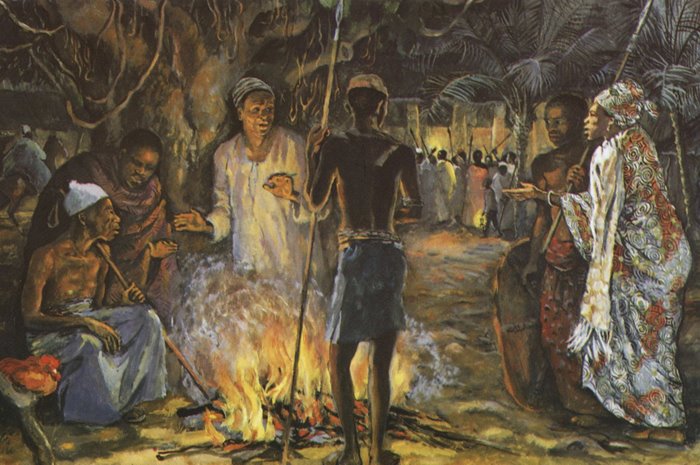
Peter Denies Jesus

Following is a 1973 painting of the JESUS MAFA project, a response to New Testament readings from the Lectionary by a Christian community in Cameroon, Africa. Each of the readings was selected and adapted to dramatic interpretation by the community members. Photographs of their interpretations were made, and these were then transcribed to paintings:

From Art in the Christian Tradition , a project of the Vanderbilt Divinity Library, Nashville, TN. Image retrieved March 23, 2026. Original source: librairie-emmanuel.fr.

Scriptures Plain & Simple (Luke 22:54-65)

Barclay Newman, a translator on the teams for both the Good News Bible and the Contemporary English Version, translated passages of the New Testament into English and published them in 2014, “in a publication brief enough to be non-threatening, yet long enough to be taken seriously, and interesting enough to appeal to believers and un-believers alike.” The following is the translation of Luke 22:54-65:

Peter kept his distance after Jesus was arrested
       and led away to the house of the high priest.
Some people were sitting around a fire
in the courtyard of the house, and Peter joined them.
       “This man was with Jesus!” blurted out a servant girl.

“I don’t even know the guy!” insisted Peter.

“You’re one of them!” someone said with a smirk.

“Not me!” denied Peter.

An hour or so later, another man swore,
       “This man was with Jesus—they’re both from Galilee.”

“I don’t know what you’re talking about!”
       came Peter’s denial.
At that very moment, while Peter was still speaking,
       he heard the sound of a rooster crowing.

The Lord looked in Peter’s direction,
and Peter remembered those solemn words,
       “Before a rooster crows tomorrow morning,
       you’ll say three times you don’t even know me.”

Peter left and wept bitterly.

Meanwhile, the guards insulted and struck Jesus.
They put a blindfold on him and sneered as they said,
       “Tell us who hit you?”
And this was not the worst they did to him.

Translation commentary on Luke 22:60

Exegesis:

anthrōpe, ouk oida ho legeis ‘man, I don’t know what you are saying, or, talking about,’ i.e. it is absolutely not true what you say.

parachrēma eti lalountos autou ‘and immediately, while he was still speaking.’ The genitive absolute eti lalountos autou stresses parachrēma which goes with the main verb ephōnēsen.

ephōnēsen alektōr ‘the cock crowed,’ cf. on v. 34.

Translation:

I do not know what you are saying, or, ‘I do not know (or, understand) what you are talking about, or, what your words (can possibly) mean.’

Immediately and while he was still speaking, or, “just as he spoke” (An American Translation), ‘before he had finished (speaking)’ (cf. The Four Gospels – a New Translation), both serve to express the concept of immediacy; the renderings may have to be combined into one phrase.

Quoted with permission from Reiling, J. and Swellengrebel, J.L. A Handbook on the Gospel of Luke. (UBS Handbook Series). New York: UBS, 1971. For this and other handbooks for translators see here . Make sure to also consult the Handbook on the Gospel of Mark for parallel or similar verses.