The following artwork is part of a series of 56 paintings on biblical themes by Kazakh artist Nelly Bube (born 1949):
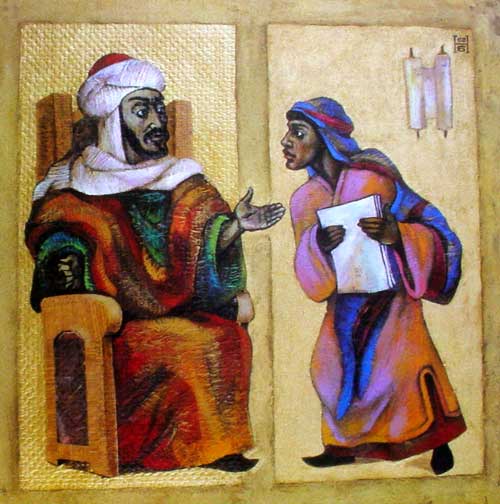
Copyright by Norwegian Bible Society , used with permission.
For other images of Nelly Bube in TIPs, see here.

καὶ ἐπῄνεσεν ὁ κύριος τὸν οἰκονόμον τῆς ἀδικίας ὅτι φρονίμως ἐποίησεν· ὅτι οἱ υἱοὶ τοῦ αἰῶνος τούτου φρονιμώτεροι ὑπὲρ τοὺς υἱοὺς τοῦ φωτὸς εἰς τὴν γενεὰν τὴν ἑαυτῶν εἰσιν.
8And his master commended the dishonest manager because he had acted shrewdly, for the children of this age are more shrewd in dealing with their own generation than are the children of light.
The following artwork is part of a series of 56 paintings on biblical themes by Kazakh artist Nelly Bube (born 1949):
Copyright by Norwegian Bible Society , used with permission.
For other images of Nelly Bube in TIPs, see here.
Following are a number of back-translations of Luke 16:8:
The Greek in the referenced verses that is typically translated as “age,” “(for)ever / eternity / eternal / permanent,” “of old / long ago” in English is translated in the German translation by Fridolin Stier (1989) consistenty as “world (or: “cosmic”) time” (Weltzeit).
Sarah Ruden (2021, p. lxii) explains the complexities of the translation of aiōn: “Trickiest of all [the words relating to time] is aion, most simply an ‘age’ or ‘era’ but sometimes denoting either the whole present world or the whole world to come. The same word can allude to all the limits of material existence (or to dangerous worldly distractions in particular), or to their absence in the eternal age to come. Looking forward, especially to ‘ages of ages’ (in the pattern of ‘King of Kings’), the meaning is ‘eternity.’”
Exegesis:
kai epēnesen ho kurios ton oikonomon tēs adikias ‘and the master praised the dishonest manager.’ Whether ho kurios refers to the master of the manager, or to Jesus is hard to decide (see commentaries). On the whole the former appears slightly preferable. oikonomos tēs adikias (qualifying genitive) is equivalent to oikonomos adikos, and refers to dishonesty, rather than unrighteousness, cf. on v. 10.
epaineō ‘to praise,’ ‘to approve,’ ‘to commend.’
hoti phronimōs epoiēsen ‘because he had acted shrewdly.’ hoti may mean here ‘that,’ or, ‘because,’ preferably the latter. phronimōs does not refer to the moral aspects of the manager’s dealing but to the fact that he knew how to act in the face of imminent crisis. This is the point of the parable.
hoti hoi huioi tou aiōnos toutou ‘for the sons of this age,’ as contrasted with the people of the age to come (cf. 18.30), i.e. people whose main concern is the here and now, as contrasted with the people whose main concern is the kingdom of God. The clause is best understood as a parenthetical comment by Jesus on the reaction of the master, and the meaning appears to be that the sons of this age are more shrewd in dealing with their own kind than the sons of light in dealing with their situation vis à vis the imminent coming of the kingdom. For aiōn cf. on 1.33.
phronimōteroi huper tous huious tou phōtos … eisin ‘are more shrewd than the sons of light.’ huper lit. ‘beyond’ means here ‘(more) than.’ The sons of light are the people who belong to the kingdom of God, of which the light is the symbol (cf. Jn. 12.36, Eph. 5.8, 1 Thess. 5.5).
eis tēn genean tēn heautōn ‘in dealing with their own generation,’ i.e. “in dealing with their own kind” (New English Bible), goes with hoi huioi tou aiōnos toutou.
Translation:
Commended (or, praised) the dishonest steward, i.e. said that the … steward had done well. Dishonest, or, ‘deceitful,’ ‘who didn’t do right’ (Sranan Tongo). Words for ‘crooked,’ ‘not straight’ can often be used in the figurative sense required here.
For his prudence, or, ‘because he had acted prudently/shrewdly/carefully, or, with (so) much forethought.’
The sons of this world, or, ‘those who belong to this world/age.’ The expression has pejorative force, since the contrast with “the sons of light” characterizes the sphere of this world or age as darkness. Some renderings used are, ‘heirs of visible-pleasures’ (Balinese, cf. 8.14), ‘people who seek this world, or, value-highly the life in the world’ (Tae’ 1933, Toraja-Sa’dan), ‘lovers of the earth’ (proposed for Shona).
Wiser, i.e. more prudent (see above).
In their own generation, or, ‘regarding those of their own kind’ (Marathi), ‘the way they live with each other’ (Sranan Tongo), ‘towards their-fellows (of-the-same-mind)’ (East and Toraja-Sa’dan, Batak Toba).
The sons of light, or, ‘people belonging to the light,’ ‘people characterized by light,’ ‘those who are in the realm of daylight’ (existing figurative expression in Tzeltal).
Quoted with permission from Reiling, J. and Swellengrebel, J.L. A Handbook on the Gospel of Luke. (UBS Handbook Series). New York: UBS, 1971. For this and other handbooks for translators see here . Make sure to also consult the Handbook on the Gospel of Mark for parallel or similar verses.
Paragraph 16:8
Jesus concluded the parable in 16:8a–b. In 16:8c he gave an explanatory comment about the parable, and in 16:9 he applied the parable to his disciples. The Berean Standard Bible puts these two verses into one paragraph. In some languages it may be more natural to start a new paragraph in 16:9, as in the Good News Translation and New Jerusalem Bible. These Notes will treat 16:8 as one paragraph and 16:9 as a separate paragraph.
16:8a–b
The master commended the dishonest manager because he had acted shrewdly: Somehow the rich man found out what the manager had done. In some languages it may be necessary to supply this information:
⌊When the master heard about this,⌋ he commended the dishonest manager for acting shrewdly.
It is important to make clear in your translation that the rich man praised his manager because he had acted shrewdly (16:8b). He did not praise him because he was dishonest. For example:
the master of this dishonest manager praised him for doing such a shrewd thing (Good News Translation)
-or-
even though the manager was dishonest, his employer complimented him because of his clever action
The master: The Greek phrase that the Berean Standard Bible translates as The master refers to the master or employer of the manager. In some languages it may be necessary to make this explicit:
⌊His⌋ employer/boss
commended: The Greek word that the Berean Standard Bible translates as commended means here to praise or compliment someone.
dishonest: The Greek word that the Berean Standard Bible translates as dishonest often refers to someone who is “unrighteous” or “wicked.” In this context it refers primarily to the manager’s earlier actions of cheating his master by wasting his master’s money and spending it on himself. But it may also include his final actions of having the debtors change the amounts of their debt. In languages that do not have a word such as dishonest, other ways to translate this word are:
deceiving/deceitful
-or-
not trustworthy
because he had acted shrewdly: This clause explains why the rich man praised his manager. The rich man admired the cleverness and foresight with which the manager had acted in 16:5–7. Here is another way to translate this:
for doing such a shrewd thing (Good News Translation)
16:8c–d
For: The Greek conjunction that the Berean Standard Bible translates as For introduces a comment that Jesus made about the parable. This comment is part of the point that the parable illustrates. Be sure it is clear in your translation that Jesus was now commenting about the parable. He was no longer telling the parable. For example:
⌊This parable shows⌋ that
-or-
⌊This is understandable⌋ because
the sons of this age are more shrewd in dealing with their own kind than are the sons of light: This is a comparison. Jesus was comparing one group of people to another group of people. (See the notes below for an explanation of what these groups are.) Like the dishonest manager, people in the first group are often very clever in how they treat other people. People in the second group are often not so clever. In some languages it may be necessary to translate this as two sentences:
…the sons of this age are very clever/wise in dealing with their own kind. The sons of the light are not so clever!
the sons of this age: The Greek phrase that the Berean Standard Bible translates literally as the sons of this age is an idiom. It refers to people who value things that are important on earth (such as money and status) instead of valuing what is important in heaven. Other ways to translate this phrase are:
worldly people (New Century Version)
-or-
people who do not obey God
-or-
people who have worldly lifestyles (Translator’s Reference Translation)
more shrewd: The Greek word that the Berean Standard Bible translates as more shrewd is a form of the same word that it translates as “shrewdly” in 16:8b.
in dealing with: The Greek word that the Berean Standard Bible translates as in dealing with is literally “in (regard to).” In this context, it implies “in interacting with” or “in handling business affairs with.”
their own kind: The Greek phrase that the Berean Standard Bible translates as their own kind is literally “their own generation.” The Revised Standard Version and several other English versions translate it that way. There are at least three ways to interpret this phrase:
(1) It refers to other people who were like them. For example:
⌊other⌋ people ⌊who are worldly⌋ like themselves (Translator’s Reference Translation)
(Berean Standard Bible, New International Version, Revised English Bible, New Jerusalem Bible, New Century Version)
(2) It refers to other people who were living at the same time. For example:
in dealing with their contemporaries (NET Bible)
(NET Bible, Revised Standard Version, Phillips’ New Testament in Modern English)
(3) It refers to money and business matters. Other people are only implied. For example:
in handling their affairs (Good News Translation)
(Good News Translation, Contemporary English Version, New Living Translation (2004))
All three of these interpretations overlap. In the context, interpretation (3) could apply to either (1) and (2) or both. It is recommended that you use a general expression that refers to dealing with people. For example:
when it comes to dealing with others (God’s Word)
the sons of light: The Greek idiom that the Berean Standard Bible translates literally as the sons of light refers to:
(a) people who are associated with God, the source of light;
(b) people who have been spiritually enlightened by God’s truth.
In some languages it may be possible to retain a reference to light. For example:
the people who belong to the light (Good News Translation)
-or-
people whose minds God has illuminated
In other languages it may be necessary to drop the figure of light. For example:
people who are followers of God
-or-
God’s people (Translator’s Reference Translation)
© 2009, 2010, 2013 by SIL International®
Made available under the terms of a Creative Commons Attribution-ShareAlike 4.0 License (CC BY-SA) creativecommons.org/licenses/by-sa/4.0.
All Scripture quotations in this publication, unless otherwise indicated, are from The Holy Bible, Berean Standard Bible.
BSB is produced in cooperation with Bible Hub, Discovery Bible, OpenBible.com, and the Berean Bible Translation Committee.
No comments yet.
Leave a Reply
You must be logged in to post a comment.