
Parable of the Great Banquet

The following artwork is part of a series of 56 paintings on biblical themes by Kazakh artist Nelly Bube (born 1949):
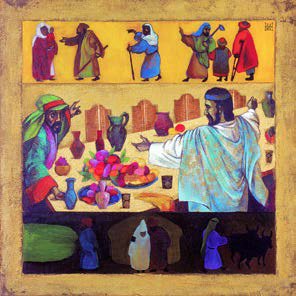
Copyright by Norwegian Bible Society , used with permission.

For other images of Nelly Bube in TIPs, see here.

Following is a 1973 painting of the JESUS MAFA project, a response to New Testament readings from the Lectionary by a Christian community in Cameroon, Africa. Each of the readings was selected and adapted to dramatic interpretation by the community members. Photographs of their interpretations were made, and these were then transcribed to paintings:

In this painting, we see a generous, wealthy host, choosing to hold a feast for the poor. A large group of disenfranchised people are gathered together eating, talking, and enjoying one another’s company. The faces of the host and all his guests show expressions of joy and gratitude. This scene reveals a community who took Jesus’ instructions from Luke 14:13 seriously: “But when you give a banquet, invite the poor, the crippled, the lame, and the blind.” Followers of Jesus are to remain humble, expecting nothing in return for the Christ-like love we are called to share with the world.

From Art in the Christian Tradition , a project of the Vanderbilt Divinity Library, Nashville, TN. Image retrieved March 23, 2026. Original source: librairie-emmanuel.fr.

complete verse (Luke 14:20)

Following are a number of back-translations of Luke 14:20:

  • Noongar: “Another person said, ‘I only just married and really, I can’t come’.” (Source: Warda-Kwabba Luke-Ang)
  • Uma: “Another one also said: ‘I just got married. I cannot go [to where you are].'” (Source: Uma Back Translation)
  • Yakan: “And one said, ‘I have recently married, therefore I cannot come.'” (Source: Yakan Back Translation)
  • Western Bukidnon Manobo: “And another person there said, ‘I cannot attend because I have just gotten married; that’s why I cannot go there.'” (Source: Western Bukidnon Manobo Back Translation)
  • Kankanaey: “One also, he said, ‘I-have-just-gotten-married, so I will not be joining-in-eating.'” (Source: Kankanaey Back Translation)
  • Tagbanwa: “As for one person, he said, ‘I really can’t come for our (excl.) marriage-legalities have just been completed.'” (Source: Tagbanwa Back Translation)

Translation commentary on Luke 14:20

Exegesis:

gunaika egēma ‘I have married a wife,’ i.e. “I have just got married” (New English Bible).

gameō ‘to marry,’ with a man as subject.

kai dia touto ou dunamai elthein ‘and therefore I cannot come.’

Translation:

Another, or, ‘yet another,’ i.e. a third example.

I have married a wife, or ‘I have married,’ since ‘a wife’ is unduly redundant here. Elsewhere ‘to marry’ may be rendered e.g. by, ‘to take a spouse’ (e.g. in Ekari, which, when a woman is the subject, uses, ‘to go-with a spouse’), ‘to take a woman’ (Batak Toba, which says of the woman, ‘to go-home,’ or, ‘to go-home to the village,’ i.e. of her husband); or by an idiomatic phrase, e.g. in Yucateco (lit. ‘to end one’s road,’ i.e. as bachelor), or in Toraja-Sa’dan (lit. ‘to establish-a-fireplace’).

Quoted with permission from Reiling, J. and Swellengrebel, J.L. A Handbook on the Gospel of Luke. (UBS Handbook Series). New York: UBS, 1971. For this and other handbooks for translators see here . Make sure to also consult the Handbook on the Gospel of Mark for parallel or similar verses.

SIL Translator’s Notes on Luke 14:20

14:20

I have married a wife, so I cannot come: The man did not say exactly why he could not go to the feast. He may have implied that he wished to spend the time alone with his new wife.

I have married a wife: The clause that the Berean Standard Bible translates as I have married a wife is literally “a woman I married.” This probably implies that he had gotten married fairly recently. Other ways to translate this clause are:

I recently got married (God’s Word)
-or-
I now have a wife (New Living Translation (2004))

Use an expression that is natural in your language.

so I cannot come: In the context of coming or going to the feast, it may be more natural in some languages to say “I cannot go.” Use whatever term is more natural in your language.

General Comment on 14:17–20

These verses contain several short speeches. These speeches occur within the story that Jesus was telling. In some languages it is more natural to use indirect quotations here. For example:

17When all was ready, he sent his servant around to notify the guests that it was time for them to come. 18But they all began making excuses. One said he had just bought a field and wanted to inspect it, so he asked to be excused. 19Another said he had just bought five pair of oxen and wanted to try them out. 20Another had just been married, so he said he couldn’t come. (New Living Translation (1996))

© 2009, 2010, 2013 by SIL International®
Made available under the terms of a Creative Commons Attribution-ShareAlike 4.0 License (CC BY-SA) creativecommons.org/licenses/by-sa/4.0.
All Scripture quotations in this publication, unless otherwise indicated, are from The Holy Bible, Berean Standard Bible.
BSB is produced in cooperation with Bible Hub, Discovery Bible, OpenBible.com, and the Berean Bible Translation Committee.