21So the slave returned and reported this to his master. Then the owner of the house became angry and said to his slave, ‘Go out at once into the streets and lanes of the town and bring in the poor, the crippled, the blind, and the lame.’
The Hebrew, Latin and Greek that is translated as “blind” in English is translated as “(having) eyes dark/night” in Ekari or “having no eyes” in Zarma. (Source: Nida 1964, p. 200)
The Hebrew, Greek and Latin that is translated as “(was or became) angry” in English is translated in Kwere as “saw anger.” In Kwere, emotions are always paired with sensory verbs (seeing or smelling or hearing). (Source: Pioneer Bible Translators, project-specific translation notes in Paratext)
In Bariai it is “to have grumbling interiors” (source: Bariai Back Translation).
The Hebrew that is translated as “the poor” in English is translated in Chichewa as “people without power.” In Chichewa context this refers to those who are in the lower class in terms of both social status and political influence in a community. (Source: Mawu a Mulungu mu Chichewa Chalero Back Translation)
In Cherokee it is translated as “those who are not doing well.” “The concept of poverty was unknown to Cherokee prior to European arrival due to the sharing of resources among clan members and the shared and welfare tradition known as gadugi (ᎦᏚᎩ). In contrast, the concepts of rich and poor play a large role in the world and message or the New Testament (…) This phrase (‘those who are not doing well’), still used today for ‘poor,’ speaks to a more general understanding of well-being than the presence of monetary resources.” (Source: Bender / Belt 2025, p. 45)
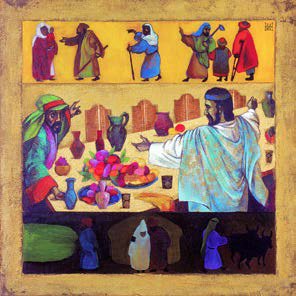
Following is a 1973 painting of the JESUS MAFA project, a response to New Testament readings from the Lectionary by a Christian community in Cameroon, Africa. Each of the readings was selected and adapted to dramatic interpretation by the community members. Photographs of their interpretations were made, and these were then transcribed to paintings:
In this painting, we see a generous, wealthy host, choosing to hold a feast for the poor. A large group of disenfranchised people are gathered together eating, talking, and enjoying one another’s company. The faces of the host and all his guests show expressions of joy and gratitude. This scene reveals a community who took Jesus’ instructions from Luke 14:13 seriously: “But when you give a banquet, invite the poor, the crippled, the lame, and the blind.” Followers of Jesus are to remain humble, expecting nothing in return for the Christ-like love we are called to share with the world.
From Art in the Christian Tradition, a project of the Vanderbilt Divinity Library, Nashville, TN. Image retrieved March 23, 2026. Original source: librairie-emmanuel.fr.
The Hebrew, Latin and Greek that is translated as “anger” or similar in English in this verse is translated with a variety of solutions (Bratcher / Nida says: “Since anger has so many manifestations and seems to affect so many aspects of personality, it is not strange that expressions used to describe this emotional response are so varied”).
Chichewa: “have a burning heart” (source: Mawu a Mulungu mu Chichewa Chalero Back Translation) (see also anger burned in him)
Citak: two different terms, one meaning “angry” and one meaning “offended,” both are actually descriptions of facial expressions. The former can be represented by an angry stretching of the eyes or by an angry frown. The latter is similarly expressed by an offended type of frown with one’s head lowered. (Source: Graham Ogden)
In Akan, a number of metaphors are used, most importantly abufuo, lit. “weedy chest” (the chest is seen as a container that contains the heart but can also metaphorically be filled with other fluids etc.), but also abufuhyeε lit. “hot/burning weedy chest” and anibereε, lit. “reddened eyes.” (Source: Gladys Nyarko Ansah in Kövecses / Benczes / Szelid 2024, p. 21ff.)
Following are a number of back-translations of Luke 14:21:
Noongar: “The servant went back home and told his boss everything. The boss became very angry and told his servant, ‘Hurry! Go to the big roads and the little paths of this town and get many people, poor people and disabled and blind and lame.'” (Source: Warda-Kwabba Luke-Ang)
Uma: “That servant returned going back to the owner of the feast bringing-back their words. No kidding the anger of the owner of the feast, he said to his servant: ‘Hurry going to the main-road and to the intersections in the town. Encourage to come the poor, the crippled, the blind and the lame.’ The servant did go to follow the command of the owner of the feast.” (Source: Uma Back Translation)
Yakan: “Then the servant went home and told it to his master. His master was very angry when he heard that and he said to his servant, ‘Listen, go quickly to the roads and to all the trails here in this place and bring the poor people here and the deformed, the blind and the lame.'” (Source: Yakan Back Translation)
Western Bukidnon Manobo: “And then the servant of the one who is giving the feast returned home, and he told his master all of these excuses the people he’d been sent to gave him. And then that master of his became very angry, and he said to his servant, ‘Go into the village, go up and down the streets and paths, and bring along with you the poor people, the crippled people, the lame and the blind.’ And then that servant went out.” (Source: Western Bukidnon Manobo Back Translation)
Kankanaey: “‘That being so, that-aforementioned servant then returned and reported everything to his master. Extreme was the anger of that master of his and he said to his servant, ‘All-right then, hurry to go to the street and market-place of the town to go invite the poor, cripples, blind and lame so they will come and join-in-eating.'” (Source: Kankanaey Back Translation)
Tagbanwa: “Without anything further, that messenger returned who had been sent. That (preceeding) is what he told to his master. Well what else but he got angry. He said next to that messenger of his, ‘Go ahead, set out again. Go to the streets of this city and the ones you are to bring with you are the poor, those who have defects in their body, the blind and the lame.'” (Source: Tagbanwa Back Translation)


Leave a Reply
You must be logged in to post a comment.