
complete verse (Luke 11:5)

Following are a number of back-translations of Luke 11:5:

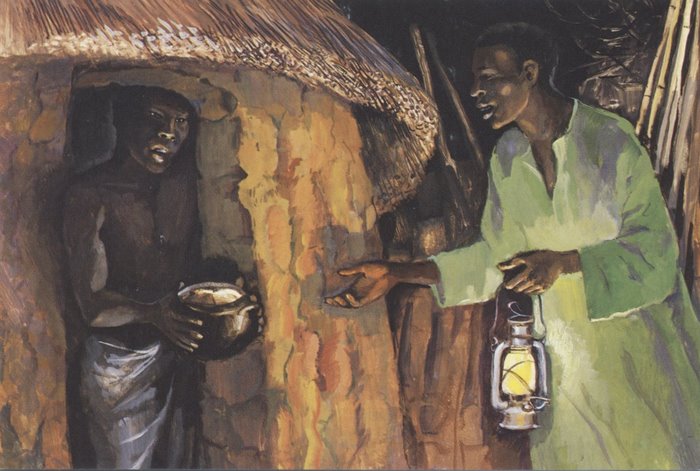
  • Noongar: “And Jesus said to his disciples, ‘Now listen, if one of you went to the house of a friend at midnight, and said to him, ‘My friend, I ask you, can I borrow three loaves of bread?” (Source: Warda-Kwabba Luke-Ang)
  • Uma: “Yesus also said to his disciples: ‘For example we go to our companion in the middle of the night and we say to him: ‘Friend, please give me three bundles of food.” (Source: Uma Back Translation)
  • Yakan: “Isa said yet to them, ‘For example one of you has a friend and you go to him in the middle of the night and say, ‘O friend, please lend me three (units) bread,” (Source: Yakan Back Translation)
  • Western Bukidnon Manobo: “Then Jesus said again, ‘For example, one of you who has a friend who comes to him in the middle of the night, and he says, ‘Hey friend, lend me some food.” (Source: Western Bukidnon Manobo Back Translation)
  • Kankanaey: “Jesus also said, ‘If for-example there is one of you who has a friend, and you (sing.) go to his house in the middle of the night to go and say to him, ‘Ay my-fellow, please give-me-some food,” (Source: Kankanaey Back Translation)
  • Tagbanwa: “Jesus added on, saying, ‘Suppose for example that one of you will go to his friend at midnight. On arriving, he says, ‘Friend, maybe you could give me even only three units of bread.” (Source: Tagbanwa Back Translation)

formal pronoun: Jesus addressing his disciples and common people

Like many languages (but unlike Greek or Hebrew or English), Tuvan uses a formal vs. informal 2nd person pronoun (a familiar vs. a respectful “you”). Unlike other languages that have this feature, however, the translators of the Tuvan Bible have attempted to be very consistent in using the different forms of address in every case a 2nd person pronoun has to be used in the translation of the biblical text.

As Voinov shows in Pronominal Theology in Translating the Gospels (in: The Bible Translator 2002, p. 210ff. ), the choice to use either of the pronouns many times involved theological judgment. While the formal pronoun can signal personal distance or a social/power distance between the speaker and addressee, the informal pronoun can indicate familiarity or social/power equality between speaker and addressee.

Here, Jesus is addressing his disciples, individuals and/or crowds with the formal pronoun, showing respect.

In most Dutch translations, Jesus addresses his disciples and common people with the informal pronoun, whereas they address him with the formal form.
formal 2nd person plural pronoun (Japanese)

Click or tap here to see the rest of this insight.

Like a number of other East Asian languages, Japanese uses a complex system of honorifics, i.e. a system where a number of different levels of politeness are expressed in language via words, word forms or grammatical constructs. These can range from addressing someone or referring to someone with contempt (very informal) to expressing the highest level of reference (as used in addressing or referring to God) or any number of levels in-between.

One way Japanese shows different degree of politeness is through the choice of a formal plural suffix to the second person pronoun (“you” and its various forms) as shown here in the widely-used Japanese Shinkaiyaku (新改訳) Bible of 2017. In these verses, anata-gata (あなたがた) is used, combining the second person pronoun anata and the plural suffix -gata to create a formal plural pronoun (“you” [plural] in English).

(Source: S. E. Doi, see also S. E. Doi in Journal of Translation, 18/2022, p. 37ff. )

Translation commentary on Luke 11:5 – 11:7

Exegesis:

kai eipen pros autous ‘and he said to them,’ or, ‘he also said to them,’ preferably the former.

tis ex humōn … kai poreusetai … kai eipē … kakeinos … eipē ‘who of you will have…, and go … and say … and he will say.’ The clause starts as an interrogative clause in the indicative of the future (hexei, poreusetai) but the question is never brought to an end, nor is a direct answer given. Instead mood and tense shift to eipē (aorist subjunctive, twice), as if ean ‘if’ preceded and the two clauses were conditional. To these conditional clauses v. 8 might be considered to be the main clause.

tis ex humōn hexei philon kai poreusetai pros auton ‘which of you will have a friend and go to him,’ or, with change of subject, ‘and he (i.e. the friend) will go to him,’ preferably the former. tis ex humōn usually introduces questions to which the obvious answer is, ‘nobody’ (cf. 12.25; 14.28; 15.4; 17.7). Also the future tense points to a self-answering question.

mesonuktiou ‘at midnight,’ ‘in the middle of the night.’ mesonuktion.

chrēson moi treis artous ‘lend me three loaves.’

kichrēmi ‘to lend,’ i.e. ‘to allow the use of.’

(V. 6) epeidē here adverbial particle, ‘for’ (cf. on 7.1).

philos mou ‘a friend of mine,’ undetermined as shown by the absence of the article.

paregeneto ex hodou pros me ‘has come to me from a journey.’ For paraginomai cf. on 7.4. ex hodou means that he interrupts his journey.

ouk echō ho parathēsō autō lit. ‘I do not have (anything) which I may set before him,’ i.e. ‘I have nothing to set before him.’ For paratithēmi cf. on 9.16.

(V. 7) kakeinos esōthen apokritheis eipē ‘and (if) he, or, that one, replies from inside.’ kakeinos is contraction of kai and the demonstrative pronoun ekeinos.

esōthen (also vv. 39f) ‘from inside,’ ‘from within.’

mē moi kopous pareche lit. ‘do not cause me troubles,’ hence ‘do not bother me.’

kopos (also 18.5) ‘trouble,’ ‘difficulty.’

ēdē hē thura kekleistai ‘already the door has been locked.’ The perfect tense denotes a situation which is the result of the act of shutting. thura also 13.24f. kleiō, cf. on 4.25.

ta paidia mou met’ emou eis tēn koitēn eisin lit. ‘my children are with me in bed’ i.e. ‘my children and I have gone to bed.’ eis is here equivalent to en.

koitē ‘bed.’

ou dunamai anastas dounai soi ‘I cannot get up and give you.’ anastas dounai represents one event, hence anastas is also rendered as an infinitive. dounai is used without object, but a reference to treis artous ‘three breads’ may be understood with it.

Translation:

To imitate the irregular structure of these verses is usually undesirable. If it has to be straightened out some of the possibilities are the following. (1) The use of one interrogative sentence all through the three verses (cf. e.g. Translator’s New Testament, Marathi), or divided over two sentences, e.g. ‘which of you … would go … and say, “… (v. 6) …”; (v. 7) and would he answer then, “…”?’ Such a rendering may require that the anticipated answer be added, i.e. ‘no one (would have so bad a friend),’ ‘no (real) friend would answer thus.’ (2) A shift to one or two affirmative clauses or sentences, introduced by ‘if,’ ‘suppose (that),’ cf. e.g. The Four Gospels – a New Translation, Good News Translation; also Tzeltal, which introduces the conditional clause by ‘is there anyone who does this?’ (3) A combination of a suppositional sentence in vv. 5-6 with a rhetorical question in v. 7, to which v. 8 forms the reply, cf. e.g. ‘For-example, you have a friend … you go and call, “… (v. 6) …”. (v. 7) Would it be possible that he replied, “…”?’ (cf. Balinese, Leyden, Tae’ 1933).

Which of you who has a friend will go to him, often better in the second person, cf. e.g. “suppose you have a friend and … you go to him…” (The Four Gospels – a New Translation), ‘would you go to a friend of yours….’

For friend see on 7.6. Shona 1966 uses a term denoting a ritual friend to whom one would turn in an emergency in vv. 5bc, 8, but another one in v. 6. The use of the former term puts the refusal in a very bad light; similarly in East Nyanja and Yao, which throughout the four verses use a term implying acceptance of reciprocal obligation. In v. 5c, however, where “friend” is used as a form of address, the usual rendering often has to be possessed (e.g. in Ekari), or is idiomatically unacceptable and, therefore, has to be replaced, e.g. by ‘brother’ (Tzeltal), ‘elder-brother’ (Balinese, which also uses ‘elder’ and ‘younger brother’ as substitutes for the pronouns of the first and second person in v. 7), ‘nephew’ (Javanese), or to be omitted (Batak Toba).

For lend see on 6.34, sub (1), and cf. ‘exchange’ (Tzeltal). In some cultures, however, it is regarded highly improper to hint at restitution, so that a phrase like ‘please, give me,’ or, ‘I ask you for,’ is the normal thing to say.

Three loaves, or, more generically ‘some food’; and see on 4.3.

(V. 6) Has arrived, or a more specific word or phrase used in case of an unexpected, short visit, e.g. ‘has-dropped-in-with me’ (Javanese); cf. also “has just come to (or, turned up at) my house” (An American Translation, New English Bible).

On a journey, or, ‘from his travels,’ “who is travelling through” (The Four Gospels – a New Translation), ‘travelling around’ (Toraja-Sa’dan).

Set before him is sometimes rendered by, ‘to give him as a meal,’ or a causative form of the verb rendering ‘eat.’

(V. 7) He will answer from within, shifting to another subject, as indicated by ‘answer’ and ‘from within.’ Yet further specification of the pronoun has been found necessary, e.g. ‘the other one’ (Bible de Jérusalem), ‘that friend-of-his’ (Bahasa Indonesia), ‘that person’ (cf. the Greek). Such specification is superfluous, however, if v. 5 has been shifted to the second person.

Do not bother me. The verb is slightly stronger than “to trouble” in 7.6; Tzeltal says, ‘don’t come and disturb my sleep.’

The door is now shut, or, ‘I have shut the door’ (Shona 1966); elsewhere one has to say, ‘the doorway is blocked’ (East Nyanja, Yao), ‘the fence of the entrance has been shut’ (Tae’), ‘my house is already closed’ (Tzeltal, where huts have no doors but planks are set up and tied in the doorway); cf. also The Four Gospels – a New Translation‘s “I locked up long ago”.

Are with me in bed, or, ‘are with me in the (bed) room (Sundanese), or, in the place where we sleep’; or, ‘are lying down with me’ (cf. Trukese, Marathi, Batak Toba), similarly in Tzeltal, which takes ‘I’ as subject, cf. also ‘I and the children have gone to bed’ (Shona 1966). For bed see on 8.16.

Anything, or, ‘what (or, the things) you want/ask’ (cf. New English Bible), ‘them’ (i.e. the loaves), ‘it’ (i.e. the bread/food).

Quoted with permission from Reiling, J. and Swellengrebel, J.L. A Handbook on the Gospel of Luke. (UBS Handbook Series). New York: UBS, 1971. For this and other handbooks for translators see here . Make sure to also consult the Handbook on the Gospel of Mark for parallel or similar verses.

SIL Translator’s Notes on Luke 11:5

Paragraph 11:5–8

In this paragraph, Jesus told a story. The main point of the story is that when a human being asks a friend for something, the friend gives it to him. He does this even if it is not convenient. This story implies that God will also give us what we request.

11:5–7

In Greek, the story in 11:5–7 is in the form of a rhetorical question. Some versions translate the beginning of the question literally, for example:

Which of you…? (Revised Standard Version)

This rhetorical question is one long, detailed sentence. For this reason, most English versions divide the sentence into several sentences. They also begin this story with the statement “Suppose one of you” rather than with a rhetorical question. (However, some versions, such as the English Standard Version, Revised Standard Version, and King James Version, translate this as a rhetorical question.)

In 11:7, Jesus tells about events that no one would do or that no one would imagine. This rhetorical question expects a negative answer, such as “None of us!” or “Of course not!” or “That would never happen!”

Some ways to translate 11:5–7 are:

Translate 11:5–6 as a statement and begin the rhetorical question in 11:7. For example:

5aSuppose one of you has a friend, 5band he goes to him at midnight and says, 5c‘Friend, lend me three loaves of bread….’

7a
Would the one inside answer, ‘Do not bother me…’?

Translate most of 11:5–7 as a statement, and ask a question at the end of 11:7. In some languages, it may be natural to answer the question. Some sample questions and answers are:

Who has a friend like that?⌋ ⌊No one!
-or-

Can any of you imagine this?⌋ ⌊No!
-or-

Would this ever happen?⌋ ⌊Of course not!

As a statement. For example:

5aSuppose one of you has a friend, 5band he goes to him at midnight and says, 5c‘Friend, lend me three loaves of bread….’

7aThe one inside would certainly not answer, ‘Do not bother me…’

Translate 11:5–7 in a natural way in your language.

11:5a

Then Jesus said to them: The clause Then Jesus said to them introduces a story that Jesus told to his disciples. Jesus told this story to teach his disciples something about prayer. Some other ways to introduce this story are:

Then Jesus went on to say (Contemporary English Version)
-or-
Then, teaching them more about prayer, he used this story: (New Living Translation (2004))

Suppose one of you: The Greek phrase that the Berean Standard Bible translates as Suppose one of you is a rhetorical question in Greek. (See the discussion above.) The Berean Standard Bible supplies the word Suppose to begin the short story that follows. This word indicates that this story is fiction (it is not an event that actually happened). However, this story is something that could happen, and it teaches a lesson about how to pray. Some other ways to begin this story are:

For example
-or-
Think about this

Begin this story in a way that is natural in your language.

one of you: The phrase that the Berean Standard Bible translates as one of you here means “any one of you disciples.”

If the phrase one of you is not natural in your language, you can simply translate this phrase as “you.” For example:

Suppose you went to a friend’s house (New Living Translation (2004))

11:5b

goes to his friend at midnight: The phrase goes to his friend at midnight means “one of you goes to your friend at midnight.” Notice that while Jesus says “one of you” in 11:5a, in the rest of the parable he says “his” and “him.” In some languages it may be more natural to continue to use “you” here. For example:

you(sing) go to him at midnight

to his friend: The man does not actually see his friend at first. He stands at the door of his house and calls out to him. So in some languages it may be more natural to translate this as:

to his house/home

General Comment on 11:5a–b

In some languages it may be more natural to combine 11:5a and 11:5b. For example:

Suppose one of you should go to a friend’s house at midnight (Good News Translation)

11:5c–6b

According to Jewish custom, a host was obligated to give his visitors something to eat. He was also expected to eat with them. In addition, he needed to give them a large quantity of food to show his generosity.

See the General Comment on 11:5c–6b at the end of 11:6b for a comment about reordering.

11:5c

Friend: The term Friend was the natural way for one Jew to politely speak to another. Use an expression that is natural in your language. For example:

My friend
-or-
My brother

lend: The verb lend is an imperative verb. In some languages, it may be more polite to use another word along with this imperative. For example:

please lend

In some languages, a polite request should be stated in the form of a question. For example:

could you please lend…?

The verb lend implies that the person will return the thing that he has borrowed. That was not the case here. The next day, the man would not give three different loaves to his friend to repay him. So, in this context, lend could be translated as:

let me have
-or-
give me

If people share food in this way in your culture, use the expression that is natural for requesting food.

three loaves of bread: The loaves of bread were probably flat loaves that made up the main part of a meal. If bread is not described in terms of loaves in your culture, it may be possible to say:

three breads

If people do not eat bread in your culture, you may use a general word such as “food,” as in 11:3.

© 2009, 2010, 2013 by SIL International®
Made available under the terms of a Creative Commons Attribution-ShareAlike 4.0 License (CC BY-SA) creativecommons.org/licenses/by-sa/4.0.
All Scripture quotations in this publication, unless otherwise indicated, are from The Holy Bible, Berean Standard Bible.
BSB is produced in cooperation with Bible Hub, Discovery Bible, OpenBible.com, and the Berean Bible Translation Committee.