The name that is transliterated as “Samson” in English means “a little sun,” “splendid sun” (i.e., great joy and felicity), “like the sun,” “distinguished,” “strong,” “a perfect servant.” (Source: Cornwall / Smith 1997 )
It is translated in Spanish Sign Language with the signs for “headband” referring to his long hair and likely use of a headband. (Source: Steve Parkhurst)
The Greek, Latin, and Hebrew that is typically translated as “prostitute” in English (in some, mostly earlier translation also as “harlot” or “whore”) is translated in the 2024 revision of the inter-confessional LatvianJauna Pārstrādāta latviešu Bībele as netikle or “hussy.” This replaced the previous translation mauka or “whore.” Nikita Andrejevs, editor of the Bible explains the previous and current translations: “The translators at the time felt that this strong word best described the thought contained in the main text. Many had objections, as it seemed that this word would not be the most appropriate for public reading in church.” (Source: Updated Bible published in Latvia ).
Other translations include:
Bariai: “a woman of the road” (source: Bariai Back Translation)
Hiligaynon: “a woman who sells her body” (source: Hiligaynon Back Translation)
Uma: “a woman whose behavior is not appropriate” or “a loose woman” (source: Uma Back Translation)
Yakan: “a bad woman” (source: Yakan Back Translation)
Western Bukidnon Manobo: “a woman who makes money through their reputation” (source: Western Bukidnon Manobo Back Translation)
Tagbanwa: “a woman who makes money with her body” (source: Tagbanwa Back Translation)
Kankanaey: “a woman whose womanhood is repeatedly-bought” (source: Kankanaey Back Translation)
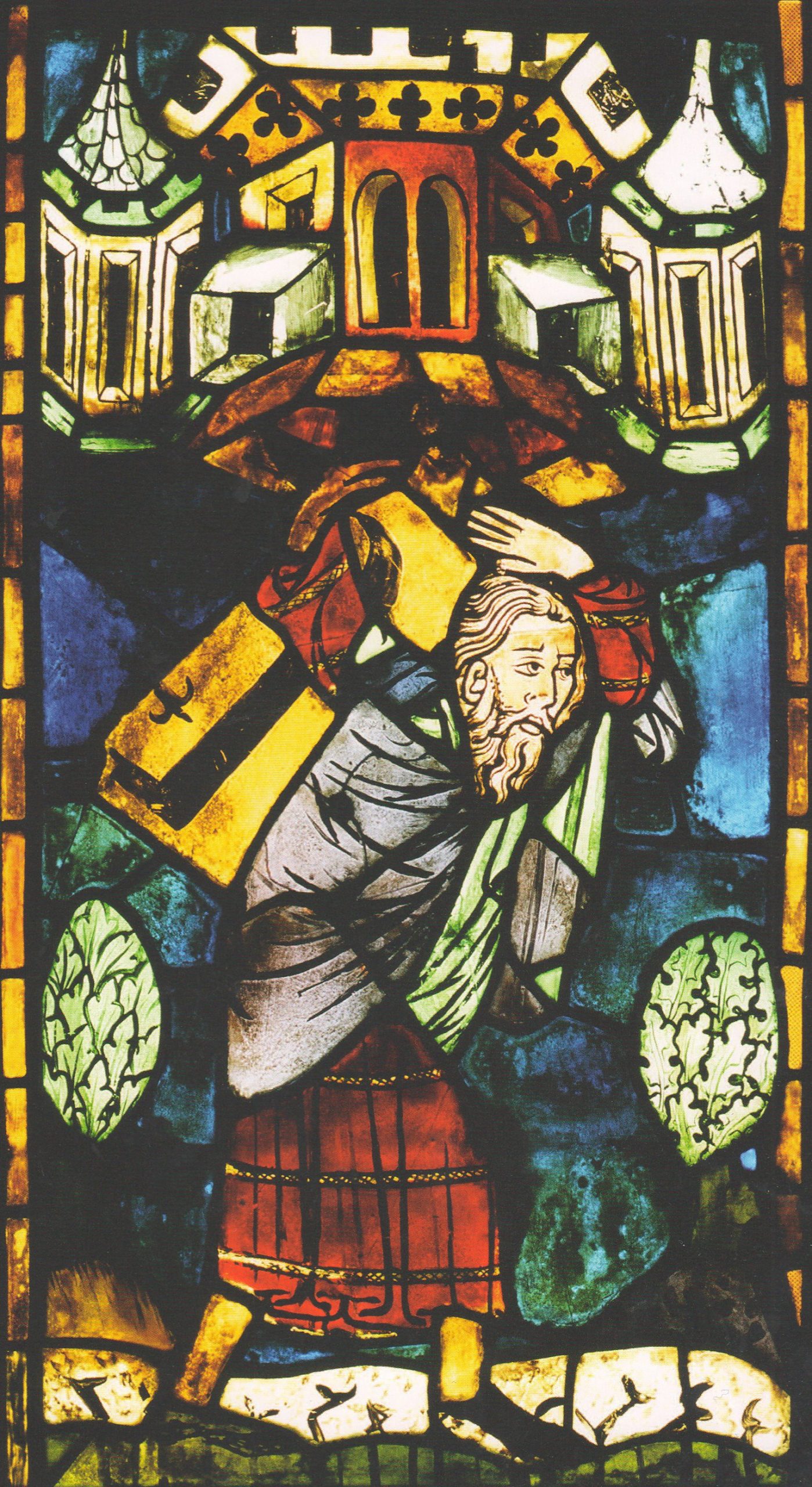
The following is a stained glass window from the Three choir windows in the Marienkirche, Frankfurt (Oder), Germany, of the 14th century, depicting Samson carrying the gates of Gaza:
Source: Der gläserne Schatz: Die Bilderbibel der St. Marienkirche in Frankfurt (Oder), Neuer Berlin Verlag, 2005, copyright for this image: Brandenburgisches Landesamt für Denkmalpflege und Archäologisches Landesmuseum
Stained glass is not just highly decorative, it’s a medium which has been used to express important religious messages for centuries. Literacy was not widespread in the medieval and Renaissance periods and the Church used stained glass and other artworks to teach the central beliefs of Christianity. In Gothic churches, the windows were filled with extensive narrative scenes in stained glass — like huge and colorful picture storybooks — in which worshipers could ‘read’ the stories of Christ and the saints and learn what was required for their religious salvation. (Source: Victoria and Albert Museum )
Following are a number of back-translations as well as a sample translation for translators of Judges 16:1:
Kupsabiny: “After that, Samson went to the city of Gaza. There he saw a prostitute and went to sleep with her.” (Source: Kupsabiny Back Translation)
Newari: “One day Samson went to Gaza. He saw a Philistine prostitute there. And he went to stay the night at her place” (Source: Newari Back Translation)
Hiligaynon: “One day, Samson went to Gaza a town of the Filistinhon. He saw there a woman who sells her body, and he lay-down-beside/(had-sexual-relations-with) that woman.” (Source: Hiligaynon Back Translation)
English: “One day Samson went to Gaza city in the Philistia area. He spent some time with a prostitute.” (Source: Translation for Translators)
This verse begins with the Hebrew waw conjunction, which Revised Standard Version omits. Good News Translation, Contemporary English Version, and New International Version begin with the phrase “One day,” a helpful model for the start of this new scene. Here the narrator is brief and quite explicit.
Samson went to Gaza: The last episode leaves Samson at the town of Lehi. Now he goes off in another direction within Philistine territory. The name Samson helps to mark the beginning of this new episode and most languages will imitate this style. Went renders the common Hebrew verb meaning “go.” Here it may be translated “departed for” or “left for.” Gaza was one of the five major towns of the Philistine region (see verse 1.18). This place name forms an inclusio around the episodes of the two Philistine women in this subsection (verse 16.1, 21). We might say “One day Samson left for Gaza.” Contemporary English Version omits the move to Gaza, but casts this information as background: “One day while Samson was in Gaza.” However, in most languages it is important to include an explicit reference to his move to Gaza.
And there he saw a harlot is literally “and he saw there a woman, a prostitute.” As Samson travels, he meets a prostitute. The narrator uses the same verb saw as when Samson was attracted to the Philistine woman who became his wife (verse 14.1). Good News Translation and New Jewish Publication Society’s Tanakh use the verb “met” instead of saw. Translators can use any verb that communicates the fact that Samson sees and is attracted to this woman. The Hebrew word rendered harlot (zonah) designates a woman who sells her sexual favors to make a living (see verse 11.1). In many languages “a woman, a prostitute” will be redundant, so the term “prostitute” can occur alone. While Revised Standard Version uses an old English word, harlot, most versions use a modern term such as “prostitute” (Good News Translation, Contemporary English Version) or “whore” (New Jewish Publication Society’s Tanakh). Along with this purely commercial practice, in some ancient religions in Canaan there were also “temple prostitutes,” whose activities were linked to rituals ensuring fertility and prosperity. The text does not specify which kind of prostitution is in view here, so it is better to assume this woman was an ordinary prostitute. Most languages will have a term for “prostitute,” often a borrowed word from a major trade language. However, if this practice is unknown, we could speak of an “immoral woman.” Since this expression is needed elsewhere in the Old Testament, it might be included and explained in the glossary. Here this woman does not have a name, in contrast to Delilah (verse 16.4), a woman Samson clearly loved.
And he went in to her is a Hebrew euphemism that means Samson had sexual relations with her (see verse 15.1). However, several versions depict Samson going to the prostitute’s house. For example, Contemporary English Version says “and went to her house to spend the night.” But the Hebrew expression here is probably purposely abrupt, so translators should use a more direct expression, such as “went to bed with her” (Good News Translation), “lay with her” (Revised English Bible), or “slept with her.” Some languages will use their own euphemisms, for example, “shared the mat with her.”
Translation models for this verse are:
• One day Samson went to Gaza where he saw a prostitute, and he went with her and had sexual relations with her.
• After some time, Samson went to Gaza and a prostitute there caught his eye. So he slept with her.
Quoted with permission from Zogbo, Lynell and Ogden, Graham S. A Handbook on Judges. (UBS Helps for Translators). Miami: UBS, 2019. For this and other handbooks for translators see here .


Leave a Reply
You must be logged in to post a comment.