2The Gazites were told, “Samson has come here.” So they circled around and lay in wait for him all night at the city gate. They kept quiet all night, thinking, “Let us wait until the light of the morning; then we will kill him.”
The name that is transliterated as “Samson” in English means “a little sun,” “splendid sun” (i.e., great joy and felicity), “like the sun,” “distinguished,” “strong,” “a perfect servant.” (Source: Cornwall / Smith 1997 )
It is translated in Spanish Sign Language with the signs for “headband” referring to his long hair and likely use of a headband. (Source: Steve Parkhurst)
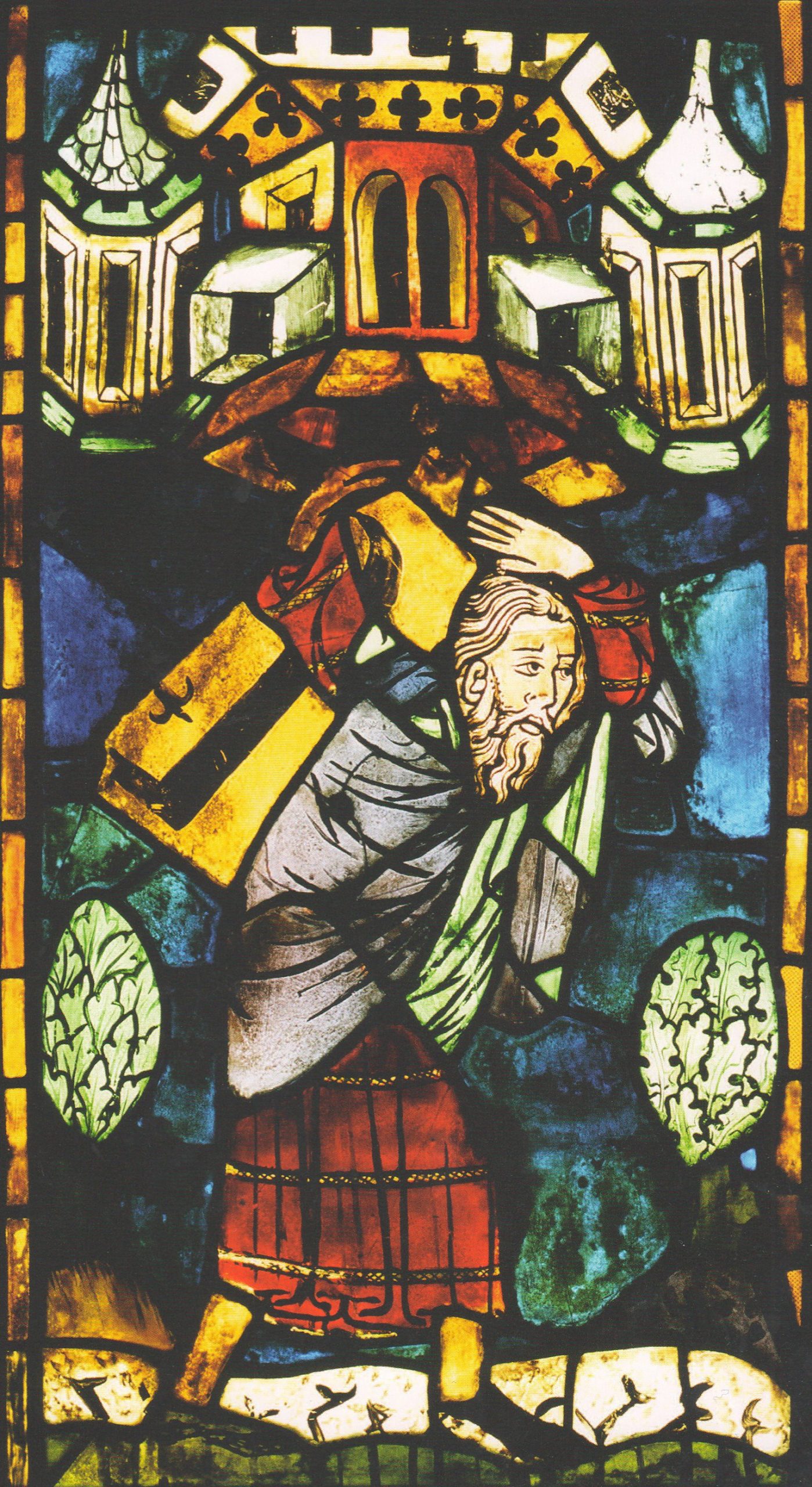
The following is a stained glass window from the Three choir windows in the Marienkirche, Frankfurt (Oder), Germany, of the 14th century, depicting Samson carrying the gates of Gaza:
Source: Der gläserne Schatz: Die Bilderbibel der St. Marienkirche in Frankfurt (Oder), Neuer Berlin Verlag, 2005, copyright for this image: Brandenburgisches Landesamt für Denkmalpflege und Archäologisches Landesmuseum
Stained glass is not just highly decorative, it’s a medium which has been used to express important religious messages for centuries. Literacy was not widespread in the medieval and Renaissance periods and the Church used stained glass and other artworks to teach the central beliefs of Christianity. In Gothic churches, the windows were filled with extensive narrative scenes in stained glass — like huge and colorful picture storybooks — in which worshipers could ‘read’ the stories of Christ and the saints and learn what was required for their religious salvation. (Source: Victoria and Albert Museum )
Following are a number of back-translations as well as a sample translation for translators of Judges 16:2:
Kupsabiny: “Then/at that time, the people of Gaza were told, ‘Samson has come here.’ Then the people lay in wait. Some stayed at the gate of the city. Those people lay quietly in wait until morning whispering to one another, ‘We keep guard and when it dawns, we shall kill this man.’” (Source: Kupsabiny Back Translation)
Newari: “Knowing that Samson had come, the men of Gaza surrounded that place. All night they waited for him at the city gate. Thinking "We will kill him in the morning," they did nothing all night.” (Source: Newari Back Translation)
Hiligaynon: “Those (who) come-from-Gaza heard-the-news that Samson was there, so they surrounded the town and watched-at the gate of the town for the whole night. They did- not -attack that night. They decided that they would-kill Samson at dawn.” (Source: Hiligaynon Back Translation)
English: “People soon found out that Samson was there, so the men of Gaza gathered together at the city gate and waited all night. They said to themselves, ‘When it dawns tomorrow morning, we will kill him when he tries to leave the city.’” (Source: Translation for Translators)
The Gazites were told: This clause is incomplete in Hebrew, which is literally “To the Gazites, saying.” There is no indication as to who told the Gazites about Samson’s arrival. The Septuagint says “And it was told to the Gazites.” Though this makes more sense, Hebrew Old Testament Text Project favors the Hebrew reading with a {C} rating. The Gazites refers to the inhabitants of the town of Gaza, so translators may say “The people of Gaza” (Good News Translation, New International Version). There is no initial Hebrew waw conjunction here, but translators might say “Then the Gazites were told” or “And they [impersonal] told the people of Gaza.”
Samson has come here: In this direct quote the narrator obviously intends a play on words, since the Hebrew verb rendered come is the same one used to speak of Samson’s sexual relations with the prostitute in the previous verse. Translators should try to retain the direct quote, but if this is not possible, they can say “The people of Gaza learned [or, discovered] that Samson had come there.” In some languages a dependent clause can be used: “When the people of Gaza found out that Samson had come there.”
And they surrounded the place is literally “and they surrounded.” The Hebrew waw conjunction rendered and introduces the result of hearing about Samson’s arrival, so it can be translated “So” (New Revised Standard Version, New International Version) or “Then.” The pronoun they refers to the people of Gaza. The Hebrew verb rendered surrounded (sabab) can mean “form a circle around” or even “march around” (verse 6.4). This is the same verb used in the second appendix of this book when the evil men of Gibeah surround the house where the Levite and his concubine are staying (verse 19.22). The use of this word here may even foreshadow that event. The Hebrew text does not say what the people surrounded, and some scholars believe it was the city. However, Revised Standard Version, along with most others, assume it was the place where Samson and the prostitute were.
And lay in wait for him all night at the gate of the city: The people of Gaza wait for Samson to come out in the open so they can capture him. For the Hebrew verb rendered lay in wait, see verse 9.25, where it is translated “men in ambush.” New Jewish Publication Society’s Tanakh says “lay in ambush.” The phrase all night, which occurs twice in this verse, emphasizes the determination and patience of the townspeople as they wait for their “prey” to emerge. In the end, however, this repetition adds to the irony, as it ridicules the Philistines for waiting so long only to be trumped by Samson’s ruse. This scene reminds the audience of the time Eglon’s servants waited for him to come out of the bathroom (see verse 3.24).
For the gate of the city, see verse 9.35. In ancient cities this was the only way in and out of the city. The men of Gaza set up some kind of guard to catch Samson there. This detail makes it unlikely that they actually circled the city. It is more likely that they encircled the prostitute’s house, putting guards also at the city gate. The narrator paints a somewhat humorous picture of a whole city being mobilized to capture a single (unarmed) man (compare verse 15.14). Contemporary English Version has the following footnote on the gate of the city: “The gate was often in a part of the town wall that was thicker and taller than the rest of the wall, and that had rooms where guards stayed when they were on duty.” This explanation or an illustration may be helpful at this point.
They kept quiet all night: This clause begins with a Hebrew waw conjunction, which might be rendered “But” in this context. Keeping still and quiet is part of the Gazites’ ruse. New Jewish Publication Society’s Tanakh’s “they kept whispering” does not seem to convey the correct meaning. We might rather say “They made no move” (New International Version) or follow Revised Standard Version here. Contemporary English Version omits this clause, but there is no justification for this. The repetition of the phrase all night draws out the suspense and is also meant to mock the Philistines.
Saying: Some translators may find it contradictory to have this quote formula just after the narrator says the people of Gaza kept quiet. The quote that follows may have been spoken out loud, but it is more likely that it expresses what the people were thinking. Good News Translation follows this latter sense and says they were “thinking to themselves.” In Hebrew, decisions and thoughts are often rendered as direct speech.
Let us wait until the light of the morning; then we will kill him: Here the storyteller introduces some irony or even humor into the story, as the townspeople are trying to figure out a strategy to capture and kill Samson. Evidently those listening to the story already know that the Israelite hero will escape. Again this storytelling technique is similar to the one used in the Ehud episode, where the servants wait around trying to figure out why their king stayed so long behind closed doors.
Let us wait until the light of the morning is literally “Until the light of the morning.” For clarity Revised Standard Version adds Let us wait, which is a good model to follow. The light of the morning refers to the first light of dawn, when there is enough light for people to see each other. We could say “When dawn comes” (Revised English Bible) or “When day breaks.” Some languages will use idiomatic expressions here, for example, “When we can see in our hands.”
Then we will kill him is literally “and we will kill him.” In some languages this clause can be rendered by a more suspenseful “And then we can kill him.” The Philistines had been waiting a long time to capture and kill Samson, and now Samson has given them a good opportunity. As the storyteller recounts the situation, tension mounts for the hearers, as it looks like Samson will be captured and killed. Contemporary English Version omits this clause, which robs the story of its flavor. Like Sisera’s mother, these enemies of Israel dream about how they will outsmart and defeat their enemy, but such musings only make them appear ridiculous.
Some languages may prefer to reverse the two clauses in this quote by saying “We will kill him as soon as it is light.” A model that uses indirect speech is “They had decided to wait until dawn and then kill him.”
Possible translation models for this verse are:
• The people in Gaza heard that Samson had come [to their town], so they set an ambush, waiting all night at the entrance of the city. Throughout the night, they didn’t budge, saying to each other, “When day breaks, we will kill him!”
• When the people of Gaza learned that Samson had come, they surrounded the place where he was staying and kept watch all night. They also set an ambush at the town gate. All night they waited for him, thinking, “When day breaks, we will kill him!”
Quoted with permission from Zogbo, Lynell and Ogden, Graham S. A Handbook on Judges. (UBS Helps for Translators). Miami: UBS, 2019. For this and other handbooks for translators see here .


Leave a Reply
You must be logged in to post a comment.