The term that is transliterated as “Canaan” in English means “father of honor,” “father of majesty,” “father of praise,” or “my father is majesty.” (Source: Cornwall / Smith 1997 )
is translated in American Sign Language with the sign loosely referencing the act of hiding/covering one’s face in shame. The association of “shame” with the name “Canaan” comes from Genesis 9, specifically verse 9:25. This sign was adapted from a similar sign in Kenyan Sign Language (see here ). (Source: Ruth Anna Spooner, Ron Lawer)
“Canaan” in American Sign Language, source: Deaf Harbor
Click or tap here to see a short video clip about Canaan in biblical times (source: Bible Lands 2012)
In the Tuvan Bible translation project, the official policy (…) was to keep the spelling of names of major characters the same as in the Russian Synodal translation. However, the translation team and representatives of local Tuvan churches agreed that deviation in proper name spelling from the RST would be allowed on a case-by-case basis if there was a concrete need to do so.
Such a need arose with the name of Noah’s son Ham (חָ֥ם) in Genesis and elsewhere in the Old Testament.
In Russian, as in English, this is transliterated with three letters — Хам (Kham). In Russian, the name of this character has entered the language with the meaning of “boorish lout, impudent person” because of how Ham treated his father; in Tuvan, however, the word Хам (Kham) already means “shaman.” Since the Tuvan people continue to practice their traditional religion in which shamans play a major role, the translation team felt that leaving the transliteration of this name with the exact spelling as in Russian might cause needless offense to Tuvan sensibilities by unwittingly causing the text of Gen. 9:20-27 to portray shamans as the targets of Noah’s curse. Therefore, the translation team chose to avoid this potential stumbling block while continuing to maintain a close sound correspondence with the name of the biblical character as Tuvan Christians already knew it from the RST text. This was done by doubling the vowel — Хаам. Tuvan has long vowel phonemes that are written with a double vowel, so this is perfectly acceptable from the point of view of Tuvan orthographic conventions.
The correspondence of the Tuvan version of the name to the Russian Synodal spelling is still recognizable, but hopefully, the wrath of Tuvan shamans and their supporters has been averted by this small disliteration.
The rationale behind such an approach to spelling changes in names is concisely described in the foreword to the Tuvan Bible for the sake of transparency
Apparently, the similarity of the English version of this name to the food item (as in “I’ll have a ham and cheese sandwich”) is not deemed offensive enough to the meat-packing industry for a similar disliteration to be performed in English Bible translations.
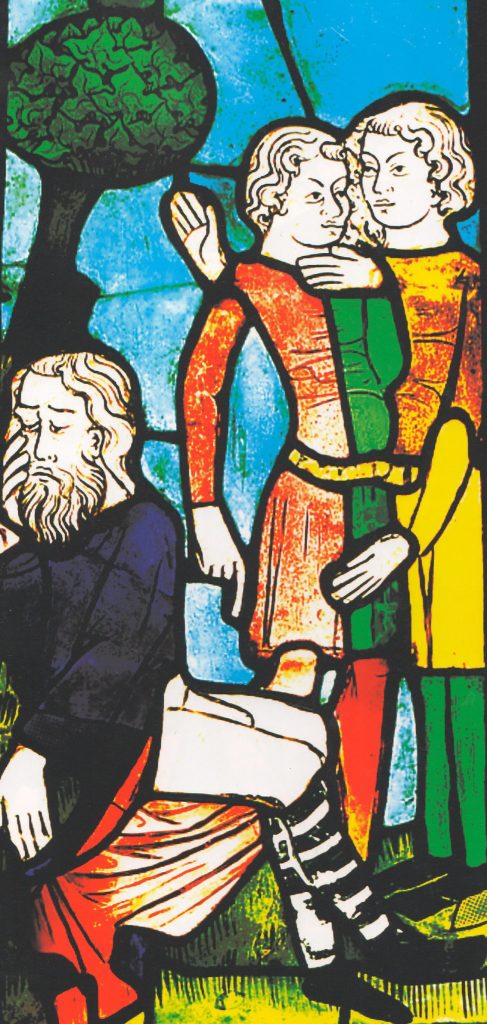
The following is a stained glass window from the Three choir windows in the Marienkirche, Frankfurt (Oder), Germany, of the 14th century, depicting Noah exposed in his drunkenness and his sons (the son with the red and green shirt likely represents both Shem and Japheth):
Source: Der gläserne Schatz: Die Bilderbibel der St. Marienkirche in Frankfurt (Oder), Neuer Berlin Verlag, 2005, copyright for this image: Brandenburgisches Landesamt für Denkmalpflege und Archäologisches Landesmuseum
Stained glass is not just highly decorative, it’s a medium which has been used to express important religious messages for centuries. Literacy was not widespread in the medieval and Renaissance periods and the Church used stained glass and other artworks to teach the central beliefs of Christianity. In Gothic churches, the windows were filled with extensive narrative scenes in stained glass — like huge and colorful picture storybooks — in which worshipers could ‘read’ the stories of Christ and the saints and learn what was required for their religious salvation. (Source: Victoria and Albert Museum )
Following are a number of back-translations as well as a sample translation for translators of Genesis 9:22:
Kankanaey: “When Ham who was father of Canaan saw that their father was naked, he abruptly-went-out and went and told his siblings.” (Source: Kankanaey Back Translation)
Newari: “Ham the father of Canaan, seeing [his] father naked, went out and told his elder brothers.” (Source: Newari Back Translation)
Hiligaynon: “Now, Ham the father of Canaan went-into the tent, and he saw that his father was naked. So he went-out and told his two siblings.” (Source: Hiligaynon Back Translation)
English: “Ham, the father of Canaan, saw his father lying naked in the tent. So he went outside and told his two older brothers what he had seen.” (Source: Translation for Translators)
Ham, the father of Canaan, saw the nakedness of his father: Revised Standard Version follows the Hebrew pattern of beginning each clause with and. Good News Translation and others translate more naturally in English by using a “when” clause first: “When Ham … saw that his father was naked.” Nakedness translates the same general term used of Adam and Eve in 2.25. But the sense here is that Ham saw his father’s genitals. This sense is well brought out by one translation that says “Ham … saw the body of his father.”
And told his two brothers outside: Ham’s shameful conduct was in failing to quietly cover his father. Instead he went outside and reported Noah’s exposure to his two brothers. Told his two brothers is somewhat shortened, and in translation it may require filling in. For example, “told his two brothers that their father was naked,” or, as a direct quotation, “and said to his brothers, ‘Our father is naked.’ ” In some languages told his two brothers is more aptly rendered “told his brothers Shem and Japheth” or “told Shem and Japheth.”
Quoted with permission from Reyburn, William D. and Fry, Euan McG. A Handbook on Genesis. (UBS Helps for Translators). New York: UBS, 1997. For this and other handbooks for translators see here .


Leave a Reply
You must be logged in to post a comment.