23Then Shem and Japheth took a garment, laid it on both their shoulders, and walked backward and covered the nakedness of their father; their faces were turned away, and they did not see their father’s nakedness.
The Hebrew and Greek that is translated with “clothes” or similar in English is translated in Enlhet as “crawling-in-stuff” (source: Jacob Loewen in The Bible Translator 1971, p. 169ff. ) and in Noongar as bwoka or “Kangaroo skin” (source: Warda-Kwabba Luke-Ang).
The Hebrew that is transliterated as “Japheth” in English is translated in Spanish Sign Language with a sign that signifies “Europe,” referring to the fact that Japheth traditionally is seen as the forefather of the European people. (Source: Steve Parkhurst)
The name “Shem” is transliterated in English means “name,” “celebrated,” “distinguished,” “renown.” (Source: Cornwall / Smith 1997 )
It is translated in Spanish Sign Language with a sign that signifies “Arab,” referring to the fact that Shem traditionally is seen as the forefather of Semitic people, including Abraham and his descendants (see Genesis 11:26 et al.) (Source: Steve Parkhurst)
Note that the terms “Semite” and “Semitic” are derived from “Shem.”
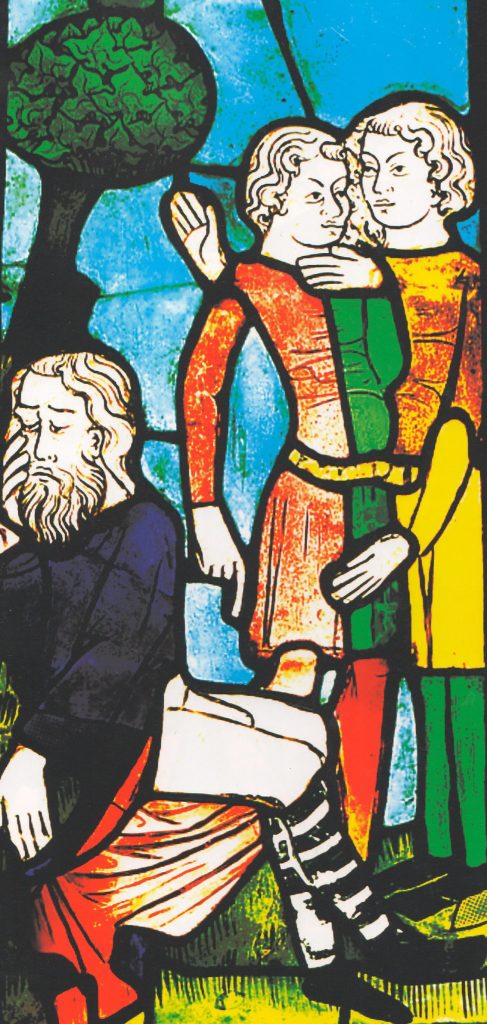
The following is a stained glass window from the Three choir windows in the Marienkirche, Frankfurt (Oder), Germany, of the 14th century, depicting Noah exposed in his drunkenness and his sons (the son with the red and green shirt likely represents both Shem and Japheth):
Source: Der gläserne Schatz: Die Bilderbibel der St. Marienkirche in Frankfurt (Oder), Neuer Berlin Verlag, 2005, copyright for this image: Brandenburgisches Landesamt für Denkmalpflege und Archäologisches Landesmuseum
Stained glass is not just highly decorative, it’s a medium which has been used to express important religious messages for centuries. Literacy was not widespread in the medieval and Renaissance periods and the Church used stained glass and other artworks to teach the central beliefs of Christianity. In Gothic churches, the windows were filled with extensive narrative scenes in stained glass — like huge and colorful picture storybooks — in which worshipers could ‘read’ the stories of Christ and the saints and learn what was required for their religious salvation. (Source: Victoria and Albert Museum )
Following are a number of back-translations as well as a sample translation for translators of Genesis 9:23:
Kankanaey: “Right then Sem and Jafet took a long garment and used-it-as-a-blanket for their father. They carried-it-between-them draped-over their shoulders. Then they walked-backward to enter their house to blanket-it on their father so that they would not see him naked.” (Source: Kankanaey Back Translation)
Newari: “Then Shem and Japheth, by carrying a long shawl on the shoulders and going in backwards, covered their father. Because they were turning their back [on him], they did not see the naked body of their father.” (Source: Newari Back Translation)
Hiligaynon: “Shem and Jafet took a cloth and laid-[it] on their shoulder(s), then they walked going-backwards going-inside the tent and they covered their father. They did- not at all -look-back because they did- not -want to see the nakedness of their father.” (Source: Hiligaynon Back Translation)
English: “Then Shem and Japheth took a large cloth and placed it across their backs, and walked backwards into the tent. They covered their father’s naked body with the cloth. Their faces were turned away from their father, so they did not see him naked.” (Source: Translation for Translators)
Shem and Japheth took a garment: garment translates the word used in Exo 22.26, which Good News Translation renders “cloak.” It refers to a large square cloth worn in the daytime and used at night to wrap around a person’s body to keep warm. In some languages “blanket,” “sheet,” or “cloth” will be the equivalent. In some parts of the world there is a special term for the kind of garment referred to here.
Laid it upon both their shoulders gives a picture of the two men facing away from the tent opening, and each holding a corner of the cloth across his back at the shoulder so that it did not drag on the ground. In order to give a clear picture, it may be necessary to say, for example, “Each brother held the cloth up to his shoulder” or “They stretched the cloth between them at their shoulders.”
And walked backward: that is, “and walked backward into the tent” (backward so they would not see their naked father). And covered the nakedness of their father: that is, “covered their father’s naked body.”
The writer makes a great effort to show that Shem and Japheth were not guilty of any wrong. Their faces were turned away: turned away translates the same word rendered backward in “walked backward.” The picture is of the brothers looking in the opposite direction from the way they were walking. They did not see their father’s nakedness once again emphasizes that Shem and Japheth did not behave themselves in an unseemly way.
At this point again it is hard not to see the funny side of the story. But it is important to translate so that the details of the actions, movements, and positions of the two men are clearly understood. The following are two examples of translations that pay attention to the details: “They-two turned their backs to the tent, and walked softly inside, and covered up their father. They-two didn’t turn their faces and look at their father who had no clothes on”; “They-two walked backward, they-two went inside the tent of their father, in order to cover him over. They-two turned away their faces, because they were ashamed to look at their father sleeping naked.”
Quoted with permission from Reyburn, William D. and Fry, Euan McG. A Handbook on Genesis. (UBS Helps for Translators). New York: UBS, 1997. For this and other handbooks for translators see here .


Leave a Reply
You must be logged in to post a comment.