
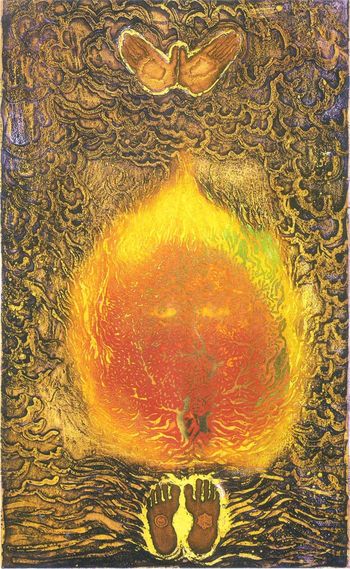
The Burning Bush

Artwork by Indian artist Paul Koli (b. 1945). “Paul Koli is Professor of the Print Making Class of the Sir J.J. School of Art, Bombay. His print ‘Burning Bush’ was produced in 1984 and was part of a collection of Christian art which traveled through Europe and America in 1988/89. It shows a strong command of color in printing.” (Source for this and the image: The Bible Through Asian Eyes by Masao Takenaka and Ron O’Grady 1991)

The following is a stained glass window in the Sacred Heart Cathedral in Chiang Mai, Thailand, depicting Moses and the burning bush:
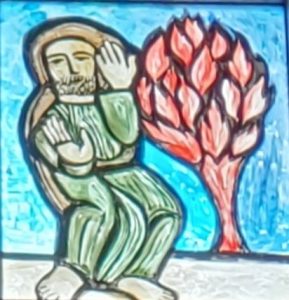
Photo by Jost Zetzsche

The following is a stained glass window from the Three choir windows in the Marienkirche, Frankfurt (Oder), Germany, of the 14th century:
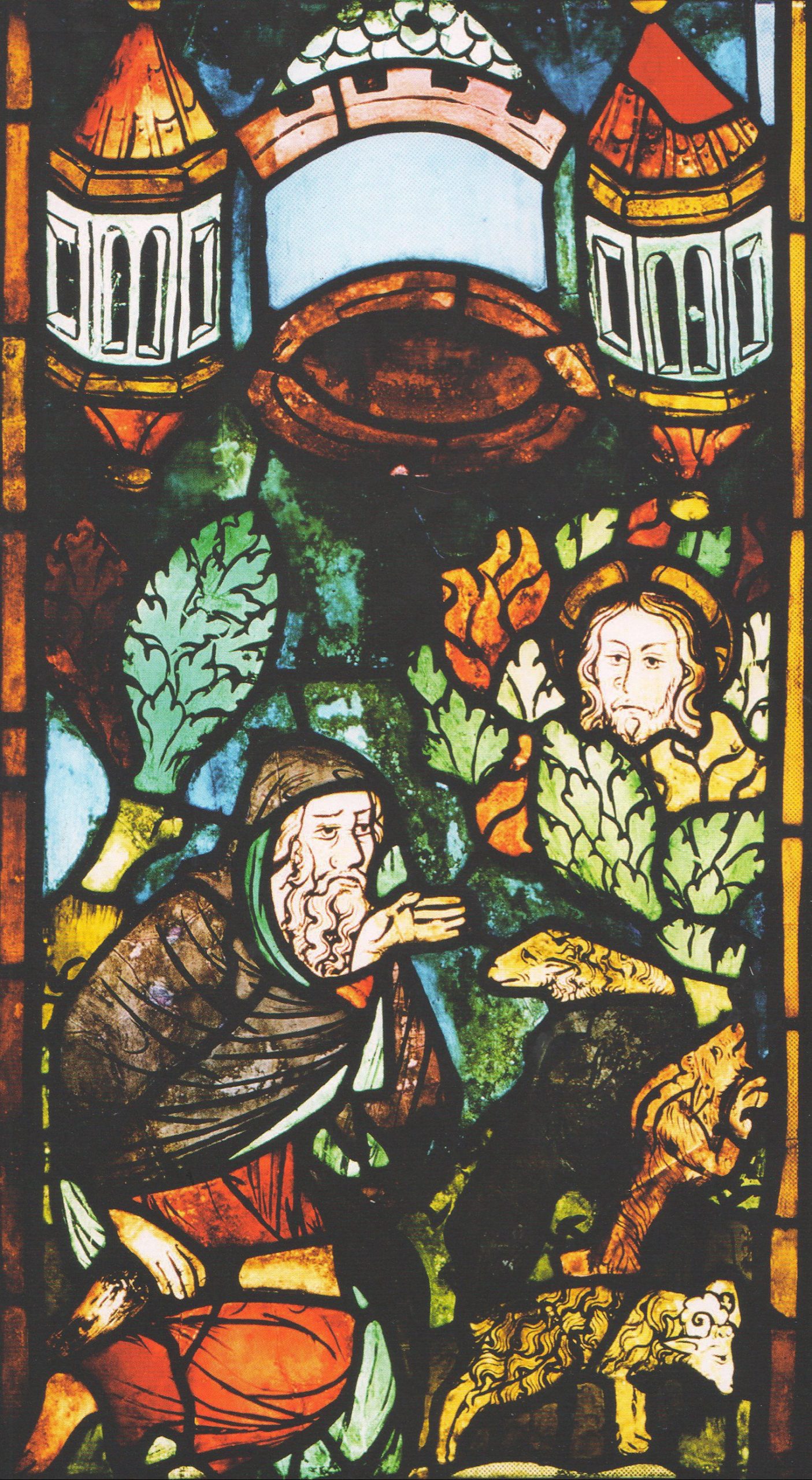
Source: Der gläserne Schatz: Die Bilderbibel der St. Marienkirche in Frankfurt (Oder), Neuer Berlin Verlag, 2005, copyright for this image: Brandenburgisches Landesamt für Denkmalpflege und Archäologisches Landesmuseum

See also other stained glass windows from the Marienkirche in Frankfurt.

Stained glass is not just highly decorative, it’s a medium which has been used to express important religious messages for centuries. Literacy was not widespread in the medieval and Renaissance periods and the Church used stained glass and other artworks to teach the central beliefs of Christianity. In Gothic churches, the windows were filled with extensive narrative scenes in stained glass — like huge and colorful picture storybooks — in which worshipers could ‘read’ the stories of Christ and the saints and learn what was required for their religious salvation. (Source: Victoria and Albert Museum )

complete verse (Exodus 3:3)

Following are a number of back-translations as well as a sample translation for translators of Exodus 3:3:

  • Kupsabiny: “So Moses thought in himself/his stomach that, ‘This thing is strange. How come the fire is burning/shining but the bush is not burning (up)? Let me go near to see well.’” (Source: Kupsabiny Back Translation)
  • Newari: “So Moses thought, ‘I’ll go near and see such a strange fire. Why is nothing happening to the bush?’” (Source: Newari Back Translation)
  • Hiligaynon: “He said, ‘Amazing! Why does- that bush not -burn-up? I will-go-closer and look-at-(it).’” (Source: Hiligaynon Back Translation)
  • Bariai: “And then he said, ‘How is this thing? Why is it that the fire doesn’t cook that tree? I will go close to see.’” (Source: Bariai Back Translation)
  • Opo: “Therefore, Moses say «I will go see that which fire not for it tree consumes!»” (Source: Opo Back Translation)
  • English: “Moses/I thought, ‘I will go closer and try to see this strange sight! Why is the bush not burning up?’” (Source: Translation for Translators)

Moses

The name that is transliterated as “Moses” in English means “taken out of the water,” “saved out of the water,” “a son.” (Source: Cornwall / Smith 1997 )

It is translated in Spanish Sign Language and Polish Sign Language with a sign in accordance with the depiction of Moses in the famous statue by Michelangelo (see here ). (Source: John Elwode in The Bible Translator 2008, p. 78ff. )


“Moses” in Spanish Sign Language, source: Sociedad Bíblica de España

American Sign Language also uses the sign depicting the horns but also has a number of alternative signs (see here ).

In French Sign Language, a similar sign is used, but it is interpreted as “radiance” (see below) and it culminates in a sign for “10,” signifying the 10 commandments:


“Moses” in French Sign Language (source )

The horns that are visible in Michelangelo’s statue are based on a passage in the Latin Vulgate translation (and many Catholic Bible translations that were translated through the 1950ies with that version as the source text). Jerome, the translator, had worked from a Hebrew text without the niqquds, the diacritical marks that signify the vowels in Hebrew and had interpreted the term קרו (k-r-n) in Exodus 34:29 as קֶ֫רֶן — keren “horned,” rather than קָרַו — karan “radiance” (describing the radiance of Moses’ head as he descends from Mount Sinai).

In Swiss-German Sign Language (and Hungarian Sign Language) it is translated with a sign depicting holding a staff. This refers to a number of times where Moses’s staff is used in the context of miracles, including the parting of the sea (see Exodus 14:16), striking of the rock for water (see Exodus 17:5 and following), or the battle with Amalek (see Exodus 17:9 and following).


“Moses” in Swiss-German Sign Language, source: DSGS-Lexikon biblischer Begriffe , © CGG Schweiz

In Vietnamese (Hanoi) Sign Language it is translated with the sign that depicts the eye make up he would have worn as the adopted son of an Egyptian princess. (Source: The Vietnamese Sign Language translation team, VSLBT)


“Moses” in Vietnamese Sign Language, source: SooSL

In Korean Sign Language it is translated with the sign that depicts the arms held up by Moses to assure the Israelites victory over the Amalekites (see Exodus 17:11).


“Moses” in Korean Sign Language, source: Korean Sign Language Bible House

In Estonian Sign Language Moses is depicted with a big beard. (Source: Liina Paales in Folklore 47, 2011, p. 43ff. )


“Moses” in Estonian Sign Language, source: Glossary of the EKNK Toompea kogudus

For more information on translations of proper names with sign language see Sign Language Bible Translations Have Something to Say to Hearing Christians .

Learn more on Bible Odyssey: Moses .

Translation commentary on Exod 3:3

And Moses said may simply mean that “he thought,” since he was probably alone except for the animals. In many languages it will be better style to place the words “Moses said [or, thought]” at the beginning of the verse rather than in the middle as Good News Translation does. I will turn aside is very literal; it means to change one’s direction or, in this context, “I will go closer” (Good News Translation). The Hebrew uses a particle here that is difficult to translate, but it conveys a sense of urgency. Some translations try to bring this out with the use of “must,” as in New Jerusalem Bible, “I must go across and see.” This great sight should be understood as “strange” (Good News Translation), “marvelous” (New Jewish Publication Society’s Tanakh), “wonderful” (New English Bible), or “remarkable” (New American Bible).

If it is unnatural to retain the direct speech when one is talking to oneself, the third person may be used. Thus the entire verse may be phrased as follows: “Moses thought it was very strange that the bush was not burning up, so he decided to go closer to investigate.” However, translators may find it more natural style to follow Revised Standard Version‘s word order; for example, “Moses decided to go closer to the bush and investigate, because he thought it was very strange that it was not burning up.” It is also possible to translate using direct speech: Moses thought, “Hey! I’m going to go closer to the bush and look. It’s very strange that this bush isn’t burning up!”

Quoted with permission from Osborn, Noel D. and Hatton, Howard A. A Handbook on Exodus. (UBS Helps for Translators). New York: UBS, 1999. For this and other handbooks for translators see here .