Image taken from He Qi Art . For purchasing prints of this and other artworks by He Qi go to heqiart.com . For other images of He Qi art works in TIPs, see here.
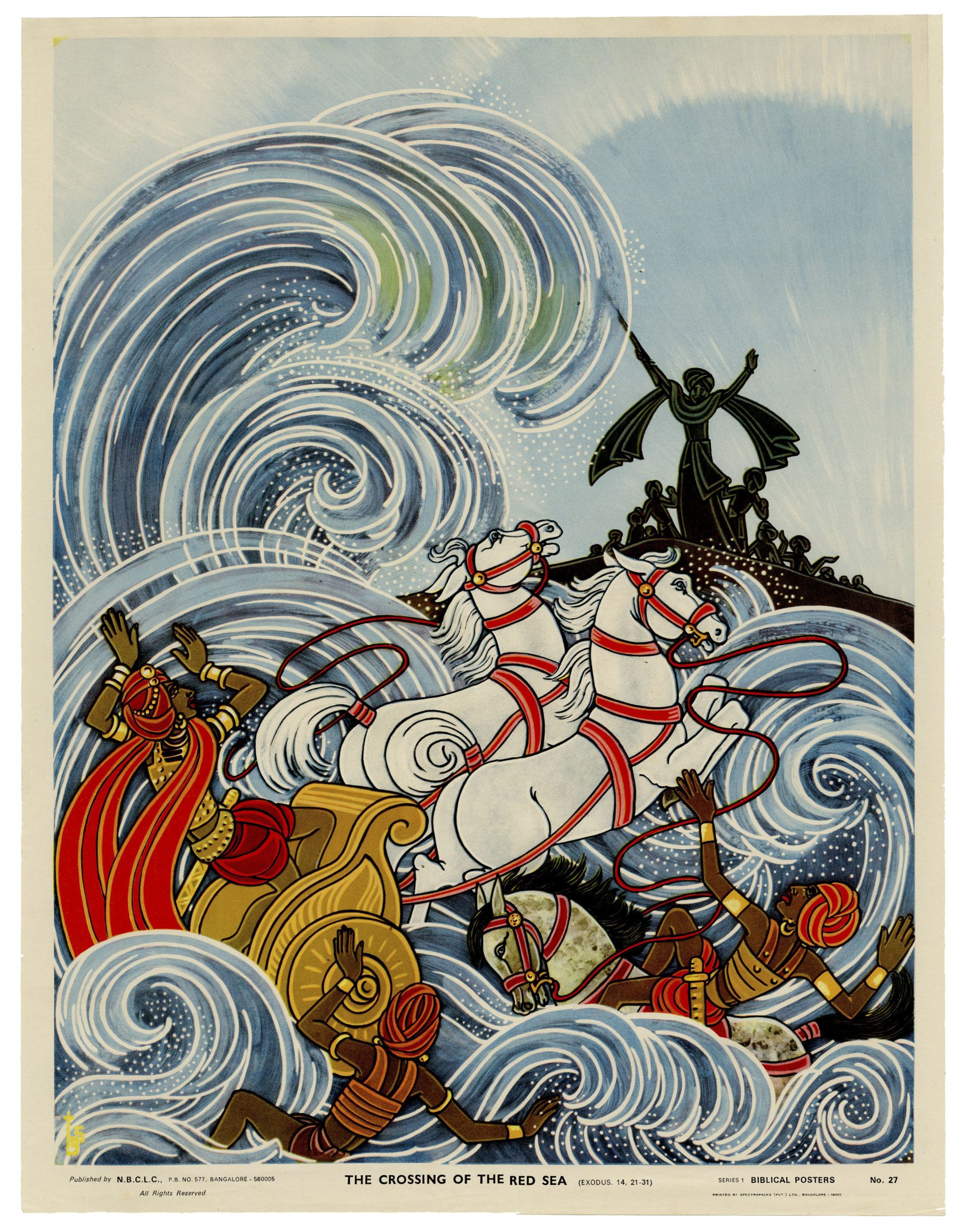
Following is an artwork by Sister Marie Claire , SMMI (1937–2018) from Bengaluru, India:
For more information about images by Sister Marie Claire and ways to purchase them as lithographs, see here .
For other images of Sister Marie Claire paintings in TIPs, see here.
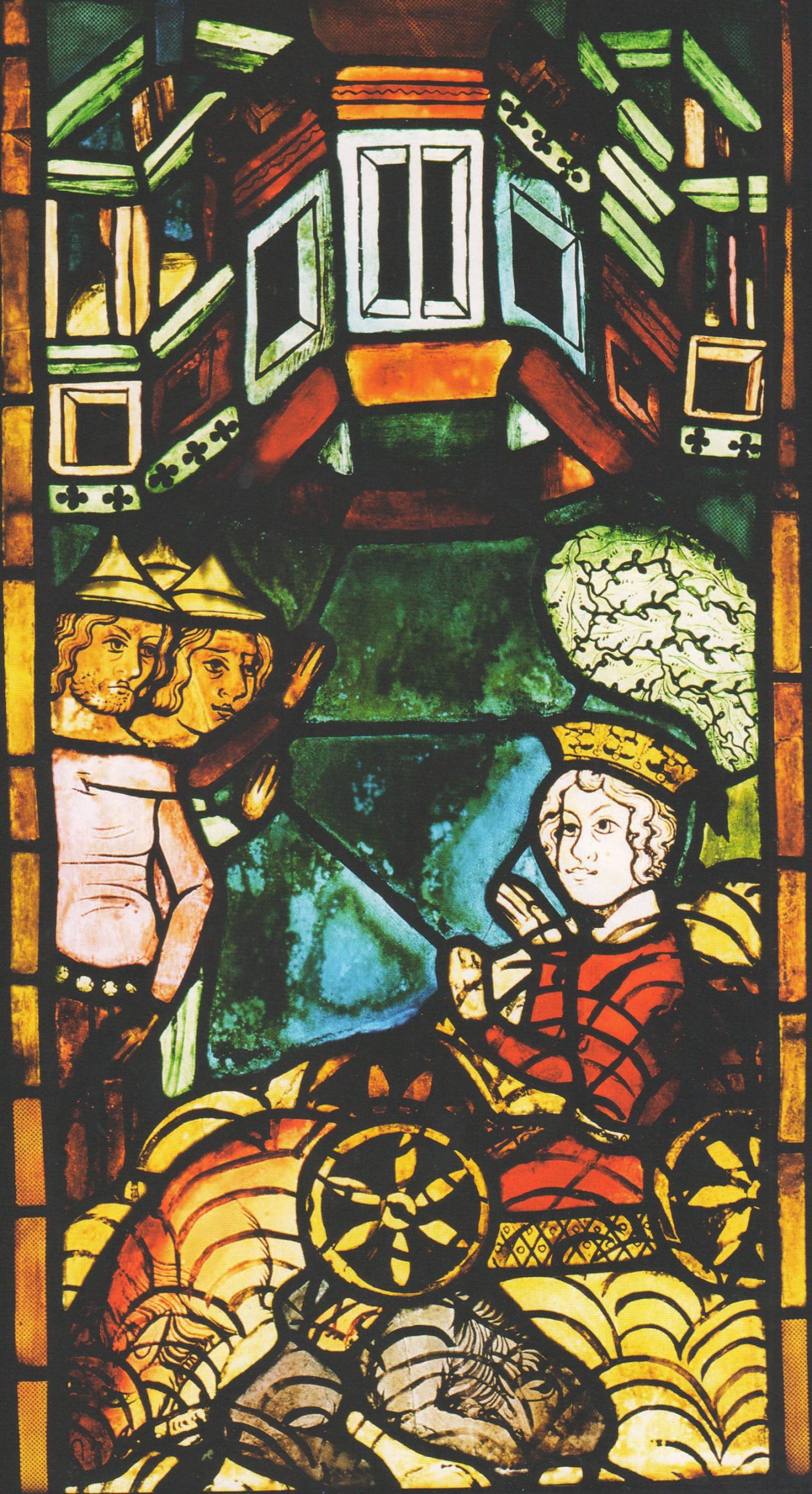
The following is a stained glass window from the Three choir windows in the Marienkirche, Frankfurt (Oder), Germany, of the 14th century:
Source: Der gläserne Schatz: Die Bilderbibel der St. Marienkirche in Frankfurt (Oder), Neuer Berlin Verlag, 2005, copyright for this image: Brandenburgisches Landesamt für Denkmalpflege und Archäologisches Landesmuseum
Stained glass is not just highly decorative, it’s a medium which has been used to express important religious messages for centuries. Literacy was not widespread in the medieval and Renaissance periods and the Church used stained glass and other artworks to teach the central beliefs of Christianity. In Gothic churches, the windows were filled with extensive narrative scenes in stained glass — like huge and colorful picture storybooks — in which worshipers could ‘read’ the stories of Christ and the saints and learn what was required for their religious salvation. (Source: Victoria and Albert Museum )
The Hebrew, Latin, Ge’ez, and Greek that is translated into English as “chariot” is translated into Anuak as “canoe pulled by horse.” “Canoe” is the general term for “vehicle” (source: Loren Bliese). Similarly it is translated in Lokạạ as ukwaa wạ nyanyang ntuuli or “canoe that is driven by horses.” (Source: J.A. Naudé, C.L. Miller Naudé, J.O. Obono in Acta Theologica 43/2, 2023, p. 129ff. )
Other translations include:
Chichicapan Zapotec: “ox cart” (in Acts 8) (ox carts are common vehicles for travel) (source: Loren Bliese)
Chichimeca-Jonaz, it is translated as “little house with two feet pulled by two horses” (source: Viola Waterhouse in Notes on Translation August 1966, p. 86ff.)
HausaCommon Language Bible as keken-doki or “cart of donkey” (source: Andy Warren-Rothlin)
Following are a number of back-translations as well as a sample translation for translators of Exodus 14:23:
Kupsabiny: “The Egyptian soldiers who went/rode in chariots which horses pulled and those riding on horses, followed those Israelites into the sea.” (Source: Kupsabiny Back Translation)
Newari: “The Egyptians chased after them and all Pharaoh’s horses and chariots and horsemen chased after them into the sea.” (Source: Newari Back Translation)
Hiligaynon: “They were-chased by the soldiers of Egipto along with its horse riders, chariots, and horses until the middle of the sea.” (Source: Hiligaynon Back Translation)
Bariai: “But the Isip people ran in pursuit of them, and so the great chief of Isip’s oses and karises and karis owners, all of them, followed them and went into the midst of that ocean.” (Source: Bariai Back Translation)
Opo: “Egyptians followed them. Horse of king, and chariot of horse his, and horsemen his, they followed them arrived in middle of water.” (Source: Opo Back Translation)
English: “Then the Egyptian army pursued them, and went after them into the middle of the sea, with their horses and their chariots and the chariot-drivers.” (Source: Translation for Translators)
The various Greek, Aramaic, Ge’ez, and Latin and Hebrew terms that are translated as “sea,” “ocean,” or “lake” in English are all translated in Chichewa with one term: nyanja. Malawi, where Chichewa is spoken, has a lot of lakes but does not share a border with the ocean. (Source: Mawu a Mulungu mu Chichewa Chalero Back Translation)
In Malagasy culture, the sea is perceived as sacred because it was a path taken by the ancestors. That is why the Malagasy word for the “sea” is ranomasina, which literally means “the sacred water.” The word masina actually has two different meanings: “salted” and “sacred/holy.” Salt is used for the conservation of some foods, such as meat or fish, that are to be set aside for later use. In this sense, the Malagasy phrase for “Holy Spirit” has the literal meaning of “Salted Spirit.” (Source: Brigitte Rabarijaona in The Bible Translator 2022, p. 103ff.)
The Egyptians refers to all those who were chasing after the Israelites. Pursued is the same word as verse 8. And went in after them is literally “and they entered after them.” What they entered, of course, was the seabed and not the water, for the water had been driven back (verse 21). Into the midst of the sea means the middle of the sea area. However, in languages that will have a problem translating this phrase, especially when the term for sea indicates an area always filled with water, it is possible to simply say “went after them,” with the implicit assumption that the Egyptians pursued the Israelites along the path between the walls of water. So Contemporary English Version has “The Egyptian chariots and cavalry went after them.”
All Pharaoh’s horses, his chariots, and his horsemen are the same terms used in verses 9 and 18.
An alternative translation model for this verse is:
• All the Egyptian chariots and the cavalry [or, soldiers riding horses] chased after the Israelites.
Quoted with permission from Osborn, Noel D. and Hatton, Howard A. A Handbook on Exodus. (UBS Helps for Translators). New York: UBS, 1999. For this and other handbooks for translators see here .




Leave a Reply
You must be logged in to post a comment.