In Gbaya, the image of the Israelites slowly passing through the waters in a long line in Exodus 14:22 is described and emphasized with wir-wir, an ideophone that refers to something long that passes slowly.
Ideophones are a class of sound symbolic words expressing human sensation that are used as literary devices in many African languages. (Source: Philip Noss)
Image taken from He Qi Art . For purchasing prints of this and other artworks by He Qi go to heqiart.com . For other images of He Qi art works in TIPs, see here.
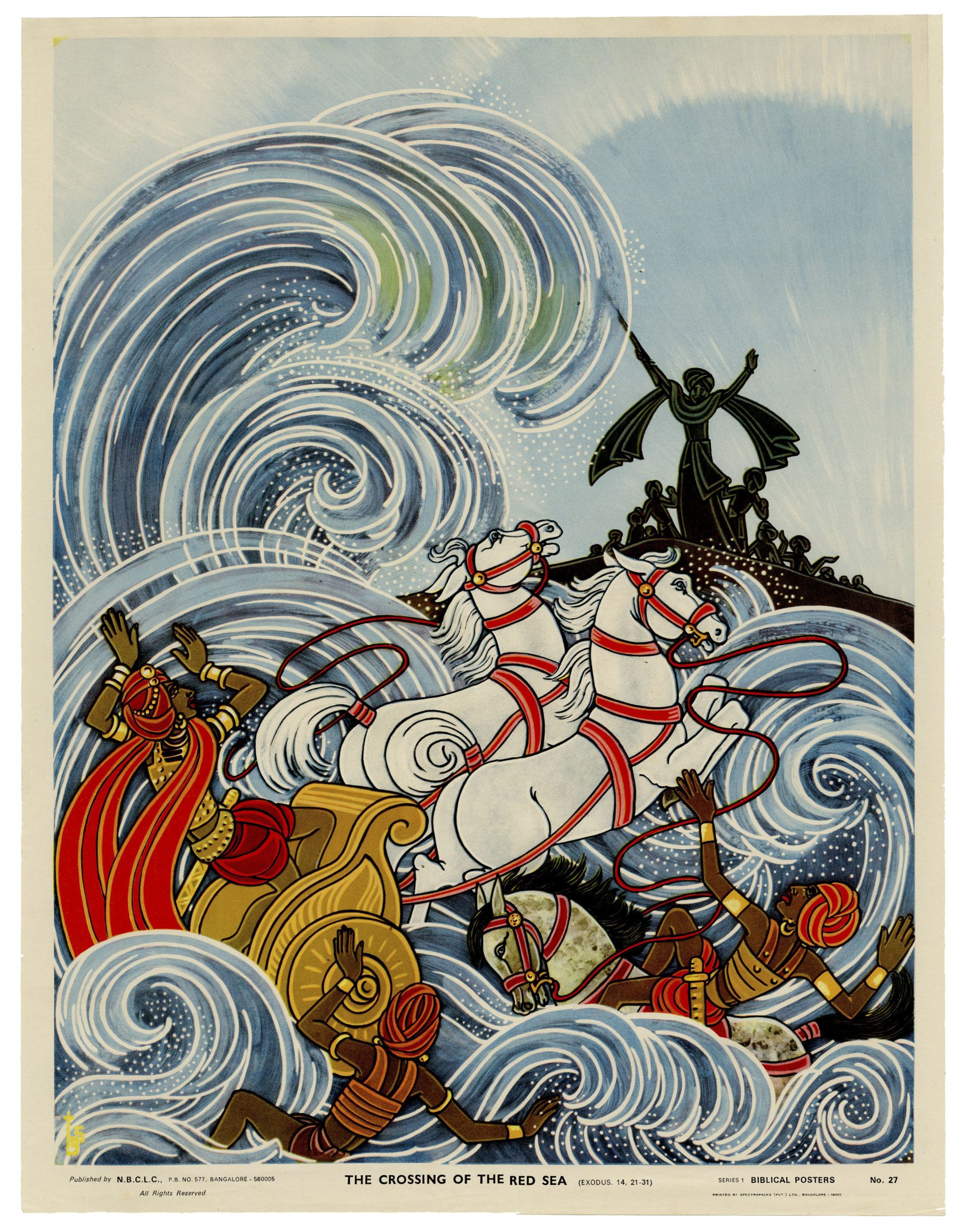
Following is an artwork by Sister Marie Claire , SMMI (1937–2018) from Bengaluru, India:
For more information about images by Sister Marie Claire and ways to purchase them as lithographs, see here .
For other images of Sister Marie Claire paintings in TIPs, see here.
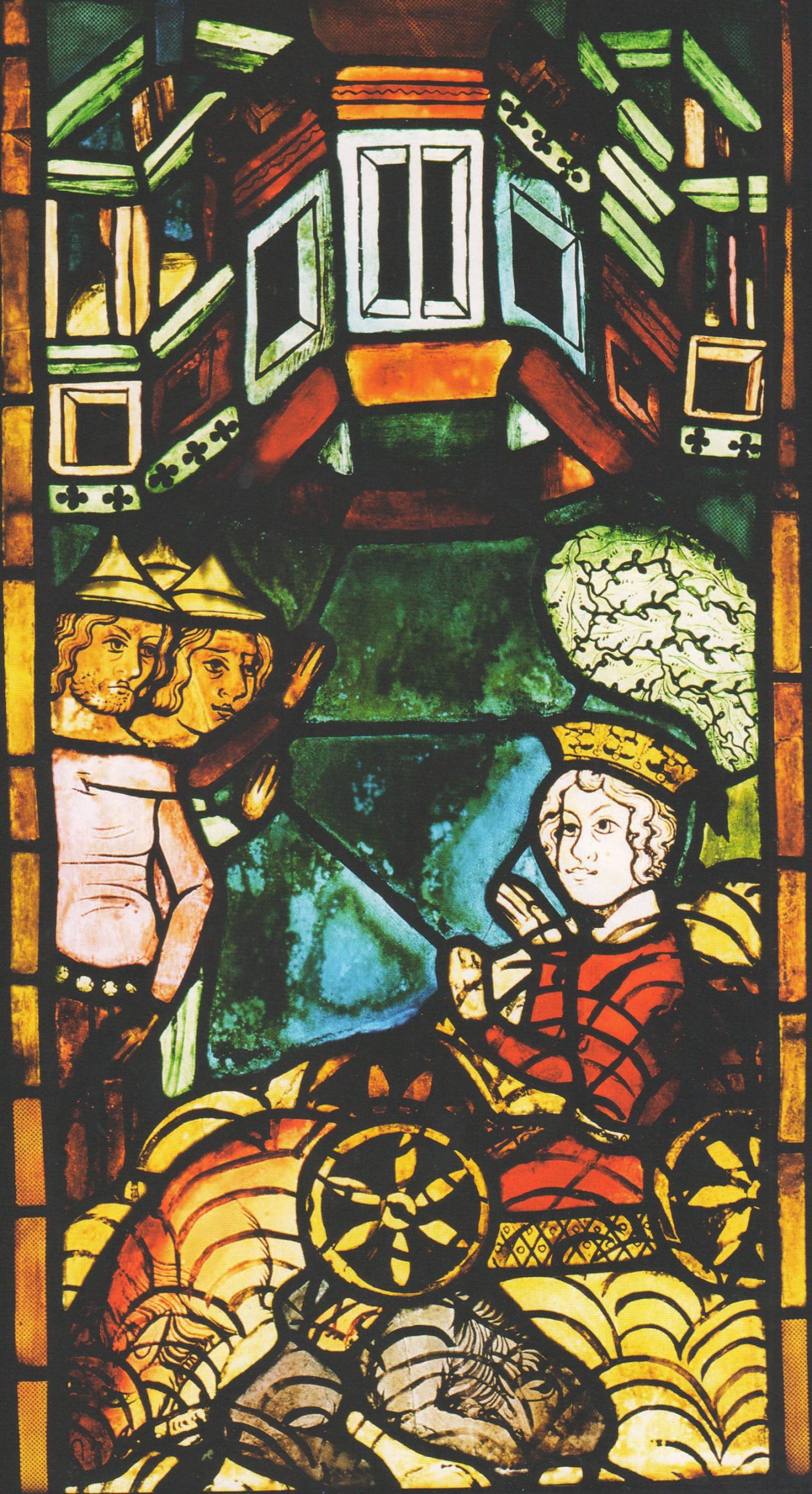
The following is a stained glass window from the Three choir windows in the Marienkirche, Frankfurt (Oder), Germany, of the 14th century:
Source: Der gläserne Schatz: Die Bilderbibel der St. Marienkirche in Frankfurt (Oder), Neuer Berlin Verlag, 2005, copyright for this image: Brandenburgisches Landesamt für Denkmalpflege und Archäologisches Landesmuseum
Stained glass is not just highly decorative, it’s a medium which has been used to express important religious messages for centuries. Literacy was not widespread in the medieval and Renaissance periods and the Church used stained glass and other artworks to teach the central beliefs of Christianity. In Gothic churches, the windows were filled with extensive narrative scenes in stained glass — like huge and colorful picture storybooks — in which worshipers could ‘read’ the stories of Christ and the saints and learn what was required for their religious salvation. (Source: Victoria and Albert Museum )
Following are a number of back-translations as well as a sample translation for translators of Exodus 14:22:
Kupsabiny: “The Israelites passed on/through the dry land where the wall of water was on both sides until they crossed to the other side/bank.” (Source: Kupsabiny Back Translation)
Newari: “The Israelites went through the sea on dry ground. There was a wall of water on their right and on their left.” (Source: Newari Back Translation)
Hiligaynon: “Then the Israelinhon crossed-over walking on dry land, with the water as-if a stone-wall on both sides/[lit. side and side]” (Source: Hiligaynon Back Translation)
Bariai: “And so the Israel people walked and crossed over to the other side on dry ground. And the ocean became like a railing/barrier standing beside of their path on this side and that side.” (Source: Bariai Back Translation)
Opo: “Therefore, people of Israel crossed over other side on a place which be dry, and water stood as fence on the right and left their.” (Source: Opo Back Translation)
English: “Then we Israeli people went on the dry land in the middle of the sea. The water was like a wall on each side of us, on the right side and on the left side.” (Source: Translation for Translators)
The various Greek, Aramaic, Ge’ez, and Latin and Hebrew terms that are translated as “sea,” “ocean,” or “lake” in English are all translated in Chichewa with one term: nyanja. Malawi, where Chichewa is spoken, has a lot of lakes but does not share a border with the ocean. (Source: Mawu a Mulungu mu Chichewa Chalero Back Translation)
And the people of Israel went … on dry ground is identical with verse 16 (see the comment there); the only difference indicated is the tense. The waters being a wall to them is literally “and the waters for them a wall.” New Revised Standard Version has “the waters forming a wall for them.” Good News Translation changes waters to “water” and a wall to “walls,” and speaks of “walls of water.” Contemporary English Version has “with a wall of water on each side.” The word for wall is the word for the city walls, which were solid and firm. It may be necessary to change the metaphor to a simile, as in Translator’s Old Testament, “with the water like walls on both sides of them.” On their right hand and on their left simply means “on both sides” (Good News Translation).
An alternative translation model for verses 21 and 22 is:
• Moses held out his hand [or, arm] over the sea, and the LORD caused a strong wind to blow from the east. It blew all night and made the water back up so that dry land appeared. The water opened up, and the Israelites walked on dry land between walls of water on each side.
Quoted with permission from Osborn, Noel D. and Hatton, Howard A. A Handbook on Exodus. (UBS Helps for Translators). New York: UBS, 1999. For this and other handbooks for translators see here .



Leave a Reply
You must be logged in to post a comment.