The Hebrew, Greek, and Ge’ez that is translated as “uncircumcised” in English is translated in Klao as “ungodly.” (Source: Don Slager)
See also stiff-necked / uncircumcised and uncircumcised.

λέγοντες ὅτι Εἰσῆλθες πρὸς ἄνδρας ἀκροβυστίαν ἔχοντας καὶ συνέφαγες αὐτοῖς.
3saying, “Why did you go to uncircumcised men and eat with them?”
The Hebrew, Greek, and Ge’ez that is translated as “uncircumcised” in English is translated in Klao as “ungodly.” (Source: Don Slager)
See also stiff-necked / uncircumcised and uncircumcised.
The Greek in Acts 11:3 that is translated as “eat with them” or similar in English is translated in Matumbi as “eat from one plate,” reflecting the common way to eat together among Matumbi speakers. “When people eat together in the village, it’s common to have one huge serving dish that people either eat from directly, or take a portion of on to their own plate (Source: Pioneer Bible Translators, project-specific notes in Paratext)
The following is a 19th century stained glass window from the Church of St. Peter in Nottingham, United Kingdom:
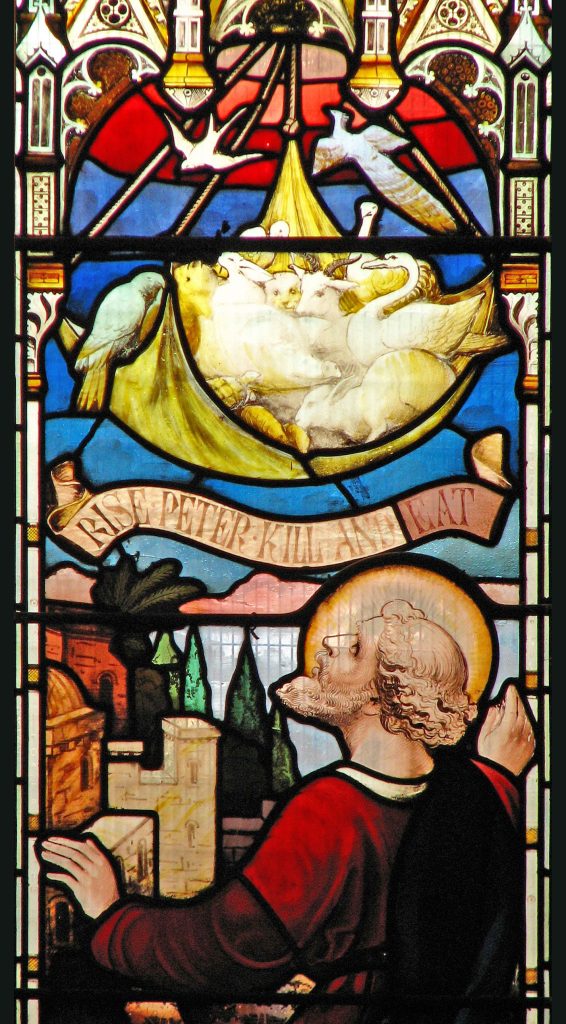
Source: Art in the Christian Tradition , a project of the Vanderbilt University Divinity Library, Nashville, TN. Original source: Flickr
Stained glass is not just highly decorative, it’s a medium which has been used to express important religious messages for centuries. Literacy was not widespread in the medieval and Renaissance periods and the Church used stained glass and other artworks to teach the central beliefs of Christianity. In Gothic churches, the windows were filled with extensive narrative scenes in stained glass — like huge and colorful picture storybooks — in which worshipers could ‘read’ the stories of Christ and the saints and learn what was required for their religious salvation. (Source: Victoria and Albert Museum )
Following are a number of back-translations of Acts 11:3:
This verse, rendered as a statement in the Good News Translation, appears as a question in some translations (see Jerusalem Bible and Revised Standard Version). The basic issue is that of fellowship between the Jewish and Gentile Christians. From the strictly Jewish point of view it was bad enough for Peter to go and preach the message to the Gentiles, but even worse for him to be willing to eat with them. Peter, however, uses this incident as an argument against requiring Gentiles to be circumcised (see 15.7 ff.).
Quoted with permission from Newman, Barclay M. and Nida, Eugene A. A Handbook on The Acts of the Apostles. (UBS Handbook Series). New York: UBS, 1972. For this and other handbooks for translators see here .
No comments yet.
Leave a Reply
You must be logged in to post a comment.