Orthodox Icons are not drawings or creations of imagination. They are in fact writings of things not of this world. Icons can represent our Lord Jesus Christ, the Virgin Mary, and the Saints. They can also represent the Holy Trinity, Angels, the Heavenly hosts, and even events. Orthodox icons, unlike Western pictures, change the perspective and form of the image so that it is not naturalistic. This is done so that we can look beyond appearances of the world, and instead look to the spiritual truth of the holy person or event. (Source )
Following is a hand colored stencil print on momigami of Peter by Sadao Watanabe (1970):
Image taken with permission from the SadaoHanga Catalogue where you can find many more images and information about Sadao Watanabe. For other images of Sadao Watanabe art works in TIPs, see here.
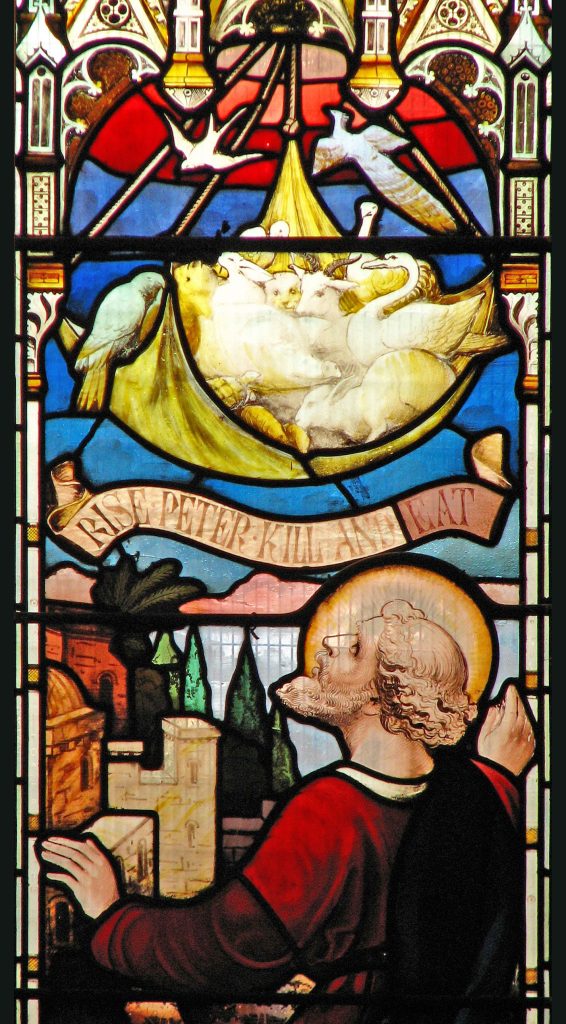
Stained glass is not just highly decorative, it’s a medium which has been used to express important religious messages for centuries. Literacy was not widespread in the medieval and Renaissance periods and the Church used stained glass and other artworks to teach the central beliefs of Christianity. In Gothic churches, the windows were filled with extensive narrative scenes in stained glass — like huge and colorful picture storybooks — in which worshipers could ‘read’ the stories of Christ and the saints and learn what was required for their religious salvation. (Source: Victoria and Albert Museum )
Following are a number of back-translations of Acts 11:4:
Uma: “From there, Petrus recounted to them all that had happened from the beginning, he said:” (Source: Uma Back Translation)
Yakan: “Therefore Petros explained to them the happenings from the beginning.” (Source: Yakan Back Translation)
Western Bukidnon Manobo: “And Peter told everything beginning with the first thing that had happened to him.” (Source: Western Bukidnon Manobo Back Translation)
Kankanaey: “Then Pedro related all that had happened from start to finish (lit. beginning with the roots up to the leaves).” (Source: Kankanaey Back Translation)
Tagbanwa: “Therefore, when it was then like that, Pedro related in detail to them everything concerning what he had been caused to comprehend.” (Source: Tagbanwa Back Translation)
Peter gave them a full account means that Peter told them “point by point” what had happened (see Jerusalem Bible “gave them the details point by point”). A full account of what had happened may be equivalent to “everything that had happened.”
From the very beginning may need to be somewhat more specific in some languages, for example, “he began talking about what had happened first” or “he started with the very first thing that happened.”
Quoted with permission from Newman, Barclay M. and Nida, Eugene A. A Handbook on The Acts of the Apostles. (UBS Handbook Series). New York: UBS, 1972. For this and other handbooks for translators see here .




Leave a Reply
You must be logged in to post a comment.