The word chazir is used for domestic and wild pigs. The domesticated pig was known in Egypt around 2500 B.C. and was probably domesticated in Canaan about that time too. Domestication of wild pigs seems to have coincided everywhere with the development of agriculture. Wild pigs were probably penned in large enclosures and fed scraps, thus keeping them away from planted fields. Later on, when full domestication had taken place, it was more usual for pigs to be herded rather than kept in pens. Pigs eat almost anything and herding did away with the necessity to feed them. It soon was noticed that the rooting activity of the pigs rid areas of tree roots and shrubs and promoted the growth of grass for grazing. So early swineherds herded the pigs into areas where future grazing was wanted, away from planted fields. Jews who kept pigs may not have done so with the idea of eating their meat, which was unclean, but to promote grazing grass and to sell the pigs to neighboring tribes.
Wild pigs, in the form of the European Boar Sus scrofus, were once abundant in Israel, especially in the Jordan Valley. Even now since neither Jews nor Moslems eat the meat of wild pigs, and thus do not hunt them, they can still be found in the Jordan Valley and in many other areas where there is both water and thick undergrowth.
The Greek words choiros and hueios mean “pig” or “pig meat”. The word hus means a female pig or sow.
The domesticated pigs of biblical times looked much more like wild pigs than the modern breeds of pig. They would have been brown or gray in color and fairly hairy. The young pigs probably had horizontal stripes.
Of all animals the pig was considered the most unclean.
In languages that differentiate between wild and domestic pigs, in Psalms 80:13 the word for a wild pig should be used. In 2 Peter 2:22, although the Greek specifies a female pig, the gender of the pig is not really important in the proverb. Many translations have simply “pig”.
In Toposa it is translated as “warthog.” “Since the warthog is not herded like its domestic counterpart, it required a footnote to explain Luke 8:32.” (source: Schröder 2026, p. 101).
This animal is only mentioned in Scripture with regard to the leather made from its skin. It is clear that its hide made very good leather. The King James Version’s “badger” and Revised Standard Version’s “goat” are almost certainly mistranslations. New English Bible’s “porpoise” has more support since an Arabic word very similar to the Hebrew refers to the porpoise or dolphin. However catching sufficient porpoises to make a covering for the tabernacle would have been problematic for the Israelites since these animals live entirely in the sea while the Israelites were not a seagoing nation.
However, some local Bedouin tribes that live near the sea have for centuries made sandals and other articles from the skins of an animal called dugong and many modern scholars interpret tachash as referring to this animal. New International Version and New English Bible (margin) have “sea cow”. The dugong, which swims slowly and feeds on underwater weeds near the shore, is fairly easy to catch in nets.
The Dugong (Dugong dugong) is a large animal about 3 meters (10 feet) long, which lives in the sea, usually in small herds of twelve to fifteen animals. They swim slowly and feed in fairly shallow water on underwater weeds near mouths of rivers. They sometimes even move a short distance up the river. They need to come to the surface every few minutes to breathe, and they sometimes come out of the water to lie on rocks or sandbanks.
Although they have flippers rather than legs and a tail that looks like that of a large fish dugongs are mammals. They have soft fur. They do not lay eggs but give birth to babies and feed them on milk from their breasts. They are found in fairly large numbers even today in the Gulf of Aqaba and the Red Sea and are also found along the tropical coasts of East Africa, South Asia, Madagascar, Malaysia, Indonesia, Papua New Guinea, Australia and the Solomon Islands. They have also been reported in Taiwan.
Dugongs are distantly related to seals. They are pale gray in color and the male has small tusks in its upper jaw. They are harmless and unsuspicious animals and are easy to catch. Dugong skins are fairly thick soft and long-wearing and make high quality leather. The fur is usually left on the leather.
Three very similar animals are the Senegal Manatee Trichechus senegalensis, which is found in West Africa, the Caribbean Manatee Trichechus manatus, which is found on the coasts and in the lagoons of the Caribbean islands and Florida, and the South American Manatee Trichechus inunguis, which is found in the Amazon and Orinoco rivers.
Where dugongs and manatees are known, the best choice will be the word for one of the three mentioned in the previous paragraph. In areas where they are not known, the word for the seal can be used. Where seals are also not known, a more general expression such as “good soft leather” or “furs” is better than trying to name the animal. It is the skin rather than the animal that is in focus in all cases.
Translations generally agree that ’anaqah indicates the gecko. There are many different species of gecko in the land of Israel, ranging from the fairly large Rock Gecko Ptyodactylus hasselquistii to the small Turkish Gecko or Mediterranean Gecko Hemidactylus turcicus, which is only about 10 centimeters (4 inches) long. ’Anaqah is probably a general word for all kinds of gecko. The word is related to a verb meaning “to cry out”, and it is this that gives the clue to the identification of the name.
Geckos are the only lizards that call. The name “gecko” is borrowed from the Malay word getjok, which mimics the call of one type of gecko. In many languages the names for the different kinds of gecko also mimic their two syllable calls. For instance, in Thai the giant gecko is called tuk-gae (ตุ๊กแก) and the house gecko ching-chok (จิ้งจก).
Besides their distinctive calls, all geckos are characterized by the knobs on the end of their toes. These pads are covered in microscopic hairs that catch on any slight roughness of the surface and enable the geckos to walk upside down on ceilings and overhangs.
Geckos feed on ants, moths, beetles, flies, mosquitoes, and other insects. The males often fight, and one may end up with the detached tail of the other in its mouth. This too may be eaten. Some of the larger geckos also eat small lizards and small snakes.
Geckos are listed as unclean. In the context of Proverbs 30:28 the gecko is a symbol of an insignificant creature that associates freely with royalty.
Geckos are found throughout Africa, the Middle East, southeastern Europe, Asia, and the tropical parts of Australia. In these areas it will not be hard to find a local word. In areas where they are not found, a word borrowed from Hebrew or the dominant language of the area can usually be combined with the word for lizard; for example, “anaka lizard” or “gecko lizard”.
While King James Version has “spider” for semamith at Proverbs 30:28, other translations and commentators are unanimous in interpreting this word as “lizard”. It probably is a reference to the house gecko, which is the most common lizard found inside houses. Most modern commentators take the verb to be a passive in this verse, that is, “the lizard, which can be held [or, caught] in the hand.”
The word tsavu‘a occurs only twice in the Bible one of them being in the phrase ‘ayit tsavu‘a (Jeremiah 12:9). The word ‘ayit is usually taken to mean a screamer and in Genesis 15:11 it is obviously a bird hence the interpretation “bird of prey.” tsavu‘a is taken to mean “speckled blotched”. Thus the “speckled screamer” is taken by some scholars to mean “speckled bird of prey” and by others to mean “hyena.” However, there are also scholars who relate ‘ayit to a different Hebrew root that means “to attack greedily” and take ‘ayit to mean “prey” or even “carrion”. These latter scholars interpret ‘ayit tsavu‘a to mean “prey for hyenas” or “carrion for hyenas.” It is recommended that this exegesis be followed. Another possible rendering of the phrase could even be a place of scavenging hyenas.
There is considerable doubt about the meaning of the Hebrew word tsiyim and different translations have marmots, wild animals, wild cats, desert animals and even sharks and dolphins. It is clear that the word refers to a specific dangerous wild animal (possibly which lives in the desert) often associated with destruction and with jackals. Although not mentioned at all in the English versions there are many scholars zoologists among them who interpret this word as referring to the hyena.
The uncertainty surrounding the word relates to the fact that nobody is sure what other Hebrew words tsiyim is related to. Some relate it to a word for “desert”, thus “desert creature”. This interpretation does not exclude the hyena and in fact since the references seem to be to a specific animal rather than to desert animals in general the contexts would all fit “hyena” well. The trend among scholars today is to associate it with a word that disappeared early from Hebrew meaning “to wail or yelp”. The fairly obvious conclusion from this would be that the word means “the wailer”, that is the hyena.
The Striped Hyena Hyaena hyaena has been a very well-known and common animal in the Middle East since time immemorial. One would expect to find references to it in the Bible.
Hyenas emerge at night from holes and hollows under logs. They are best known as scavengers. They eat carcasses and bones of all kinds and forage in refuse dumps around cities, towns, and villages. However, they also hunt and are opportunistic, killing young goats, sheep, and baby gazelles. They often occupy abandoned houses or tombs.
Their weird calls at night vary from loud whoops and howls when they mark territory and contact family members to moans when they chase away rival scavengers and to yelps and wails when they are frightened away by humans or other predators.
The striped hyena is also found in northeast Africa the Arabian Peninsula and India. Like all hyena species it looks like a big dog with a large head. Its front legs are longer than its back legs and it has a stiff upright mane that stretches from between its ears all the way down its back to the end of its tail. It is a brownish gray color with dark indistinct stripes that become spots and blotches on its neck.
Since we cannot be one hundred percent sure that tsiyim refers to hyenas neither can we be sure of the connotations of the word. However from what is known about hyenas and their significance to other Semitic peoples we can draw some conclusions. As scavengers that eat carcasses hyenas thrive in times of famine or war. They are thus associated with both types of catastrophe. Their weird noises at night are often associated with demons and stories abound of ghosts that return in the form of hyenas. And finally probably because they are known to eat human corpses that have not been properly buried most people view them with repugnance. Anywhere in the Middle East to call someone a hyena is a terrible insult.
A different, but very similar species of hyena, the Spotted Hyena Crocuta crocuta, is found throughout eastern, central, and southern Africa. Another species, the Brown Hyena Hyaena brunnea, is found in southwestern Africa. In these areas, therefore, a word for hyena will be easy to find.
In areas where some kind of wild scavenging dog or wolf is known, the name for this animal can be used. Elsewhere one may use a phrase like “wild dog” or a transliteration and give a fuller description in the glossary or word list.
Coney: The seventeenth century English word “coney” was the common word at that time for the rabbit, “rabbit” being used at that time only for the baby rabbit. In later English, “rabbit” came to be used for the adults as well. “Coney” then dropped out of use except among fur traders. However it is certain that the Hebrew word shafan does not mean “rabbit” so the King James Version translation “coney” was incorrect. In the nineteenth century, Bible readers perhaps not being sure what a “coney” was, came to identify the “coney” with the Syrian hyrax, probably as the result of hearing preachers describe the animal. To these readers then “coney” acquired a new meaning that it had nowhere else. The use of “coney” is thus both archaic and incorrect.
Badger: Two types of badger live in the land of Israel. The more common is Meles meles and the second is the ratel or Honey Badger Mellivora capensis. The ratel eats anything from small mammals to lizards, insects, snails, fruit, honey and any dead animal or bird. But the animal referred to in Leviticus 11:5 and Deuteronomy 14:7 eats only vegetation and in Psalm 104:18 and Proverbs 30:26 it is associated with rocks as its natural habitat. Shafan therefore cannot be the badger or the ratel Thus those versions using “badger” are likewise incorrect.
Rock badger: Mystery surrounds the name “rock badger”. There was no known animal popularly called a “rock badger” prior to the release of the Brown, Driver, and Briggs translation of Gesenius’ Hebrew Lexicon in 1906. In this lexicon apparently for the first time, “rock badger” appears as the translation of the Hebrew shafan. It is unclear why they coined this new word in preference to the more common “rock rabbit”, but it was probably the result of translating the Cape Dutch klip dassie (“little rock badger”) too literally. However “rock badger” has been used by most English translators ever since. Both “coney” and “rock badger” are, however, not only basically meaningless to most readers but are also incorrect.
The animal referred to by the Hebrew word shafan is undoubtedly the Syrian Rock Hyrax Procavia capensis syriaca. This identification was first made by Canon Tristram in 1867 and has been confirmed many times since. It is a very common animal in the Middle East and Africa eats only vegetation and lives among the rocks.
In southern and eastern Africa other subspecies of the Hyrax Procavia capensis and the Yellow-spotted Hyrax Heterohyrax brucei are sometimes called “rock rabbit”, but are more usually called by the Afrikaans name “dassie”.
Hyraxes are found only in the Middle East and Africa. They are the size of small rabbits, but there the similarity ends. Hyraxes are unique in many ways. They have small round ears, no visible tail, and short legs. They look a bit like giant guinea pigs or cane rats, but they are not really rodents. They live mainly on leaves and herbs. The structure of their jaws, teeth, and feet and the size of their prehistoric ancestors link them to the rhinoceros and elephant.
Two of their top front teeth develop into small tusks which sometimes protrude from the side of their mouth. They have four toes on their front feet and three on the back feet. These toes do not have claws but each has a small hoof-like nail. The soles of their feet are perpetually clammy, being lubricated by a special gland. This enables them to run up almost vertical rock faces and climb trees with ease. In the middle of their back they have another large gland covered with an oval patch of hairs of a different color. These hairs can be raised as an alarm signal.
For such small mammals hyraxes have a very long gestation period of seven months. They live in fairly large family groups and since they are unable to regulate their body temperature by perspiring they huddle together in cavities under rocks when the weather is cold and lie stretched out in breezy locations in the shade of the rocks or trees when it is hot. They are thus only active and visible when the temperature is neither very hot nor cold.
They are quite vocal creatures, communicating by a variety of grunts, whistle-like alarm squeals, and territory-marking barks.
The Syrian rock hyrax is a fawny gray color with a yellowish back patch. Today they are easily seen in the wadis of the Judean Desert and in many parts of Galilee. They are also found in the Sinai, Arabian Peninsula, Syria and Lebanon.
In Leviticus 11:5 and Deuteronomy 14:7 hyraxes are said to “chew the cud”. This is not factually correct but they often look as if they are chewing endlessly. The reasons for them being declared “unclean” are strictly religious. As vegetation eaters they are no more a health hazard than for example goats or sheep. They actually spend a lot of time cleaning themselves.
Apart from being viewed as “unclean” animals there is one additional significance associated with the hyrax. Being virtually defenseless and easy prey for hawks, leopards, and human beings, the hyrax in Proverbs 30:26 symbolizes a combination of defenselessness and wisdom. It is defenseless but wise enough to seek the protection of the rocks which in turn are symbolic of the timeless protective stability of God.
Hyraxes are distributed over a wide area of eastern, western, central, and southern Africa. It is thus not usually difficult to find a word for hyrax in this region. In many eastern and southeastern Bantu languages the word for hyrax is mbira, mbila, mpila, or some similar derivative. It is usually classified in these languages as a type of rat.
Outside of the Middle East and Africa, however, it is difficult to find a word that will be both accurate and well known. Phrases such as “cliff rabbits” or “rock rabbits” are sometimes acceptable, but the best solution is probably to transliterate either the Hebrew word shafan or the scientific general name “hyrax”, and to include a fuller description in a footnote or in a glossary.
In the passages in Leviticus and Deuteronomy the translator is obliged to translate the writer’s view that the hyrax is a cud-chewing animal, even though this may not be factually correct.
The Hebrew, Ge’ez, and Greek that is translated as “bear” in English is translated in Mungaka and Berom as “leopard” since bears are not known in that culture (see also wolf) (source: Nama 1990 and Andy Warren-Rothlin).
In Vidunda and Kutu it is translated as “lion,” in Kwere as “cheetah” (in Proverbs 17:12) (Source: Pioneer Bible Translators, project-specific translation notes in Paratext) and in Idakho-Isukha-Tiriki as “jackal” (source: Andy Warren-Rothlin).
Michel Kenmogne comments on this and comparable translations (in Noss 2007, p. 378 ff.): “Some exegetical solutions adopted by missionary translations may have been acceptable during that time frame, but weighed against today’s translation theory and procedures, they appear quite outdated and even questionable. For example, Atangana Nama approvingly mentions the translation into Mungaka of terms like ‘deer’ as ‘leopard’, ‘camel’ as ‘elephant’, and ‘wheat’ as ‘maize,’ where the target language has no direct equivalent to the source text. These pre-Nida translation options, now known as adaptations, would be declared unacceptable in modern practice, since they misrepresent the historico-zoological and agricultural realities in the Bible. Nowadays it is considered better to give a generalized term, like ‘grain,’ and where necessary specify ‘a grain called wheat,’ than to give an incorrect equivalence. Unknown animals such as bears, can be called ‘fierce animals,’ especially if the reference is a non-historical context.”
The bear that was known in biblical times was the Syrian Brown Bear ursus arctos syriacus. The same word in Hebrew refers to either male or female bears, and it is the gender of the associated words that will indicate the gender of the bear in a specific context.
The Syrian brown bear is very large, similar to the North American Grizzly Bear ursus horribilis, or the European Brown Bear ursus arctos. It has a rather doglike face. It has thick fur, and walks on all fours, but may stand up on its back legs to get a better view. When it stands up like this it may be 2 meters (6 feet) or more tall. It may also weigh over two hundred kilos (440 pounds). Like many other bears Syrian brown bears accumulate fat by gorging themselves in the summer and autumn, and then they sleep through the winter in caves or holes they have dug under logs.
Although its basic food is roots, berries, wild fruit, mice, and lizards, occasionally a rogue bear might kill small livestock. Bears are not able to see very well, and this means that often a person gets quite close to a bear before either one sees the other. The bear is then likely to attack, striking out with its strong digging claws and perhaps biting. Female bears are very protective of their young.
In the Bible, bears and lions are often mentioned together, both being symbols of fierce strength and danger. The female bear in particular was viewed as dangerous, especially if she had young.
For translators in the Northern Hemisphere, finding a word for bear is not usually too difficult. The best choice is a generic word for “bear” rather than the specific word for a type of bear. If a specific word must be used, the word for the grizzly bear is suitable in North America, while in Europe and parts of Asia the European brown bear is the closest relative to the Syrian brown bear. In parts of mainland Asia where the brown bear is not known, the word for the Himalayan Black Bear selenarctos thibetanus is the best choice. The word for the sloth bear of India and Ceylon, or for the sun and moon bears of Malaysia, Indo-China, and Indonesia should be avoided, since these bears have small teeth and are not dangerous.
In the higher parts of South America the word for the Spectacled Bear tremarctos ornatus can be used if this animal is known to the readers. For translators elsewhere in the Southern Hemisphere, the problem is more difficult, especially in areas where bears are not known. The use of the name for a local animal is seldom successful, since the more dangerous local animals are usually too different from bears. The only alternative is to transliterate the name from the dominant major or trade language of the area, or from the original biblical language, with a glossary item saying something like: “A bear is a large dangerous animal with big claws and teeth.”
Owls are found worldwide except in the Antarctic and on some islands. They are active at night and are characterized by flat faces and short hooked beaks that they can open very wide. They swallow their prey whole and later regurgitate the undigested parts as small balls. They also have the ability to turn their heads more than 180 degrees.
There are two basic owl families, both of which are found in the land of Israel. One family is the Tytonidae, which are the Barn and Grass Owls. They have heart-shaped whitish faces, usually outlined by a dark line, and small dark eyes. The other family is the Strigidae, the typical owls. This family contains a large variety of species, all of which have large eyes that may vary in color from light brown through orange to yellow. This family includes the eared or horned owls, the fairly rare fishing owls, and owls that vary in size from the midget scops owl (less than 20 centimeters [8 inches]) through to the giant eagle owl (over 70 centimeters [28 inches]).
Eight species of owl are fairly common in the land of Israel. Most are very seldom seen by humans, but they are quite well known by their different and distinct calls. In biblical times the nights would have been much quieter than in most modern places, and the strange night sounds probably would have interested people, causing some speculation about what was making the sound. The different owls would thus probably have had different names even if people had never seen them. In fact it is unlikely that they would have been able to associate most of the calls with the owls that were seen.
Some scholars have linked bath ya‘anah with the word ya‘en, which is the ostrich. In view of the contexts in which the word occurs, however, it does not seem that this is a likely interpretation. In the biblical contexts it can be seen that the bath ya‘anah is linked with jackals, deserted ruins, and wailing sounds. It also seems to be reliant on water (compare Isaiah 43:20). None of these are contexts into which the ostrich would fit easily. Furthermore, while it is easy to see the reason why certain birds are listed as unclean, from their diet or association with foreign deities, it is not easy to see why ostriches would be included in the list. They are basically vegetarian, like domestic fowls. The only possible reason would be that since they cannot fly, they were considered somehow “unnatural,” as was the bat.
Other scholars have derived the name from an Arabic word meaning “desert,” and still others from an Aramaic word meaning “greedy.” Hasting’s Dictionary of the Bible suggests that it refers to the eagle owl, and from its position in the list of unclean birds this seems a distinct possibility. The “desert-owl” of New English Bible and Revised English Bible is not a distinct species but a general word for owls that live away from towns.
Eagle owls are the giants in the owl family. The European Eagle Owl Bubo bubo is the largest owl in the Middle East, standing over 75 centimeters (30 inches) tall. The corresponding owl in the land of Israel is a pale fawn color, spotted, has ear tufts, and is best known by its loud, deep hooting at night. It roosts by day in deep shade in acacia trees, caves, tombs, and ruined buildings. It feeds on small mammals, including hares, baby gazelles, lambs, rats and mice, and large roosting birds, especially wild and domestic ducks. It is sometimes seen when it is roosting during the day, or when disturbed in a cave or old tomb, but it is seldom seen at night, except in modern times when it is sometimes seen on roads late at night.
In the Bible this owl is associated with death, mourning, and ruin, as well as being listed as an unclean bird.
Eagle owls of one species or another are found in southern and eastern Europe and throughout Africa and South and Southeast Asia. Large owls of a slightly different kind are found in Australasia. The two most common African eagle owls are the Spotted Eagle Owl Bubo africanus and the Giant Eagle Owl Bubo lacteus (known as Verreaux’s eagle owl in East Africa). The Asian Eagle Owl Bubo indicus is found in hilly wooded or forested country away from towns. The largest Australian owl is the Great Scrub Owl Ninox strenua. A word for any of these owls, or a phrase meaning “giant owl”, would be a close local equivalent to use in the lists of unclean birds. In other contexts, a phrase such as “large owls” would be sufficient.
There is a reasonably strong consensus among scholars that leta’ah refers to the lacertid and agama lizards, both of which are common and fairly obvious in Israel. The lacertids are soft-skinned lizards that live in close proximity to roads and houses. One of the more colorful is the Syrian Green Lizard Lacerta trilineata, which lives in orchards and woods. The most common of the agamas is the Rainbow Agama Agama stellio, which is very common around houses and on walls and rocks.
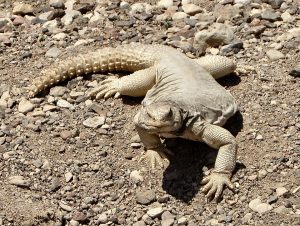
Most scholars agree that tsav is the name for the dab or thorn-tailed lizards of which there are many species in Israel. Two of the most common are the Egyptian Thorn-tailed Lizard Uromastyx aegyptius and the Colored Thorn-tailed Lizard Uromastyx ornatus. The name “dab” is an English version of their Arabic name dhabb (ضب), which is reflected in the Hebrew tsav.
Lacertid lizards (leta’ah) are fairly small, about 15-20 centimeters (6-8 inches) long, and they have a shiny smooth skin. Syrian green lizards have dark green spots on a lighter green background, with a yellow-green belly. They feed on flies, gnats, mosquitoes, and ants.
The rainbow agama is much larger, reaching 50-60 centimeters (20-24 inches) in length. In the breeding season the male develops bright colors, with a blue tail, green body, and bright orange or bright green head, dependent on the subspecies. The females and non-breeding males are a dull gray color. All agamas are characterized by the fact that they bob their heads vigorously by doing “push-ups” with their front legs. They have long, fairly stiff tails, which they raise when they run. They feed on a wide variety of insects and also prey on smaller lizards. In most of the Arab-speaking world they are known as hardoun lizards. Some agamas have the ability to change color to match their surroundings in the same way that chameleons do.
The thorn-tailed lizards (tsav) are relatively large desert lizards with a length of about 65 centimeters (26 inches). They have a fairly thick, squat appearance and have a thick short tail covered with sharp spikes, which are actually cone-shaped scales. They use this tail for defense. They often crawl into holes or cracks in rocks and then block the entrance with their thorny tail. They are vegetarian, eating various succulent desert plants. Even though they are on the list of unclean foods, they are commonly eaten by Arabs and Bedouin, who keep them in cages and fatten them.
They are listed as unclean.
Agamas are found throughout Africa and in tropical Asia. Lacertids are found all over Europe. Elsewhere a general word for lizard can be used.
For tsav a phrase, such as “big thorny lizard” or “big lizard with a thorny tail”, is usually the best option. Where languages differentiate between smaller lizards and monitor lizards, “thorny monitor” or “monitor with a thorny tail” will better convey the idea of large size.