eagle / vulture

Vultures and eagles were much more common in the ancient world than they are today. In fact since the end of World War II in 1945 the world’s population of vultures and eagles has been reduced by over sixty percent. This is due mainly to a) calcium deficiencies as a result of eating animals in which there were high concentrations of the insecticide DDT, b) eating poisoned rats, and c) the reduction in the amount of carrion due to both the disappearance of wild animals since the invention of the modern rifle, and the modern garbage disposal systems.

Click or tap here for the rest of this entry in United Bible Societies’ All Creatures Great and Small: Living things in the Bible

Nesher: As is the case with many Hebrew bird names, the word nesher refers both to one particular bird and to a general class of birds. It seems likely that nesher refers specifically to the largest of the local birds of prey, namely the Griffon Vulture Gyps fulvus, but since this word also refers to large birds of prey, it also has a general reference to all or any of them. Thus this category of large birds probably also includes the Lappet-faced Vulture Torgos tracheliotus negevensis, (now fairly uncommon, but previously very numerous), the Golden Eagle Aquila chrysaetos, the Imperial Eagle Aquila heleiaca, the Steppe Eagle Aquila nipalensis, and possibly the Black or Verreaux’s Eagle Aquila verreauxii. The last mentioned bird has only been breeding in modern Israel in the last thirty-five years, but some ornithologists believe that it may have lived there in ancient times, since it is associated closely with the hyrax, its favorite prey.

‘Ozniyah: There is considerable doubt about the meaning of this word. Its meaning is basically derived from its position in the list of unclean birds, and this makes a type of vulture more likely than the osprey. Since the Black Vulture Aegypius monachus is slightly smaller than the lappet-faced vulture and the bearded vulture, this seems to be the most likely candidate. It probably represents eagles and buzzards of the same size as itself, that is, some of the eagles mentioned above. In modern Hebrew ‘ozniyah is the name for the lappet-faced and black vultures.

Black vulture, Wikimedia Commons

‘Ayit: There is general agreement that the word ‘ayit in the Bible is a word that includes in its meaning both eagles and vultures. However, it probably does not include smaller birds of prey, such as the hawk, sparrow hawk, or smaller falcons. In the contexts in which it occurs it is clear that carrion-eating birds of prey are meant, rather than all birds of prey. Therefore the English expression “birds of prey” is too inclusive, but the term “carrion birds” is probably more correct.

The word ‘ayit is usually taken to be derived from a Hebrew root meaning “to scream”, hence “the screamer”, and is obviously a bird in Genesis 15:11 and other passages. However, there are also scholars who relate ‘ayit to a different Hebrew root meaning “to attack greedily”.

Peres, a word derived from a Hebrew root meaning “to tear apart” or “to break”, probably refers to the Bearded Vulture or Lammergeir Gypaëtus barbatus, which looks much like an eagle. It probably represents a grouping of eagles and vultures slightly smaller than those mentioned above under nesher and would include the Black-breasted Snake Eagle (also called the Short-toed Eagle or the Black-chested Harrier Eagle) Circaetus gallicus (alternatively Circaetus pectoralus) and the Booted Eagle Hieraeetus pennatus, as well as one or two others.

Bearded Vulture, Wikimedia Commons

Racham refers to something that is black and white. The position of the name in the list of unclean birds would indicate that it is a waterside bird. This narrows the choice to two possibilities, the Egyptian Vulture Neophron percnopterus and the Osprey Pandion haliatus. In modern Hebrew racham is the name for the Egyptian vulture.

The Egyptian vulture is smaller than the other vultures mentioned above. It has long, untidy, light orange-brown feathers on its neck and head, with a bare yellow face and yellow beak that is longer and less hooked than most vultures. The rest of the body and wings are white with black wing tips. In flight the body and the front half of the wings are white, with the wing tips and the back half of the wings black.

While this vulture does eat carrion, it is usually the scraps dropped by larger vultures, since its beak is not strong enough to tear skin and meat easily. It usually scavenges scraps on beaches or rubbish dumps and eats the eggs of ground-nesting waterside birds such as plovers, sandpipers, curlews, and others, which it breaks by knocking them with a large stone.

Egyptian Vulture, Wikimedia Commons

Aetos: This is the usual Greek word for any kind of eagle.

Aquila: This is the usual Latin word for any kind of eagle.

True eagles have feathers on the lower part of their legs, but vultures, snake-eagles, hawks, and others usually have no such feathers. Vultures have slightly longer beaks and longer necks than eagles, and their heads and necks are usually either bald or have sparse down covering them rather than proper feathers.

Griffon vulture: This is the largest of the Gyps vultures, having a wingspan of about 2.5 meters (8 feet), and weighing up to 10 kilograms (22 pounds). It has a thick hooked black beak. Its head and neck are covered in fine down, and it always looks as though it is frowning. It has a tuft of feathers on its back between its shoulders. The head, neck, and chest are gray and fawn, and its back is dark brown with darker feathers on the edges of its wings. When it is soaring, its body and the leading edges of its wings appear light brown with a broad dark band on the trailing edge of the wings. Like all true vultures, it has featherless legs.

Griffons live in fairly large groups and roost and nest together on high rock ledges, and, like most other vultures of large size, they have to wait until mid-morning when there is warm air rising up from the ground before they can fly. They then soar in spirals, going higher and higher.

They have very specialized eyes that enable them to see great distances. A proverb quoted in the Talmud says, “A vulture in Babylon sees a carcass in Israel.” They keep watch to find any dead or dying animals, and at the same time they keep track of other vultures flying nearby. They soar fairly slowly, without beating their wings. As soon as one stops spiraling and heads toward its prey, it gathers speed quickly in a shallow dive, still not beating its wings, but often reaching high speeds. The Hebrew name nesher may reflect the swishing sound made by its wings when it is flying this fast. Other vultures will notice this movement and will start to follow.

In African countries where both griffon and lappet-faced vultures live, griffons usually arrive at a carcass in fairly large numbers, with the lappet-faced vultures arriving in pairs. Often a dead cow will attract twenty griffons or more and perhaps four lappet-faced vultures. It is likely that this ratio was the case in ancient Israel too.

The griffons attack the stomach and other soft parts of the carcass and thrust their heads deep into the body to eat the liver and other soft organs before starting on the softer meat, eating “from the inside out.” They eat very quickly and can consume a kilogram (2 pounds) of meat in about two minutes. After gorging themselves it is difficult for them to fly, and they need to run and hop along the ground before getting airborne. If there is no obvious danger, they prefer to remain on the ground or to perch on logs or in nearby trees after eating.

Lappet-faced vulture: This vulture is almost as big as the griffon in terms of height and wingspan but has a lighter build. They live singly or in pairs in the Negev and roost and nest in the tops of flat-topped trees such as acacias. The lappet-faced vulture has a yellowish beak, which is thicker and stronger than that of the griffon, and this enables it to eat skin, sinews, and tough meat. The head, face, and neck are covered with bare red skin. The head and neck have thick wrinkles. The rest of the body is dark brown or black with white thighs and shoulders. When they are soaring they appear to be uniformly black except for a thin white streak on the leading edge of the wings, with the white thighs (usually referred to by bird watchers as their “white pants”) clearly visible.

At a carcass they feed “from the outside in,” tearing the skin and eating it before starting on the meat. Lappet-faced vultures are very aggressive and dominate the griffons at a carcass they are sharing. Although carrion is their main food, they also sometimes kill their own prey, mainly small mammals such as young gazelles or hares.

Black vulture: The black vulture, as its name suggests, is black all over apart from the bare head and neck, which are a bluish gray. When viewed from below it appears completely black.
Large eagles: The golden, imperial, and Verreaux’s eagles mentioned above are all very large and have a wingspan of at least 2 meters (6 feet). They are not mainly scavengers, but may occasionally join vultures at a carcass. Generally their prey is small mammals, such as baby gazelles, lambs, hyraxes, hares, and young ibexes, as well as occasional game birds such as partridges and doves.

Bearded vulture: Also known as the lammergeir, this bird is unique among vultures, as it has feathered legs like an eagle. It is smaller than the vultures mentioned above. Its head, neck, and body are an orange-brown, and it has a black stripe running from the back of its head, through its eye to the beak, where it ends in a short bristly black beard on both sides of the beak. Its back and wings are dark brown. In flight it is easily recognized by its coloring and its large diamond shaped tail. It usually feeds when other vultures have eaten, and it has the unique habit of carrying bones high into the air and then dropping them onto a large rock to break them so that it can eat the marrow and the bone fragments. It will use the same rock for this purpose for many years.

Both eagles and vultures are associated with large size and great strength. Especially important is their ability to fly great distances at high speed, without even beating their wings. Both Egyptian and Assyrian deities had the eagle or vulture as their symbol, and this, as well as their diet of meat, meant that these birds were “unclean” to the Jews. The famous mummy of Tutankhamen, the young Egyptian king, was found with a large collar made of gold and colored glass adorning his neck and shoulders, in the form of a flying vulture representing the goddess Nekhbet. The eagle in Scripture is also a symbol of protection, and in Deuteronomy the eagle is a metaphor for God.

As carrion-eating birds of prey, eagles and vultures symbolized death in battle, in which the corpses were not buried. They are listed among the unclean birds.

The vulture or eagle was a symbol of healthy, long life. In actual fact these birds can live for a great many years. One fairly reliable report from Austria refers to an eagle kept in captivity for 104 years. Some scholars relate the Hebrew association of long life and the eagle to the ancient Arabian myth about the phoenix, usually portrayed as some sort of eagle, which flew to the sun every five hundred years, was consumed by the sun’s fire, and emerged reborn from its own ashes.

By the time of the New Testament the eagle, besides the symbolism mentioned above, had also become a symbol of the power of the Roman Empire.

The context will usually indicate whether vultures or eagles are intended by the author. When there is reference to speed and swooping down on the prey, the eagle is intended, but when there is reference to eating dead bodies, the vulture is intended. When the text speaks of flying high or nesting in safety on high cliffs, either eagles or vultures fit the context.

Three linguistic situations are possible: a) Languages in which the same word is used for both vultures and eagles (for example, Lisu, Lahu, and other Tibeto-Burman languages). Here there is no need to differentiate between them, except where both Hebrew words appear together. b) Languages in which there are no generic words for vultures or eagles, but each individual subspecies has its own name (as with many southeastern Bantu languages). In these cases it is best to choose the biggest vulture or eagle for nesher and a slightly smaller one for peres. c) Languages in which there are two generic words, one for vultures and another for eagles (as is the case in English). Here the context will determine the choice.

Care should be taken in those contexts where the nest is referred to as high on a cliff face, since some species of vulture and eagle nest in trees. In these cases a cliff-nesting alternative should be chosen, even if it is a smaller bird of prey.

‘Ozniyah: Probably a word for the black vulture or a type of medium-sized eagle. An expression meaning “small vulture” is probably the best equivalent.

Another name for an eagle or vulture of similar size as the black vulture can be used in the lists of unclean birds for ‘ozniyah, or it can be included, along with peres, in a general expression covering both fairly large vultures and eagles.

‘Ayit: In languages that do not have a single word including both eagles and vultures, but where both types of bird are found, such as in Africa and the Middle East, it is better to use a simple phrase meaning “eagles and vultures.” A phrase such as “scavenging birds of prey,” or simply “vultures,” could also be used.

True vultures are not found in the Americas or Australasia, but a word for “buzzards,” or, in the case of the Americas, “condors” can substitute for “vultures.” Elsewhere a phrase such as “eagles that eat dead things” or a borrowed word can be used.

Peres: The bearded vulture is found in the mountainous regions of southern Europe, Central and South Asia, and eastern and southern Africa. The medium-sized short-toed eagle is found throughout Eastern Europe, the Middle East, and Africa. The booted eagle is found all over Europe, Asia, and Africa. Elsewhere, the name for a medium-sized vulture or eagle can be used to translate peres.

In Africa there are many vultures closely related to the griffon vulture, and the lappet-faced vulture is common in most areas of the African continent. The African griffons include the White-backed Vulture Gyps africanus(alternately Gyps bengalensis), which nests in trees, the Cape Vulture Gyps coprotheres, and Ruppell’s Vulture Gyps ruppelli. The local word for any of these would be a good equivalent in contexts where the text refers to vultures.

Griffons are also found in central and eastern Europe and on the Indian sub-continent. The condors of Latin America and California would be local equivalents. The Wedge-tailed Eagle Aquila audax of Australia would be an equivalent there.

Golden and imperial eagles are found in most of western Europe as well as Israel.

African equivalents of the golden and imperial eagles would be the Black or Verreaux’s Eagle Aquila verreauxii and the Martial Eagle Polemaetus bellicosus.

The Steppe Eagle Aquila nipalensis migrates across Israel to as far south as the northern parts of South Africa. It is also found in eastern Europe, Kazakhstan, Central Asia, and South Asia.

In North America the Bald Eagle Haliaeetus leucocephalus would be an equivalent in some contexts of the Hebrew nesher.

Source: All Creatures Great and Small: Living things in the Bible (UBS Helps for Translators)

See also eagle

heron

There is little doubt that ’anafah refers to any type of heron found in the land of Israel, such as the Gray Heron Ardea cinerea, the Purple Heron Ardea purpurea, the Squacco Heron Ardeola ralloides, and the Night Heron Nycticorax nycticorax. However, since the name is derived from a Hebrew root meaning nose, there are many scholars who feel that the word originally was used for any waterside bird with a prominent beak. This would include not only herons but also ibises, egrets, and perhaps bitterns and spoonbills.

Herons are fairly large birds with long necks, long beaks, and usually with long legs as well. They stand or walk slowly in shallow water in rivers, dams, ponds, or lakes looking into the water for small fish, which they catch by suddenly darting their heads into the water. They fly with slow wing-beats.

They are listed as an unclean bird.

Herons and egrets are widespread around the world, and finding a local equivalent should not be a problem.

Source: All Creatures Great and Small: Living things in the Bible (UBS Helps for Translators)

roe deer

Although the majority of English versions have roebuck, which is the male form of roe deer many biblical zoologists reject this rendering. They argue that roe deer while being fairly common in biblical times live singly or in pairs for part of the year but not in herds they are extremely shy and difficult to hunt as they live in thick undergrowth and seldom leave it. They are rarely even seen in areas where they live. Thus the argument goes it would have been almost impossible for large numbers of roe deer to have been brought to Solomon’s table on a daily basis as recorded in 1 Kings 4:23. However others argue that trapping roe deer would have been easy even though hunting was not.

The consensus among the zoologists supports the translation “bubal hartebeest” which was well known and could easily have been kept in semi-domesticated herds as were deer [Note that bubal hartebeest are now extinct]. In Egypt and to a lesser extent in Sinai the bubal hartebeest was depicted in murals and stone carvings and many mummified hartebeests have also been found in Egyptian sites. Both Canaanite and Israelite archeological sites have yielded hartebeest bones in fairly large quantities. They have even been found in close proximity to Canaanite altars suggesting that the Canaanites sacrificed them.

The Hebrew name yachmur is probably derived from a root ch-m-r, which means “red” and is the same root from which the Hebrew name for a donkey is derived. The bubal hartebeest is both red and remarkably like a horned donkey. It is also known as the red hartebeest. The word “hartebeest” is a word borrowed from Dutch and literally means “deer-cow”.

Interestingly, the Septuagint translates yachmur as bubalos “water buffalo”, which was an animal well known to the Israelites. Water buffalo were domesticated in Babylonia and Syria and were found in the marshes of northern Israel around Lake Huleh. However this translation has no support among modern scholars. The name bubal in bubal hartebeest is derived from this same Greek word.

Roe Deer capreolus capreolus are small deer, the adult males having short horns that have three prongs. Their fur is brownish in summer and gray in winter. They live singly or in pairs in the undergrowth of forests and thick woodland, never moving more than one or two meters (3-6 feet) from cover, even when feeding.

The Bubal or Red Hartebeest alcelaphus buselaphus is a large antelope about 1.5 meters (5 feet) high at the shoulder. Both males and females have very long faces with a large lump on the head from which sprout short thick horns. These curve upward and forward for half their length and then angle sharply backwards. Hartebeests are reddish brown in color.

They are plains animals and graze in herds often among gazelles zebras or other antelope. Although they look slightly ungainly with their sloping backs hartebeests are very good runners and can sustain high speed for as much as 10 kilometers (6 miles) easily outrunning any other animal over this distance.

These animals were once found all over North Africa and the plains of the land of Israel where they were known as “wild cows” by Bedouin. In some Jewish versions of the Bible yachmur is translated as “wild cow”. The bubal hartebeest has disappeared from those areas, but it is still found in the Kalahari semidesert in Botswana and in adjacent areas in Angola Namibia Zambia and Zimbabwe. Very similar hartebeests alcelaphus lelwel and alcelaphus cokei are also found in Chad, Sudan, Uganda, Kenya and Tanzania. In the latter two countries they are known by their Swahili name “kongoni”.

If the interpretation “roe deer” is chosen, then the local name for this deer can be used, where roe deer are known. In areas where roe deer are not known, names for other similar small deer can be used, as for instance: India, Myanmar (Burma), and Southeast Asia: Muntjak or Barking Deer muntiacus muntiacus; Latin America: Pampas Deer blastocerus bezoarticus of Brazil and Argentina. In areas of Africa where deer are not known, the name of a small solitary antelope, such as one of the duikers, can be used. Elsewhere an expression such as “small deer” (in contrast to “large deer” for the fallow deer), or a transliteration, can be used.

If the choice is for red or bubal hartebeest the following possibilities exist: Botswana, Zambia, Zimbabwe: the local word for Red Hartebeest alcelaphus buselaphus; East Africa: the Coke’s Hartebeest or Kongoni alcelaphus cokei; Chad and Sudan: Lelwel Hartebeest alcelaphus lelwel; Southern Africa: Cape Hartebeest alcelaphus caama, Tsessebe damaliscus lunatus, Bontebok damaliscus pygargus, or Blesbok damaliscus albifrons. Elsewhere a name like “wild cow” can be used.

Red Hartebeest, Wikimedia Commons

Source: All Creatures Great and Small: Living things in the Bible (UBS Helps for Translators)

mouse / rat

The Hebrew word ‘akbar is a very general one including all of the small rodents. The word thus includes house mice, field mice, voles, dormice, jerboas, jirds, gerbils (sand or desert rats), black rats, brown rats, hamsters, and others. The Canaanites hunted and ate the larger rodents such as jerboas and gerbils (which are not rats at all, in spite of their nickname “sand rats”), and so do many of the desert tribes today in the Middle East.

It would not be possible to describe here all the various rodents covered by the Hebrew word ‘akbar. The descriptions will thus be limited to rats, voles, jerboas, and gerbils. House mice and field mice are too well known all over the world to warrant description.

Rats are larger than mice (25-30 centimeters [1 foot] long including tail) but otherwise look very much like them. Both the Black Rat Rattus rattus and the Brown Rat Rattus norvegicus vary in color from black to grayish brown with the brown rat having a slightly shorter snout. The black rat is host to a certain type of flea that is a carrier of the dreaded bubonic plague. Although zoologists in the 1960’s believed that Rattus rattus originated in Asia remains of this rat have been found in Israel dating from prehistoric times. The Brown Norwegian Rat only arrived in the land in the 1930’s.

Levant Vole Microtus socialis guentheri: Voles differ from small mice only in the shape of their cheek teeth so to most people they look just like mice. They are small grayish brown and have pale bellies. They feed on grass stalks and the stalks of grains such as wheat and barley. They are active day and night for about two or three hours at a time eating their own body weight and more each day. They also produce up to sixteen litters a year with up to twelve babies in a litter. Thus in a good season when there is plenty of food and cover in which to hide from predators their population explodes and this vast increase in numbers poses a very serious threat to crops. Of all mice these are the most destructive.

Lesser Jerboa Jaculus jaculus: The scientific name means “jumper”. Jerboas are slightly larger than most mice and have very long hind legs and very short front legs. They hop like kangaroos and are even known (erroneously) as “kangaroo rats”. They have a long tail with a tuft at the end and this is used for balance when they hop. They live in desert and semidesert areas and are the color of sand. They are active only at night and have large eyes and ears to compensate for this. They feed on seeds and can go without water for long periods.

Palestinian Gerbil Gerbillus andersoni allenbyi: Gerbils are very similar to jerboas but are smaller. When alarmed they can move very fast covering up to 3 meters (10 feet) with each leap. Although called “sand rats” or “desert rats”, they are actually not rats at all in the strict sense of the word.

In Leviticus 11:29 the ‘akbar is listed as an unclean animal. It is not clear and has often been debated by rabbinic scholars whether all “mice” are included in the ban, or only some species. Jerboas, gerbils, and hamsters are a common food among Middle Eastern desert tribes and are not classified as “mice” today.

The major exegetical choice to be made by the translator is whether the ban is on all types of small rodents or only on some. Commentators are divided on the issue. NEB, JB, NIV, and REB all take the prohibition to apply to specific species: rats (JB and NIV) or jerboas (NEB and REB). “Rats” is an understandable choice, since rats, especially the black rat, are known to be carriers of disease. TEV takes the view that all species are included in the ban and has “rats, mice”. KJV, RSV, and NAB have “mouse”, probably with a wide rather than a restricted meaning.

Source: All Creatures Great and Small: Living things in the Bible (UBS Helps for Translators)

hoopoe

There is unanimous agreement today about the meaning of this word.

The Hoopoe Upupa epops is so named to represent its call, which has been described as hoop-hoop, poop-poop, or similar sounds. Its name is even similar in some African languages, such as Shona mupupu and Tswana pupupu. [The German name Wiedehopf (ˈviːdəhɔpf/) is onomatopoetic as well. (Source: Zetzsche)]

It is a bird about the size of a large dove, with a ginger colored head and body, and with wings and a tail that have black and white stripes. It has a long slender beak that curves slightly, and a long crest on its head, which it can erect into a fan shape.

The hoopoe has rather floppy wings and rises and falls as it flies. As soon as it lands, it erects its fan-shaped crest briefly. It spends a lot of time walking around on the ground looking for food. It nests in any suitable hole in a tree or in the ground and may raise two or three broods in a season. Unlike most other birds, it does not remove the nestlings’ droppings from the nest, and the nest smells badly as a result. Hoopoes eat insects and their larvae, termites, worms, small frogs, and beetles.

It is listed as an unclean bird.

The hoopoe is found all over Africa, Madagascar, the Middle East; across tropical Asia in savannah, but not rain forest areas; in Japan; and in southern Europe. In these areas a local name should not be difficult to find. Elsewhere, a name that approximates its call can usually be used, such as “hoopoo bird”, “pupu bird”, or something similar.

Hoopoe, Wikimedia Commons

Source: All Creatures Great and Small: Living things in the Bible (UBS Helps for Translators)

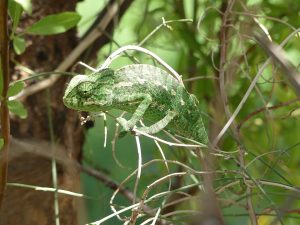
chameleon

This word appears in the list of unclean birds as well as in the list of lizards, and it seems quite clear that an owl and a reptile had the same name. Giving quite different creatures the same name is a common phenomenon in many languages. For instance, in English the word “cob” is used for a male swan as well as for a type of riding horse, and “sable” is the name of a small carnivorous animal as well the name of a large antelope; in Dutch “duiker” is the name of both the cormorant (a bird) and a type of antelope.

The Hebrew name tinshemeth is derived from a verb that means “to pant or to breathe loudly”. This makes it very likely that the reference is to the chameleon. When annoyed, hurt, or in danger, the chameleon turns black, inflates its large lungs, making itself look bigger, and then opens its mouth, puffing and hissing like a snake. See also tinshemeth / barn owl.

The Chameleon Chamaeleo chamaeleon is a very interesting lizard. It lives in vegetation. It is basically green but can change color to match its environment. It can become brown, pale yellow, or gray, and can vary the shade at different points of its body so as to become mottled or to have patches of dark and light color. This gives it good camouflage in vegetation. It is slow moving, often moving only one limb at a time in a series of wavering movements, mimicking the movement of twigs in the breeze. It has opposed claws on each foot, enabling it to hold very tight and to walk along thin twigs.

It has small scales and many small wart-like lumps on its tough skin. It has a row of pointed scales down its spine. Some species of chameleon have horn-like protrusions on their heads and faces.

The chameleon’s eyes are unique. It has an eyelid that completely covers the eye except for a small hole for the chameleon to see through. The chameleon can move this aperture around with each eyelid working independently of the other, and this enables it to look in two directions at once. It feeds on insects by catching them with its long, sticky, elastic tongue, which it flicks at the prey. The chameleon is also able to use its tail to wrap around twigs and other things to support itself when the wind blows or when climbing at a steep angle. It can hang by this tail from a twig or small branch and often uses this technique to move from a higher branch to a lower one.

It is listed as an unclean animal.

Chameleons are found all over Africa except in desert areas, and in some parts of tropical Asia. Where chameleons are not known, it may be necessary to borrow a word from the dominant language of the area, or from Hebrew, as Jerusalem Bible has done. A phrase such as “slow lizard” or “puffer lizard” is another option.

Chamaeleo chamaeleon, Wikimedia Commonsb

Source: All Creatures Great and Small: Living things in the Bible (UBS Helps for Translators)

oryx

Most modern scholars are of the opinion that the Hebrew word te’o refers to the oryx. Oryx bones have been found in proximity to Israelite and Canaanite domestic and sacrificial sites that date over a very wide time span proof that the animal was fairly common and was considered to be acceptable to eat. Furthermore it is known that until the mid-nineteenth century large numbers of oryx roamed the Negev in Palestine.

The Arabian or Desert Oryx Oryx leucoryx is a medium-sized antelope, about the size of a donkey. It is closely related to the African oryxes, such as the Gemsbok Oryx gazella of the Kalahari and Namib semideserts, the East African Oryx Oryx beisa, and the Scimitar-horned Oryx Oryx algazel of the Sudan and Egypt. In many ways the oryx is also similar to, but smaller than, the Sable Antelope Hippotragus niger and the Roan Antelope Hippotragus equinus, both of which are found in South Africa, Zimbabwe, Zambia, and Angola.

The Arabian oryx, which was once plentiful in the land of Israel is now almost extinct and the only remaining specimens have been bred in semicaptivity and in captivity from one small breeding herd. This inbreeding and captivity have resulted in marked genetic deterioration so that today’s specimens are smaller and weaker than their ancestors and many have deformed horns. So although the specimens in photographs give us a rough idea of what the original Arabian oryx was like, these modern defects should be borne in mind.

Both males and females of the Arabian oryx have long slender horns that are usually over a meter (3 feet) long. The horns are almost straight and slope back from the animal’s head at about thirty degrees from the perpendicular. The adults are a light fawn color with dark brown markings on the face and on the lower part of both front and back legs. The belly is white.

In the wild oryxes are well able to defend themselves with their long horns and the African species are often able to drive off lions and other predators sometimes even killing their attackers. When wounded by hunters they are extremely dangerous. They are also very strong runners. They live in semi-desert conditions and are very hardy.

The oryx was known for its strength (perhaps exaggerated since strength was associated with long horns) and bravery. Oryx horns are the longest horns known in the Middle East and North Africa and since horns were a symbol of power and strength this probably added to the association of the oryx with power. According to some Jewish scholars oryx horns were later used to make special shofar trumpets blown only at Passover. The oryx is listed among the clean animals.

In Africa and other areas where oryxes or sable and roan antelopes are known, the word for one of these animals could be used throughout. Elsewhere, a term, such as “long-horned antelopes”, could be used for te’o, or a transliteration of the Hebrew word might be considered, with a description given in a footnote or in the glossary.

Arabian oryx, Wikimedia Commons

Source: All Creatures Great and Small: Living things in the Bible (UBS Helps for Translators)

jackdaw

There is no consensus among scholars about the bird this word refers to. The word occurs five times, and from the contexts it can be stated with some certainty that

a. it is an unclean bird (that is, it is not a seed eater)
b. it is associated with the Judean Desert
c. it is associated with ruin

An additional feature, which has largely been overlooked, is that in four of the five verses the discourse structure indicates that it was paired in the biblical writers’ minds with the raven. This would indicate that this bird is probably a carrion eater or scavenger and possibly black.

These contexts would rule out the interpretation “pelican”. Psalm 102:6 could possibly be construed as referring to the great distress a pelican would suffer in the desert. However, this argument is weakened by the fact that it would be almost nonsensical in Isaiah 34:11 to indicate that Edom will become a place of hot springs and desolation by saying that it will be “a dwelling place of pelicans”. The White Pelican Pelecanus onocrotalus, which is the pelican seen most often in the land of Israel, lives in large rivers, lakes, lagoons, and oceans. They are passing migrants in Israel, staying only a few weeks in autumn. They stop briefly in the Huleh and Eilat areas, as they move from the Black Sea, the Danube Delta, and the Caspian Sea to Africa. No place in the whole of the Middle East could be called a “dwelling place of pelicans”. To do so would be to indicate that the place has become a wetland or full of suitable lakes well-stocked with fish.

Some sort of owl seems more likely, and most modern English translations follow Driver’s suggestion in this regard. New English Bible and Revised English Bible have “horned owl”. This is not a species of owl but a much broader classification referring to a family of owls that have prominent ear tufts. New International Version and New American Bible have an even more general term, “desert owl”. There is no such family or species of owl, and the phrase simply means an owl found in the desert.

However, another interesting suggestion has been the jackdaw. Besides fitting all of the contexts, it also makes a fitting pairing with the raven in Leviticus 11:18; Deuteronomy 14:17; Isaiah 34:11; and Zephaniah 2:14. In the latter two passages the birds mentioned would be the jackdaw, two types of owl, and the raven, making a typical Hebrew correspondence between opening and closing items, and between the two middle items. In modern Hebrew the jackdaw is called qa’ak, which might be a slightly modified form of the biblical qa’ath. All scholars are agreed that the name relates to the sound the bird makes, and this would certainly be a good representation of the sound made by the jackdaw.

Since the pelican is unlikely as the proper translation of this name, it will not be described here. Descriptions of owls indigenous to Israel can be found under owl.

The Jackdaw Corvus monedula is a member of the same family as ravens and crows but is smaller. It is black all over.

This bird is a symbol of uncleanness, desolation, and possibly death.

Jackdaws are found in the Middle East, South Asia, and Europe. A word for a small type of crow would be the best choice in most other places. Even a phrase such as “small crows and big crows” could be used for jackdaws and ravens.

If an owl is accepted as the meaning of qa’ath then a general word for owl is a better choice than any one subspecies of owl. However, care should be taken not to introduce an association with witchcraft, since this was not the case in the original Hebrew.

Jackdaw, Wikimedia Commons

Source: All Creatures Great and Small: Living things in the Bible (UBS Helps for Translators)