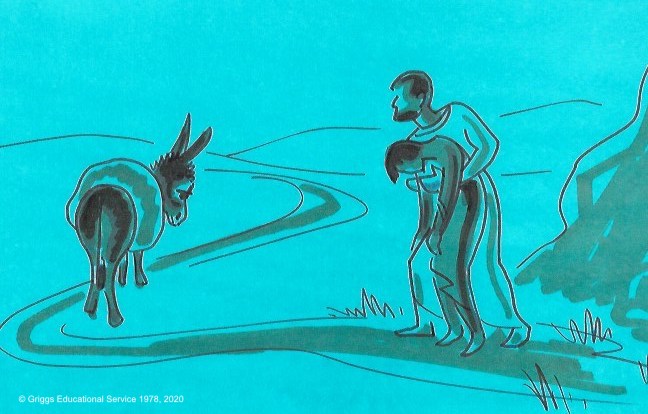
Illustration by Annie Vallotton, copyright by Donald and Patricia Griggs of Griggs Educational Service. More images can be viewed at rotation.org .
For other images by Annie Vallotton on Translation Insights & Perspectives, see here.

καὶ προσελθὼν κατέδησεν τὰ τραύματα αὐτοῦ ἐπιχέων ἔλαιον καὶ οἶνον, ἐπιβιβάσας δὲ αὐτὸν ἐπὶ τὸ ἴδιον κτῆνος ἤγαγεν αὐτὸν εἰς πανδοχεῖον καὶ ἐπεμελήθη αὐτοῦ.
34He went to him and bandaged his wounds, treating them with oil and wine. Then he put him on his own animal, brought him to an inn, and took care of him.
Illustration by Annie Vallotton, copyright by Donald and Patricia Griggs of Griggs Educational Service. More images can be viewed at rotation.org .
For other images by Annie Vallotton on Translation Insights & Perspectives, see here.
Indonesian uses a way to introduce a person in the beginning of a story that communicates to the reader or listener whether the story is a historical account a non-historical account. Ada seorang is used for the historical account and adalah seorang for the non-historical account. “In the Indonesian Common Language Bible (Alkitab dalam Bahasa Indonesia Masa Kini, publ. 1985), the second formula is used in the parable of the Prodigal Son (Luke 15), in the parable of the rich man and Lazarus (Luke 16), and in many other places. The first formula however is used in the parable of the Good Samaritan in Luke 10. Why is it used here when in fact this is a non-historical account? Simply because while it is a parable, yet Jesus told it as if it was a real historical account. This is shown, for example, by the ending of the parable where Jesus asked the religious teacher to give his opinion as to which man showed love to his neighbor.” (Source: Daniel Arichea in The Bible Translator 1986. p. 235f. )
The Greek in Luke 10:34 that is translated in English as “wounds” is translated into Folopa as nopulu daayale tiki: “where the clubs stood” (= wounds caused by clubs).
Translator Neil Anderson tells the story on how this was decided:
I knew no word for wounds and I had a difficult time getting one. I said, “The word is for things like sores, but they’re not sores; it’s like injuries, but not accidental.”
They were trying to grasp it. “Read it again,” they said. So I read it again, explaining as I went.
“These thieves had jumped him,” I said, “and he’s down, and now he’s lying there with these . . . problems . . . these results of what was perpetrated upon him. But what’s the word?”
“What did they use on him?”
“I don’t know what they used on him. What does it matter?”
“We have to know what they used on him or we can’t tell you the word.”
“Why not?”
“Because it all depends. If he was speared we say, ‘where the spear stood;’ if he was shot with an arrow we say, where the arrow stood;’ if he was axed we say, ‘where the axe stood.’ You tell us what they used on him and well tell you how to say it.”
Apparently there was no generic word for “wounds” and this was the best we were going to do. The only trouble was, Scripture didn’t tell how it happened. In the original telling, it wasn’t important.
So we tried to figure it out.
“Let’s say it was a spear,” I said.
“Okay,” the old ones said, the ones with the most experience with this kind of thing, “did the man live?”
“Yes, he lived,” I said.
“Then it wasn’t a spear. If it was a spear he would have most likely died.”
“Maybe it was an arrow,” I offered.
“No, if it had been by arrows they would have pulled them out. Does it say anything about pulling arrows out?”
“No. What about a dagger?”
“No,” they said, “if it had been a dagger he probably would have never recovered either.”
“Then what about an ax?”
“No way. If they had axed him that would have been the end of him right then!”
“Well then, maybe they just beat him up with their hands,” I said.
“No,” they protested, “when you do that the person may be covered with lumps and bumps but there’s nothing open, nothing for the Samaritan to pour medicine into.”
“Then you tell me,” I said.
“Well, he was lying there on the road, half dead, bleeding but still alive. He must have been beaten with clubs.” With general agreement on that I wrote it down: nopulu daayale tiki “where the clubs stood.” We were off and moving again.
(Source: Anderson / Moore 2006, p. 165ff.)

Image taken from the Wiedmann Bible. For more information about the images and ways to adopt them, see here .
For other images of Willy Wiedmann paintings in TIPs, see here.
The parable is illustrated for use in Bible translations in West Africa by Wycliffe Cameroon like this:

Illustration 1999 Mbaji Bawe Ernest, © Wycliffe Bible Translators, Inc. Used with permission.
Following is a painting by Chen Yuandu 陳緣督 (1902-1967):

Housed in the Société des Auxiliaires des Missions Collection – Whitworth University.
Image taken from Chinese Christian Posters . For more information on the “Ars Sacra Pekinensis” school of art, see this article , for other artworks of that school in TIPs, see here.
Following is a painting by Ketut Lasia (b. 1945):

Ketut Lasia is one of the last traditional Balinese painters in the Ubud style. As an adult, Lasia converted from Hinduism to Christianity, and he paints primarily biblical scenes. You can find artwork from Ketut Lasia in a variety of formats for sale at Fine Art America .
The different Hebrew, Ge’ez, and Greek terms that are translated as “(olive) oil” and “(animal) fat” in English are translated in Kwere with only one term: mavuta. (Pioneer Bible Translators, project-specific translation notes in Paratext)
The Hebrew, Aramaic, Ge’ez, and Greek that are translated as “wine” in English is translated into Pass Valley Yali as “grape juice pressed long ago (= fermented)” or “strong water” (source: Daud Soesilo). In Guhu-Samane it is also translated as “strong water” (source: Ernest L. Richert in The Bible Translator 1965, p. 198ff. ), in Noongar as “liquor” (verbatim: “strong water”) (source: Warda-Kwabba Luke-Ang), in Hausa as ruwan inabi or “water of grapes” (with no indication whether it’s alcoholic or not — source: Mark A. Gaddis), in sar as kasə nduú or “grape drink” (source: Andy Warren-Rothlin), or in Papantla Totonac and Coyutla Totonac as “a drink like Pulque” (for “Pulque,” see here ) (source: Jacob Loewen in The Bible Translator 1971, p. 169ff. ).
In Swahili, Bible translations try to avoid local words for alcoholic drinks, because “drinking of any alcohol at all was one of the sins most denounced by early missionaries. Hence translators are uncomfortable by the occurrences of wine in the Bible. Some of the established churches which use wine prefer to see church wine as holy, and would not refer to it by the local names used for alcoholic drinks. Instead church wine is often referred to by terms borrowed from other languages, divai (from German, der Wein) or vini/mvinyo (from ltalian/Latin vino/vinum). Several translations done by Protestants have adapted the Swahili divai for ‘wine,’ while those done by Catholics use vini or mvinyo.” (Source: Rachel Konyoro in The Bible Translator 1985, p. 221ff. )
The Swahili divai was in turn borrowed by Sabaot and was turned into tifaayiik and is used as such in the Bible. Kupsabiny, on the other hand, borrowed mvinyo from Swahili and turned it into Finyonik. (Source: Iver Larsen)
In Nyamwezi, two terms are used. Malwa ga muzabibu is a kind of alcohol that people specifically use to get drunk (such as in Genesis 9:21) and ki’neneko is used for a wine made from grapes (source: Pioneer Bible Translators, project-specific translation notes in Paratext).
In some Hindi translations (such as the Common Language version, publ. 2015 ), one term (dākharasa दाखरस — grape juice) is used when that particular drink is in the focus (such as in John 2) and another term (madirā मदिरा — “alcohol” or “liquor”) when drunkenness is in the focus (such as in Eph. 5:18).
In Mandarin Chinese, the generic term jiǔ (酒) or “alcohol(ic drink)” is typically used. Exceptions are Leviticus 10:9, Numbers 6:3, Deuteronomy 29:6, Judges 13:4 et al., 1 Samuel 1:15, and Luke 1:15 where a differentiation between weak and strong alcohol is needed. The Mandarin Chinese Union Version (2010) translates that as qīngjiǔ lièjiǔ (清酒烈酒) and dànjiǔ lièjiǔ (淡酒烈酒), both in the form of a Chinese proverb and meaning “light alcohol and strong drink.” (Source: Zetzsche)
See also proceeds from the vine / anything that comes from the grapevine, wine (Japanese honorifics), filled with new wine, and wine (Gen 27:28).
Following are a number of back-translations of Luke 10:34:
Barclay Newman, a translator on the teams for both the Good News Bible and the Contemporary English Version, translated passages of the New Testament into English and published them in 2014, “in a publication brief enough to be non-threatening, yet long enough to be taken seriously, and interesting enough to appeal to believers and un-believers alike.” The following is the translation of Luke 10:25-37:
A biblical scholar once questioned Jesus,
“Teacher, what must I do to have eternal life?”
“What do you think the Bible teaches about this?”
asked Jesus in return.
The scholar answered, “It commands us
to love God with all our heart
and to love others as much as we love ourselves.”
“That’s right,” answered Jesus
“Now do this, and you’ll have eternal life.”
The man wanted to show off somewhat and inquired,
“Who are these others you’re talking about?”
Jesus explained with a story:
“A Jewish man was on his way to worship in Jerusalem,
when he was brutally robbed and left for dead.
Along came a theologian, but he didn’t pause to help,
then a parishioner praised for his piety passed right by,
too fearful of being defiled and unable to worship God.
“Finally, an Arab came along, and when he saw the man,
he stopped and ministered first aid.
Then he put the Jewish man on his own donkey
and took him to the nearest motel.
“Next morning, he gave the motel manager his credit card
and said, ‘Give him the best treatment possible,
and charge it all to my account’.”
Then Jesus asked the biblical scholar,
“Which one of these people truly cared for the injured man?”
To this the scholar replied, “The one who showed mercy.”
“Go and do the same!” was the answer Jesus gave.
No comments yet.
Leave a Reply
You must be logged in to post a comment.