Retrotraducciones en español (haga clic o pulse aquí)
Si en tu opinión somos verdaderos compañeros en el servicio de Dios, y tú me aceptas, acepta en la misma manera a Onésimo y dale un bienvenido.
Si Onésimo te hizo algun mal o te debe dinero, pidemelo. Yo, Pablo, te escribo con mis propias manos para mostrarte que yo te pagaré para cancelar (la deuda).
Yo te enseñé y tú creíste en Dios, tú eres salvo, por cierto ¿yo no necesito pedirte que me pagues?
Hermano en Cristo hazme un favor y anima mi corazón para que esté alegre.
If you consider us to be real partners in God’s service and you accept me, then also accept Onesimus in the same way and welcome him in.
If Onesimus did something bad to you or if he owes you money, ask me for it. I, Paul write to you with my own hands to show you that I will pay you to erase (the debt).
I taught you and you believed in God and were saved, certainly I don’t have to ask you to pay me?!
Brother in Christ, do me a favor and encourage my heart, so that it will be joyful.
Following are a number of back-translations of Philemon 1:17:
Uma: “So, relative, since you consider me your one-faith friend, I request that you receive back Onesimus like you were receiving me.” (Source: Uma Back Translation)
Yakan: “So-then, if we (dual) are still good friends, Pilemon, accept/receive him as you would receive me.” (Source: Yakan Back Translation)
Western Bukidnon Manobo: “And if you regard me as your partner, welcome Onesimus just like you would welcome me.” (Source: Western Bukidnon Manobo Back Translation)
Kankanaey: “Therefore if it’s true that you (sing.) consider me your (sing.) companion/partner who believes, receive him upon-his-return as you (sing.) would receive me.” (Source: Kankanaey Back Translation)
Tagbanwa: “Therefore, since our unity/harmony in standing up for the Lord is really very-strong, receive this Onesimo with a happy mind/inner-being in that in your estimation, I personally am the one you are receiving.” (Source: Tagbanwa Back Translation)
Tenango Otomi: “Therefore if you are friends with me, then give a welcome to Onesimus just like you would give me a welcome.” (Source: Tenango Otomi Back Translation)
The following is a translation for a performance of the book of Philemon in Papiamento and its English translation. The translation is interspersed with a provocative fictional response by the historical character of Tula, the Curaçaoan revolt leader of 1795, juxtaposing the subtle liberating message of Paul with a revolutionary approach. This is followed by a video showing the performance:
1 Esaki ta karta
1 This is [a] letter
di Pablo,
from Paul,
i di ruman Timoteo,
From sibling Timothy
Pablo prezu pa kousa di Kristu-Hesus;
Paul imprisoned for the cause of Christ-Jesus
ta pa Filemon, kompañer’i trabou,
it is for Philemon, fellow of work
2 ta pa Iglesia, reuní na su kas.
2 It is for the church, gathered at his house
Karta tambe pa Apfia, nos ruman muhé,
Letter also to Apphia, our sibling female
Karta tambe pa Argipo, kompañer’i lucha.
Letter also for Archippus fellow of fight
Click or tap here to see the rest of this translation as well as the video performance
3 Dios nos Tata, duna boso
3 God the Father give you
Señor Hesu-Kristu duna boso
Lord Jesus-Christ give you
grasia i pas.
grace and peace
Filemon, Filemon,
Philemon, Philemon
Skucha bon Filemon
Listen good, Philemon
Bo n’ tende anto Filemon
Have you not heard (then) Philemon
Skucha bon Filemon
Listen good, Philemon
Lesa mi ta lesa den karta sagrado
Read I do read in holy letter
Ta ku masha kachèt mester kumindá bo
(that) with lots of respect you have to be greeted
Pa kombensébo ku hende ta util
(so as to) convince you that (a) human being is useful
Hende ta mas k’util.
(A) Human being is more than useful
4 Mi Dios mi ta gradisí,
4 My God I do thank
Ora mi kòrdabo den mi orashon,
When I remember you in my prayer
5 pasobra hopi fe den Señor Hesus bo tin
because lots of faith in (the) Lord Jesus you have
Segun mi a tende,
From what I hear
Stimashon pa Dios su pueblo bo tin.
Love for God his people you have.
6 Mi ta resa, pa e fe
I pray for the faith
ku bo ta kompartí ku otro kreyente,
that you share with other believers,
hiba na komprondementu berdadero di tur kos bon
lead to understanding true of all good things
ku pa Kristu nos por hasi.
that for Christ we can do
7 Mi ruman, bo amor
7 My sibling, your love
a hasi mi mashá kontentu
has made me very happy
kurashá mi hopi,
encouraged me a lot
pasobra el a sirbi pa animá kurason di e rumannan.
Because he has to animate (the) heart of the siblings.
Filemon, Filemon,
Philemon, Philemon
Skucha bon Filemon
Listen good, Philemon
Bo n’ tende anto Filemon
Have you not heard (then) Philemon
Skucha bon Filemon
Listen good, Philemon
Ta trasta mester trasta ku bo
Flatter has to flatter you
Hunta stropi na bo boka
Put honey at your mouth
Pa por bisa bo ku bo ta mal robes
So as to say that you are badly wrong
Pa por bisa bo ku bo ta mal brua
So as to say that you are badly confused
8 P’esei derecho mi tin di bisa bo kiko hasi,
8 That is why with what right I have to tell you what to do,
Ora mi apelá na Kristu.
When I appeal to Christ.
9 Tòg a base di amor,
9 Though on (the) basis of love,
un petishon mi ta preferá hasi na bo.
A petition I prefer to do to you.
Ami, Pablo un hòmber bieu kaba,
I, Paul a man old already
asta prezu awor pa kousa di Kristu
even imprisoned now for (the) cause of Christ
10 Mi ke pidi bo pa mi yu Onésimo;
10 I want to ask you for my son Onesimus;
ta den prisón mi a bira su tata spiritual.
it is in prison that I have become his spiritual father.
11 Un tempu e no tabata sirbi bo pa nada,
11 A time he was not useful for anything
pero awor el a bira útil pa nos tur dos,
but now he has become useful to two of us,
manera su nòmber mes ta nifiká.
just as his name means.
Filemon, Filemon,
Philemon, Philemon
Skucha bon Filemon
Listen good, Philemon
Bo n’ tende anto Filemon
Have you not heard (then) Philemon
Skucha bon Filemon
Listen good, Philemon
Pachi7 Pablo pone preshon
Old man Paul put pressure
Pachi Pablo no papia ko’I kèns
Old man Paul do not speak foolishness
Ku trabou’i katibu n’ ta bal nada
(to say) that work of slave is not worth anything
Ku mi t’ei djis pa ta “util.”
That I am (exist) just to be “useful”
12 Mi ta mand’é bèk pa bo;
12 I am sending him back to you
ta manera mi kurason mes
as if my heart itself
mi ta ranka saka manda pa bo!
I rip out and send to you!
13 Gana di ten’é serka mi, mi tin
13 Desire to have him with me, I have
pa e por a yuda mi na bo lugá,
so that he can help me in your place
tanten mi ta prezu pa kousa di e bon notisia.
while I am imprisoned for the cause of the good news.
14 Sinembargo mi no ke hasi nada sin bo aprobashon,
14 Although I do not want to do anything without your approval
pa bo no haña bo ta hasi un bondat fòrsá,
so you will not find yourself doing a good, forced,
ma dje manera akí bo por hasié di bo mes boluntat.
but in this way you can do it from your own will.
Filemon, Filemon,
Philemon, Philemon
Skucha bon Filemon
Listen good, Philemon
Bo n’ tende anto Filemon
Have you not heard (then) Philemon
Skucha bon Filemon
Listen good, Philemon
Ai malai ai malai ei
(lamentation sound)
Ai malai ai malai ei
(lamentation sound)
Si bo tabata konosé doló di katibu
If you do not know (the) pain of slave(s)
Pablito lo bo no a saka bo shiri shiri,
(Dear) Paul (diminutive)
you would not have to take out your guts,
Bo yu sin doló, mand’é bèk.
your child-without-pain to send him back.
15 Por ta mashá bon:
15 Could be very well:
pa un tempu el a alehá for di bo,
For a time he has gone away from you,
djis pa bo hañ’é bèk pa semper.
Just so you can find him back for ever.
16 Pasobra awor e no ta djis un simpel katibu:
16 Because now he is not just a simple slave:
mas ku un katibu e ta un ruman stimá.
More than a slave he is a beloved sibling.
Anto spesialmente pa mi, e ta mashá stimá!
And especially for me, he is very well loved.
Pero pa abo: mas stimá ainda, komo katibu i komo ruman den Señor.
And for you more: more loved, as a slave/servant and as sibling in (the) Lord.
17 Ke men si bo tin mi pa kompañero,
17 That is to say if you have me for (a) collaborator,
risibí Onésimo manera lo bo a risibí mi mes.
receive Onesimus as you would have received me.
Filemon, Filemon,
Philemon, Philemon
Skucha bon Filemon
Listen good, Philemon
Bo n’ tende anto Filemon
Have you not heard (then) Philemon
Skucha bon Filemon
Listen good, Philemon
Di Adam ku Eva nos ta bini.
From Adam and Eva we come
Boso Buki mes ta bisa.
Your Book itself says it
Si nos tur ta bin di tera,
If we all can come from the earth
T’un lokura abusá di esun
It is a madness to abuse
ku ta puluwé den tera.
the one who plows the earth.
18 Si el a perhudiká bo den ki forma ku ta
18 If he has damaged you in whatever manner
òf si e ta debe bo algu,
or if he owes you something
laga esei pa mi kuenta.
leave that for to my account.
19 Awor mi mes man ta skibi esaki:
19 Now my own hand writes this:
‘Ami, Pablo, ta paga bo bèk!’
“I, Paul, will pay you back!”
Mi n’ tin nodi’ kòrda bo ku bo debe serka mi ta bo mes!
There is no need for me to remind me that your debt with me is yourself!
20 Sí, mi ruman, hasi mi e fabor akí pa Señor;
20 Yes, my sibling, do this favor for me for (the) Lord;
animá mi kurason komo ruman den Kristu!
animate my heart as sibling in Christ!
Filemon, Filemon,
Philemon, Philemon
Skucha bon Filemon
Listen good, Philemon
Bo n’ tende anto Filemon
Have you not heard (then) Philemon
Click or tap here to see the rest of this insight.
Like a number of other East Asian languages, Japanese uses a complex system of honorifics, i.e. a system where a number of different levels of politeness are expressed in language via words, word forms or grammatical constructs. These can range from addressing someone or referring to someone with contempt (very informal) to expressing the highest level of reference (as used in addressing or referring to God) or any number of levels in-between. One way Japanese shows different degree of politeness is through the choice of a benefactive construction as shown here in the widely-used Japanese Shinkaiyaku (新改訳) Bible of 2017.
Here, mukaete (迎えて) or “welcome” is used in combination with kudasaru (くださる), a respectful form of the benefactive kureru (くれる). A benefactive reflects the good will of the giver or the gratitude of a recipient of the favor. To convey this connotation, English translation needs to employ a phrase such as “for me (my sake)” or “for you (your sake).” (Source: S. E. Doi, see also S. E. Doi in Journal of Translation, 18/2022, p. 37ff. )
On the basis of this relationship with Philemon as a partner, Paul appeals to him to give Onesimus the same kind of welcome he would give Paul, that is, receive him as a brother and a partner. The word partner translates the Greek koinōnos, cognate of the noun koinōnia “sharing, fellowship” in verse 6 (compare 2 Cor 8.23 where Paul calls Titus his partner; in Luke 5.10 James and John are called Simon Peter’s partners). Paul is talking about partnership in the Christian faith and work. Paul phrases the matter as if it were in doubt, but this is a rhetorical device (compare a similar kind of statement in Col 2.20).
A literal rendering of the conditional clause if you think of me as your partner might suggest that this would not be the case. In order to indicate clearly the implication of what Paul is saying, one may translate “you think of me as your partner and therefore…” The expression partner often requires some kind of descriptive equivalent, for example, “as one who works together with you for the Lord.”
Welcome him back may be rendered in some instances as “receive him gladly” or, as in some languages, “when he returns, say to him, ‘You are in your own home’ ” or “… my home is your home.” These types of formulaic statements are frequently the way in which people welcome a guest.
Quoted with permission from Bratcher, Robert G. and Nida, Eugene A. A Handbook on Paul’s Letter to Philemon. (UBS Handbook Series). New York: UBS, 1977. For this and other handbooks for translators see here .
Paragraph 17–21 Paul asks Philemon to welcome Onesimus back
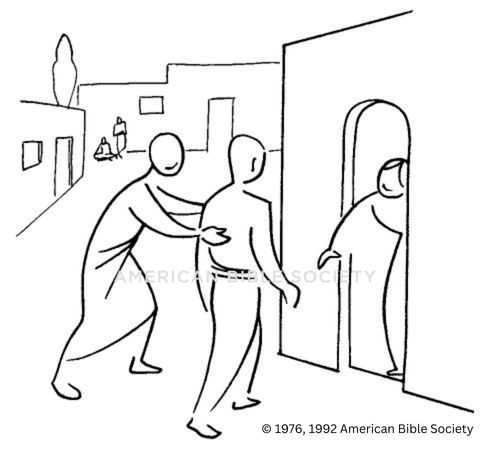
In this paragraph Paul finally stated clearly to Philemon what he wanted him to do. He wanted Philemon to welcome Onesimus back in the same way that Philemon would welcome Paul if Paul were visiting him. This is the main point of the whole letter.
Paul promised to repay Philemon for anything Onesimus may have taken from Philemon or for anything wrong he may have done against him. But Paul knew that Philemon probably would not ask him to repay him, because Paul had helped him to become a Christian. Christ surely changed the way Philemon thought about life and about money. In fact, Paul was sure that Philemon would do what he was asking him to do and even more.
Paul was also sending Onesimus back to Philemon because Onesimus needed to obey his master again and help him and show that he had changed. If Onesimus did this, he and Philemon could have peace with each other again.
Read verses 17–21 again.
17a
So: Instead of saying So, Paul could have said “On the basis of what I have just said.” (verses 8–16). This would mean the same thing. He could also have said, “Thinking of what I have just written to you.”
if: Another way of expressing what Paul means by the word the Berean Standard Bible translates as if is “since” or “because.” Paul often used the word if with this meaning. If you translated 17a as “I am not sure you consider me a partner,” this would be the wrong meaning. Paul knew that Philemon thought of him as his partner. So he was saying, “Since you think of me as your partner.”
partner: The Greek word koinōnos in this verse means “a friend who is a fellow Christian” (see verse 17 in Living Bible, Phillips’ New Testament in Modern English). It refers to someone who works together with someone else to serve the Lord. This is very similar to the meaning of the term that the Berean Standard Bible translates as “fellow worker” in verse 1.
17b
receive: To receive someone means to welcome him, to accept him gladly. Paul was asking Philemon to receive Onesimus back just as gladly as he would have received Paul.
Living Water is produced for the Bible translation movement in association with Lutheran Bible Translators. Lyrics derived from the ESV® Bible (The Holy Bible, English Standard Version®).

Leave a Reply
You must be logged in to post a comment.