The Greek that is translated as “became dazzling white” in English is translated in Sa’a with “a specially-coined, but old word for what happened to Jesus at the transfiguration. It means ‘gloriously changed to be bright and shiny and totally unlike anything else at all.’ It is used only for Jesus’ transfiguration, and then, by extension, for what will happen to us at our resurrection. The word is ‘nu’e’ — an awful lot meaning packed into just four letters!”
In Gbaya, the notion of something that shines dazzingly is emphasized in the referenced verses with the ideophones zar-zar or bar-bar.
In Job 28:17, it refers to the glass, in Lamentations 4:1 it is used in a negated form (“grown dim”), and in Luke 23:11 it refers to “elegant robe” (which is translated as “bright clothing” [vêtement éclatant] in the FrenchTraduction œcuménique de la Bible).
Ideophones are a class of sound symbolic words expressing human sensation that are used as literary devices in many African languages. (Source: Philip Noss)
The Hebrew and Greek that is translated with “clothes” or similar in English is translated in Enlhet as “crawling-in-stuff” (source: Jacob Loewen in The Bible Translator 1971, p. 169ff. ) and in Noongar as bwoka or “Kangaroo skin” (source: Warda-Kwabba Luke-Ang).
Following is a Ukrainian Orthodox icon of the Transfiguration by Ivan Rutkovych (c. 1650 – c. 1708) (for the Church of Christ’s Nativity in Zhovkva, Ukraine, today in the Lviv National Museum).
Orthodox Icons are not drawings or creations of imagination. They are in fact writings of things not of this world. Icons can represent our Lord Jesus Christ, the Virgin Mary, and the Saints. They can also represent the Holy Trinity, Angels, the Heavenly hosts, and even events. Orthodox icons, unlike Western pictures, change the perspective and form of the image so that it is not naturalistic. This is done so that we can look beyond appearances of the world, and instead look to the spiritual truth of the holy person or event. (Source )
Six days had passed. Jesus took three disciples with Him – Peter, James, John — and they went up a high mountain. There on the mountain, no one was there, just the four of them. And then Jesus’ appearance began to change. His clothes became shiny. His clothes became white as snow. There is no such white color on earth. And no one can wash clothes like that. Then Moses and Elijah appeared. Both of them talked with Jesus.
The disciples were amazed. Peter turned to Jesus:
— Teacher! It is so good here! Let’s make three tents: one for you, Jesus, one for Moses and one for Elijah.
Suddenly a cloud came down from the sky. It covered them. God’s voice came out of the cloud, “Jesus is my beloved son! Listen to him!”
The disciples were amazed. They began to look and suddenly saw Jesus standing alone. Moses and Elijah had disappeared.
Original Russian back-translation (click or tap here):
Прошли шесть дней. Иисус взял с собой троих учеников — Петра, Иаков, Иоанна — и они взошли на высокую гору. Там на горе, никого не было, только они вчетвером. И тут облик Иисуса начал изменяться. Его одежды заблестели. Его одежда стала белой как снег. На земле такого белого цвета нет. И никто не может так выстирать одежды. После этого явился Моисей и Илия. Оба они беседовали с Иисусом.
Ученики были поражены. Петр обратился к Иисусу:
— Учитель! Здесь так хорошо! Давай сделаем три шалаша: один — для тебя, Иисус, один — для Моисея и один — для Илии.
Вдруг с неба спустилось облако. Оно покрыло их. Из облака раздался голос Бога: «Иисус — он мой любимый сын! Слушайте его!»
Ученики были поражены. Они стали смотреть и вдруг увидели, что Иисус стоит один. Моисей и Илия исчезли.
Retrotraducciones en español (haga clic o pulse aquí)
Seis días después Jesús llamó a que vinieran Pedro, Jacobo y Juan. Jesús subió y los tres discípulos fueron con él a un lugar en las montañas donde no había gente.
Los discípulos vieron con sus propios ojos que la cara y la ropa de Jesús se cambiaron a un blanco brilloso, no blanco como ropa lavada, sino diferente, un blanco muy brilloso que brillaba sobre ellos.
Vieron Elías y Moisés hablando con Jesús. Los tres discípulos se asustaron y se volvieron miedosos.
Pedro quería decir algo pero no sabía cómo. Dijo: “Maestro, está bien, suficiente, nosotros tres tiremos ramas de los árboles y hagamos tres tiendas para uds, ¿qué te parece?”
Vieron una nube bajando y la voz de Dios (dijo): “Este es mi hijo amado, pongan atención a él, Jesús.” Y la nube desapareció.
Los discípulos vieron sólo a Jesús parado. Después Jesús bajó caminando y los tres discípulos bajaron también.
Jesús les advirtió: “Lo que vieron ahorita no lo cuenten a otras personas, guarden silencio, es un secreto.
Cuando vean al Hijo de Hombre resucitado del muerto, pueden contarlo, ahorita todavía no lo cuenten.”
Six days later Jesus called Peter, James and John to come and he walked up and the three disciples went with him to a place in the mountains where there were no people.
The disciples saw with their own eyes that the face and the clothes of Jesus changed to a shining white, not white like clothes that have been washed, but different, a very shining white that shone on them.
They saw Elijah and Moses talking with Jesus. The three disciples were shocked and became afraid.
Peter wanted to say something but did not know how. He said: “Teacher, it is well, sufficient, let us three break branches from the trees and make three tents for you, what do you think?”
They saw a cloud coming down and the voice of God (said): “This is my beloved son, pay attention to him, Jesus.” And the cloud disappeared.
The disciples saw only Jesus standing there. Then Jesus walked down and the three disciples went down as well.
Jesus warned them: “That which you just saw, don’t tell it to other people, keep silent, it is a secret.
“When you see the Son of Man risen from the dead you can tell, but right now don’t tell it yet.”
The three disciples agreed to keep it secret and Jesus walked on down, and the disciples also went down. They said to each other: “What would resurrection mean?” “I don’t understand.” “Me neither.”
As they were walking they thought of something and said: “Jesus, we ask you, why do the teachers of the Law tell us that Elijah will come first and then the Christ?”
Jesus (answered): “This is true, first comes Elijah to prepare things and make them ready for Christ to come.”
“But Elijah has already come and the people were against him and Elijah suffered exactly as is written in the scroll.
“In the same way the Son of Man will suffer and be rejected by the people.”
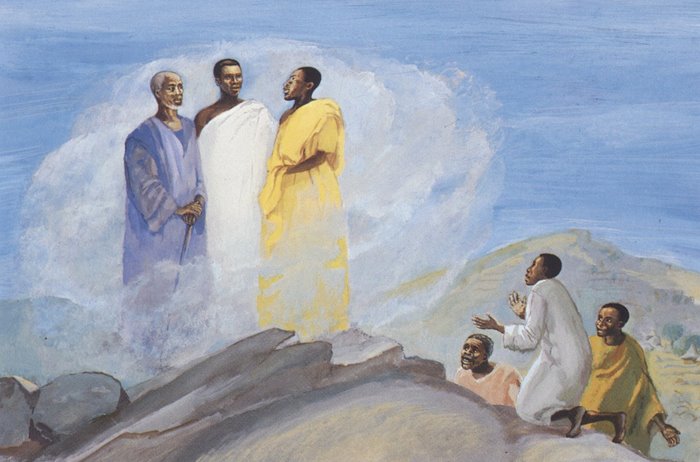
Following is a 1973 painting of the JESUS MAFA project, a response to New Testament readings from the Lectionary by a Christian community in Cameroon, Africa. Each of the readings was selected and adapted to dramatic interpretation by the community members. Photographs of their interpretations were made, and these were then transcribed to paintings:
In this theatrical representation of Jesus’ transfiguration, Jesus is robed in a dazzling white garment, as the story in the gospels describes. He appears to be greeting Moses and Elijah like old friends as they are surrounded by a cloud that makes the whole scene feel ethereal. Peter, James, and John look on with flabbergasted and fearful expressions, bewildered at what they should do. This painting invites the viewer to imagine what it would be like to have seen such amazing things. Undoubtedly, it would inspire one to follow and obey Jesus, just as God commands in the story: “This is my son, the beloved. Listen to him!”
From Art in the Christian Tradition, a project of the Vanderbilt Divinity Library, Nashville, TN. Image retrieved March 23, 2026. Original source: librairie-emmanuel.fr.
Following are a number of back-translations of Mark 9:3:
Uma: “His clothes became all shining white, there isn’t anyone in the world who can launder as white as that.” (Source: Uma Back Translation)
Yakan: “His clothes really shone and were very white. There is no person here in the world who can make clothes white like the whiteness of his clothes.” (Source: Yakan Back Translation)
Western Bukidnon Manobo: “His shirt was like the full moon because it was very white. There is nothing washed white here on the earth that could compare with it.” (Source: Western Bukidnon Manobo Back Translation)
Kankanaey: “and his clothes became-extremely-white becoming-dazzling. Its whiteness, nothing can-equal-it on earth.” (Source: Kankanaey Back Translation)
Tagbanwa: “His clothes gleamed very-white like just-broken waves, which really couldn’t be equalled by any bleacher of cloth here in the world.” (Source: Tagbanwa Back Translation)



Leave a Reply
You must be logged in to post a comment.