Following are a number of back-translations of Luke 22:56:
Noongar: “When one serving woman saw him sitting close to the fire, she looked straight at him and said, ‘This man also accompanied Jesus!’ ” (Source: Warda-Kwabba Luke-Ang)
Uma: “A female working in the house of the High Priest saw Petrus while he was warming-himself-by-the-fire. She recognized him and she said: ‘That person is a companion of Yesus!'” (Source: Uma Back Translation)
Yakan: “Then he was seen by one of the servant girls while he was sitting in the light of the fire. The girl stared at him and she said, ‘This person is also a companion of Isa.'” (Source: Yakan Back Translation)
Western Bukidnon Manobo: “And there was there a woman servant and she saw Peter warming himself, and she looked carefully at Peter and she said, ‘Even that man is a companion of the one they have arrested.'” (Source: Western Bukidnon Manobo Back Translation)
Kankanaey: “A young-lady servant saw him because he was lit-up by the fire, and she looked-closely at him saying, ‘This man, he was definitely one of his companions.'” (Source: Kankanaey Back Translation)
Tagbanwa: “One of the servant girls saw Pedro warming-himself-by-the-fire. When she saw him, she scrutinized him well and said, ‘This fellow is a companion of that Jesus.'” (Source: Tagbanwa Back Translation)
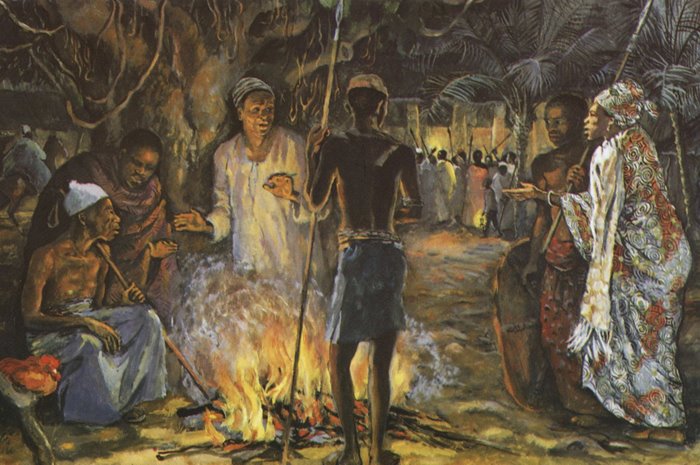
Following is a 1973 painting of the JESUS MAFA project, a response to New Testament readings from the Lectionary by a Christian community in Cameroon, Africa. Each of the readings was selected and adapted to dramatic interpretation by the community members. Photographs of their interpretations were made, and these were then transcribed to paintings:
From Art in the Christian Tradition, a project of the Vanderbilt Divinity Library, Nashville, TN. Image retrieved March 23, 2026. Original source: librairie-emmanuel.fr.
Barclay Newman, a translator on the teams for both the Good News Bible and the Contemporary English Version, translated passages of the New Testament into English and published them in 2014, “in a publication brief enough to be non-threatening, yet long enough to be taken seriously, and interesting enough to appeal to believers and un-believers alike.” The following is the translation of Luke 22:54-65:
Peter kept his distance after Jesus was arrested
and led away to the house of the high priest.
Some people were sitting around a fire
in the courtyard of the house, and Peter joined them.
“This man was with Jesus!” blurted out a servant girl.
“I don’t even know the guy!” insisted Peter.
“You’re one of them!” someone said with a smirk.
“Not me!” denied Peter.
An hour or so later, another man swore,
“This man was with Jesus—they’re both from Galilee.”
“I don’t know what you’re talking about!”
came Peter’s denial.
At that very moment, while Peter was still speaking,
he heard the sound of a rooster crowing.
The Lord looked in Peter’s direction,
and Peter remembered those solemn words,
“Before a rooster crows tomorrow morning,
you’ll say three times you don’t even know me.”
Peter left and wept bitterly.
Meanwhile, the guards insulted and struck Jesus.
They put a blindfold on him and sneered as they said,
“Tell us who hit you?”
And this was not the worst they did to him.
Living Water is produced for the Bible translation movement in association with Lutheran Bible Translators. Lyrics derived from the ESV® Bible (The Holy Bible, English Standard Version®).
idousa de auton … kathēmenon pros to phōs ‘when (she) saw him … sitting by the light.’ pros to phōs may mean ‘in the firelight,’ or ‘by the fire,’ preferably the former. It is best understood as going with kathēmenon.
paidiskē tis ‘a servant-maid.’ For paidiskē cf. on 12.45. tis has approximately the function of the indefinite article.
kai atenisasa autō eipen ‘she stared at him and said.’ Though both idousa and atenisasa are particles in the aorist and syntactically co-ordinate, the latter goes more closely with the main verb eipen. For atenizō cf. on 4.20.
kai houtos sun autō ēn ‘this man was with him too,’ implying that Jesus was usually accompanied by a group of people. sun autō ‘with him’ may refer to a specific occasion or to a more general relationship between Jesus and Peter, preferably the latter.
Translation:
Then a maid, seeing him as he sat … Reasons of focus or transition may make preferable a transposition, e.g. ‘while he was sitting there…, a maid saw him’ (Bahasa Indonesia KB), or, ‘there was a maid there, who (or, she) saw him sitting….’ Cf. also on 5.27. — Maid can usually be rendered by a word for ‘servant’ (cf. on 12.37) or ‘slave’ (cf. on 7.2) with indication of female sex. In some languages the term employed refers to a job that is characteristic in the society for female slaves, e.g. ‘grinder’ (Totontepec Mixe).
In the light, preferably, ‘in the firelight,’ ‘shone-upon by the fire’ (cf. Toraja-Sa’dan).
Gazing at him. The preceding “seeing” referred to initial perception, here “gazing” (see on “fixed” in 4.20) indicates further, more accurate observation.
This man was with him, or, ‘with Jesus,’ or, ‘this man also was one of his companions, or, of Jesus’ followers.’ Languages with evidential aspect pose a problem here. Thus in Huli the translator must decide whether he will use the speculative aspect, expressing that the slave’s statement is based on a supposition, or the factual aspect, indicating that her statement is founded on what she saw herself. If one chooses the latter, as seems preferable, a second decision must be taken, i.e. between remote or near past, indicating respectively that the seeing has happened before, or, on the day of speaking, preferably the former.
Quoted with permission from Reiling, J. and Swellengrebel, J.L. A Handbook on the Gospel of Luke. (UBS Handbook Series). New York: UBS, 1971. For this and other handbooks for translators see here . Make sure to also consult the Handbook on the Gospel of Mark for parallel or similar verses.
A servant girl saw him seated in the firelight: This clause indicates that the servant woman saw Peter as he sat by the fire. She could see him because of the light from the fire. The Greek word that the Berean Standard Bible translates as firelight is literally “light,” as in the Revised Standard Version. The Berean Standard Bible translates it as firelight to indicate that the light was coming from the fire.
Some other ways to translate the phrase are:
Then a maid, seeing him as he sat in the light (Revised Standard Version) -or-
A servant girl noticed him in the firelight (New Living Translation (2004))
A servant girl: The servant girl was probably a mature woman. Peter called her “woman” in 22:57. The text does not specify how old she was. Other ways to translate this are:
one of the servant women (Good News Translation) -or-
A female servant (God’s Word)
22:56b–c
and looked intently at him…she said: This phrase is literally “and looking intently at him, she said.” The Berean Standard Bible places the words she said after what the woman said in 22:56c. However, in some languages, it may be necessary to place these words where it is in the Greek, at the end of 22:56b. For example:
She looked closely at him and said… (New International Version)
and looked intently at him: The Greek phrase that the Berean Standard Bible translates as and looked intently at him indicates that the female servant looked at him carefully. The context implies that she wanted to be sure that she recognized him as a person who had been with Jesus in the garden. Some other ways to translate the phrase are:
Then after she had looked at him carefully (Contemporary English Version) -or-
looking intently at him (New American Standard Bible) -or-
She stared at him (God’s Word)
she said: Notice that the servant girl was speaking to the other people around the fire. She was talking about Peter, rather than to him. In some languages it may be necessary to make this clear. For example:
she said ⌊to the people sitting there⌋ -or-
she said ⌊about Peter⌋
This man also was with Him: The Greek clause that the Berean Standard Bible translates as This man also was with Him includes a word that means also or “indeed, certainly.” In this context the word may imply that the servant girl had seen one or more other disciples with Jesus in addition to Peter. She may have seen the apostle John, since he went to the high priest’s house with Peter, as John 18:15 says. The woman’s statement was probably an emphatic exclamation.
Some ways to translate the clause are:
This man too was with Jesus! (Good News Translation) -or-
That man was certainly one of Jesus’ followers! -or-
This man, he was definitely one of his companions.
In some languages a word like also may be confusing here, since no one else is mentioned in the context. If that is true in your language, you may omit it. For example:

Leave a Reply
You must be logged in to post a comment.