Hand colored stencil print on washi by Sadao Watanabe (1984).
Image taken with permission from the SadaoHanga Catalogue where you can find many more images and information about Sadao Watanabe. For other images of Sadao Watanabe art works in TIPs, see here.
Image taken from He Qi Art . For purchasing prints of this and other artworks by He Qi go to heqiart.com . For other images of He Qi art works in TIPs, see here.
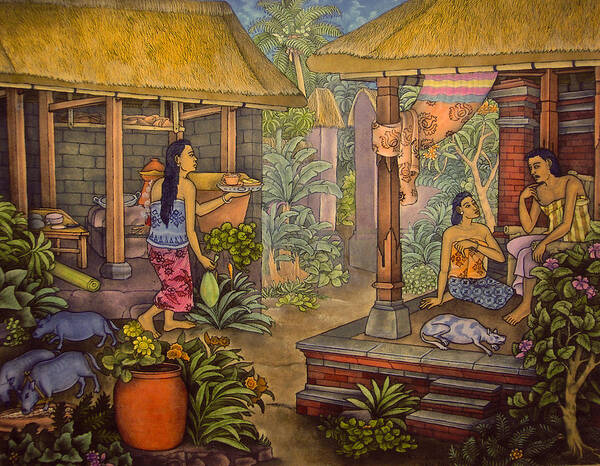
Following is a painting by Ketut Lasia (b. 1945):
Ketut Lasia is one of the last traditional Balinese painters in the Ubud style. As an adult, Lasia converted from Hinduism to Christianity, and he paints primarily biblical scenes. You can find artwork from Ketut Lasia in a variety of formats for sale at Fine Art America .
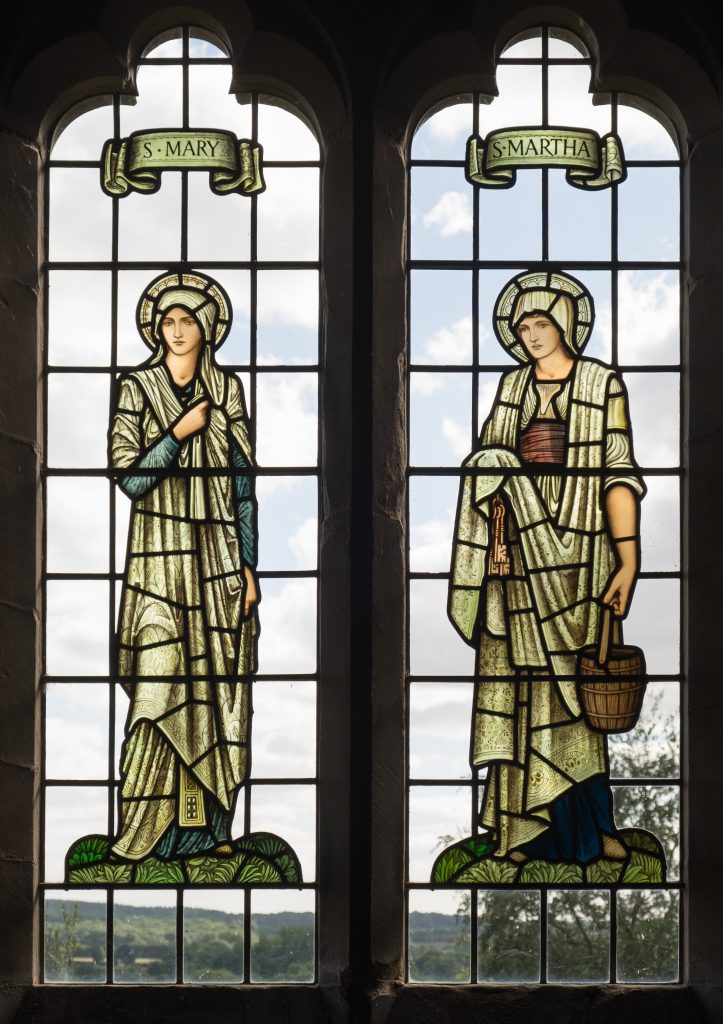
The following is a contemporary stained glass window from All Saints church, Preston Bagot, Warwickshire, England. The windows were designed by Edward Burne-Jones and made by Morris & Co, Birmingham:
Photo by DeFacto, hosted by Wikimedia Commons , Creative Commons Attribution-Share Alike 4.0 International
Stained glass is not just highly decorative, it’s a medium which has been used to express important religious messages for centuries. Literacy was not widespread in the medieval and Renaissance periods and the Church used stained glass and other artworks to teach the central beliefs of Christianity. In Gothic churches, the windows were filled with extensive narrative scenes in stained glass — like huge and colorful picture storybooks — in which worshipers could ‘read’ the stories of Christ and the saints and learn what was required for their religious salvation. (Source: Victoria and Albert Museum )
The Greek that is transliterated as “Mary (of Bethany)” in English is translated in Spanish Sign Language with a signs for “woman” and “listen,” referring to Luke 10:39. (Source: Steve Parkhurst)
Following are a number of back-translations of Luke 10:42:
Noongar: “But you need only one thing. Mary desires the best thing. We must not take that away from her.” (Source: Warda-Kwabba Luke-Ang)
Uma: “But really, what you need to do is just one-kind, that is to hear the Word of God. As for Maria, she has chosen the good portion, and that portion will not be taken from her.'” (Source: Uma Back Translation)
Yakan: “Only one thing has great use/value. And Mariyam has chosen this good thing and this will not be taken away from her.'” (Source: Yakan Back Translation)
Western Bukidnon Manobo: “There’s only one thing that is really of great value, and that’s what Mary chose, and this cannot be taken away from her.'” (Source: Western Bukidnon Manobo Back Translation)
Kankanaey: “but only one is necessary to do, and that is the correct-thing that Maria has chosen. It can emphatically not be removed from her.'” (Source: Kankanaey Back Translation)
Tagbanwa: “But only one is really necessary to do. Maria has chosen this which is much the best, that she is listening to my teaching, and this which she has chosen won’t be taken away from her.'” (Source: Tagbanwa Back Translation)
Living Water is produced for the Bible translation movement in association with Lutheran Bible Translators. Lyrics derived from the ESV® Bible (The Holy Bible, English Standard Version®).
Martha, Martha, the repetition lends emphasis, cf. 22.31.
merimnas kai thorubazē peri polla ‘you are anxious and troubled about many things.’
merimnaō ‘to be anxious,’ ‘to be worried,’ ‘to fret.’
thorubazō ‘to be troubled,’ ‘to be agitated.’
(V. 42) henos de estin chreia ‘but one thing is needed.’ For the textual problems see commentaries, esp. Klostermann. Nestle reads oligōn de estin chreia ē henos ‘but a few things are needed, or rather one.’ This one thing is, in the present situation, to listen to Jesus, and, in a more general sense, to have faith in him.
Mariam gar tēn agathēn merida exelexato ‘for Mary has chosen the right portion.’ gar implies that this clause illustrates the one thing that is needed.
meris ‘share,’ ‘portion,’ sometimes of the portion one receives at a meal (cf. Plummer and references there), but here rather of the lot which one receives by virtue of divine grace (cf. Acts 8.21 where meris and klēros are used as synonyms).
hētis ouk aphairethēsetai autēs ‘which shall not be taken away from her,’ i.e. in the day of judgment.
Translation:
Martha, Martha. Where repetition of a proper name does not convey the right meaning one will have to find an equivalent form, e.g. ‘you, Martha, you are…,’ or, E Marta (Tboli, expressing the emphasis by the use of a particle requesting close attention); cf. also Phillips‘ “Martha, my dear”.
You are anxious and troubled about many things is rendered in Tzeltal, ‘doing all kinds of things has gone to your heart and you have difficulty because of it’ (cf. v. 40). The two terms reinforce each other and express one idea. Some idiomatic renderings of anxious, or, ‘worried,’ are, ‘eating for oneself one’s heart’ (Shona 1966), ‘black with worry’ (East Nyanja), ‘breaking one’s head’ (Sranan Tongo, cf. also ‘our heads are breaking,’ Cuyono in 2.48), ‘hanging up the heart’ (Bulu), ‘crumbling in one’s abdomen’ (Conob), ‘one’s stomach is rising up’ (Farefare), ‘one’s mind is killing one’ (Navajo). Cf. also on 12.29.
(V. 42) One thing is needful, or, ‘needed,’ or, ‘(only) one thing you need, or, are in want of.’
Mary has chosen the good portion, i.e. has taken for herself the lot of one who expresses her devotion by listening to Jesus rather than that of one who does so by preparing his meal. Better to bring out the contrast one may say, ‘it is M. who has chosen the good part’ (cf. Bible de Jérusalem, similarly Shona 1966). The good portion, or, ‘the right thing’ (An American Translation), ‘what is good’ (Toraja-Sa’dan). Some versions prefer ‘better,’ or, ‘best’ (e.g. New English Bible), since a comparison is implied.
Which shall not be taken away from her, or, ‘that which no one will take from her’ (Tboli); often better co-ordinated, cf. ‘there-is-not who will take (it) from her’ (Pohnpeian, similarly Tzeltal, Zarma).
Quoted with permission from Reiling, J. and Swellengrebel, J.L. A Handbook on the Gospel of Luke. (UBS Handbook Series). New York: UBS, 1971. For this and other handbooks for translators see here . Make sure to also consult the Handbook on the Gospel of Mark for parallel or similar verses.
But only one thing is necessary: There is a textual issue here:
(1) Some Greek texts say: “but ⌊only⌋ one ⌊thing⌋ is needed.” For example:
but only one thing is necessary (Contemporary English Version)
(Berean Standard Bible, New International Version, Good News Translation, Revised Standard Version, NET Bible, King James Version, New American Standard Bible, Revised English Bible, God’s Word, New Living Translation (2004), Contemporary English Version, New Century Version)
(2) Other Greek texts say: “but few ⌊things⌋ are needed, or ⌊only⌋ one.” For example:
and yet few are needed, indeed only one (New Jerusalem Bible)
(New Jerusalem Bible, Phillips’ New Testament in Modern English)
It is recommended that you follow option (1) along with the majority of English versions.
But: In contrast with the “many things” that Martha was worried about in 10:41, 10:42a speaks about “only one thing” being necessary. The Berean Standard Bible indicates this contrast with the word But. Connect these two verses in a way that naturally shows this kind of contrast in your language.
only one thing is necessary: The Greek clause that the Berean Standard Bible translates as only one thing is necessary indicates that only one thing is truly important or necessary in a person’s life. Jesus did not specify here what that thing is. However, the context shows that he was referring to the same thing that Mary chose (10:42b). She chose to listen to what Jesus was teaching about God and his kingdom. Other ways to translate this clause are:
Only one thing is important. (New Century Version) -or-
There is only one thing worth being concerned about. (New Living Translation (2004))
10:42b
Mary has chosen the good portion: The Greek clause that the Berean Standard Bible translates as Mary has chosen the good portion is more literally “Mary has chosen the good part.” This refers to the fact that Mary chose to sit at Jesus’ feet and learn from him. She chose to do this rather than to work hard at providing a nice big meal for him. Learning from Jesus was the more important thing. Other ways to translate this clause are:
Mary has chosen the right thing (Good News Translation) -or-
Mary has chosen what is best (Contemporary English Version)
10:42c
and it will not be taken away from her: The Greek pronoun that the Berean Standard Bible translates as it refers to the good part that Mary had chosen. This good part was to listen to Jesus. That privilege should not be taken away from her.
In some languages it may be necessary to say who would not “take away” from Mary the good thing that she had chosen. Jesus probably meant that neither he nor Martha nor anyone else should take it away. He would not tell Mary to help in the kitchen, and he would not let Martha or anyone else force Mary to leave him. Some other ways to translate this are:
which will/must not be taken away from her ⌊by anyone⌋ (Translator’s Reference Translation) -or-
no one should take it away from her
In some languages it will not be possible to translate this literally, because “listening to Jesus” is not an object that someone can actually take away from a person. In those languages it may be necessary to make the meaning more explicit. For example:
and no one should make her stop ⌊listening to me⌋.




Leave a Reply
You must be logged in to post a comment.