
The woman caught in adultery

He Qi © 2021 All Rights Reserved.

Image taken from He Qi Art . For purchasing prints of this and other artworks by He Qi go to heqiart.com . For other images of He Qi art works in TIPs, see here.

Following is a painting by Kim Ki-chang (1913-2001):

Kim Ki-chang (pen name: Unbo) had been deaf and partially mute since the age of 7. He painted a series of 30 paintings for the “Life of Christ” cycle in 1952 during the Korean War. Kim portrayed Jesus as a seonbi / 선비, or a Joseon Period (1392-1910) gentleman scholar, wearing a gat / 갓 (hat) and dopo / 도포 (robe). For other images of Kim Ki-chang art works in TIPs, see here.

Following is a 1973 painting of the JESUS MAFA project, a response to New Testament readings from the Lectionary by a Christian community in Cameroon, Africa. Each of the readings was selected and adapted to dramatic interpretation by the community members. Photographs of their interpretations were made, and these were then transcribed to paintings:
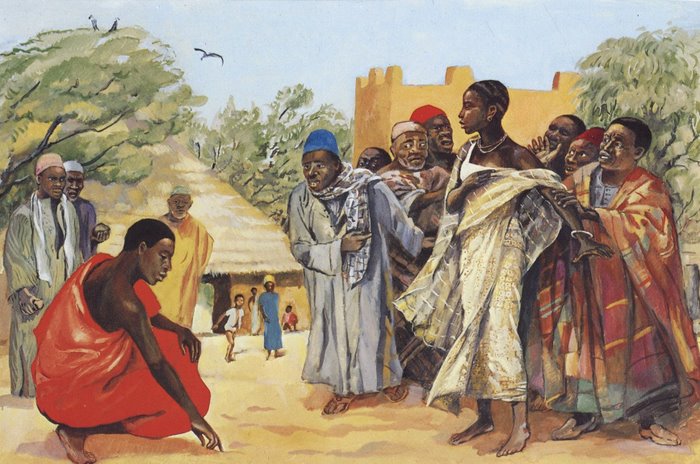
From Art in the Christian Tradition , a project of the Vanderbilt Divinity Library, Nashville, TN. Image retrieved March 23, 2026. Original source: librairie-emmanuel.fr.

Learn more on Bible Odyssey: The Woman Caught in Adultery .

complete verse (John 8:8)

Following are a number of back-translations of John 8:8:

  • Uma: “After that, he stooped down again, and he again wrote in the ground with his finger.” (Source: Uma Back Translation)
  • Yakan: “So-then he bowed down again and wrote again with his forefinger on the ground.” (Source: Yakan Back Translation)
  • Western Bukidnon Manobo: “When Jesus had said this, he squatted down again and he wrote again on the ground.” (Source: Western Bukidnon Manobo Back Translation)
  • Kankanaey: “After-that he again bent-downwards and wrote-with his finger on the soil.” (Source: Kankanaey Back Translation)
  • Tagbanwa: “When he had said that, he stooped down and wrote again on the ground.” (Source: Tagbanwa Back Translation)
  • Tenango Otomi: “He bent down again and wrote on the ground with his finger.” (Source: Tenango Otomi Back Translation)

Honorary "rare" construct denoting God ("continue")

Click or tap here to see the rest of this insight.

Like a number of other East Asian languages, Japanese uses a complex system of honorifics, i.e. a system where a number of different levels of politeness are expressed in language via words, word forms or grammatical constructs. These can range from addressing someone or referring to someone with contempt (very informal) to expressing the highest level of reference (as used in addressing or referring to God) or any number of levels in-between.

One way Japanese shows different degree of politeness is through the usage of an honorific construction where the morpheme rare (られ) is affixed on the verb as shown here in the widely-used Japanese Shinkaiyaku (新改訳) Bible of 2017. This is particularly done with verbs that have God as the agent to show a deep sense of reverence. Here, tsuzuke-rare-ru (続けられる) or “continue” is used.

(Source: S. E. Doi, see also S. E. Doi in Journal of Translation, 18/2022, p. 37ff. )

Translation commentary on John 8:8

At least one ancient scribe was not satisfied with the Greek text as it came to him, and so added the words “the sins of each one of them,” to explain what Jesus wrote on the ground. This phrase should not of course be included in the translation, since it is not a part of the original text.

Quoted with permission from Newman, Barclay M. and Nida, Eugene A. A Handbook on the Gospel of John. (UBS Handbook Series). New York: UBS, 1980. For this and other handbooks for translators see here .

SIL Translator’s Notes on John 8:8

8:8

And again He bent down and wrote on the ground: The conjunction that the Berean Standard Bible translates as And here introduces the next event in the story, which is similar to 8:6c. In some languages it may be natural to follow the New International Version and leave it implicit. Or it may be natural to use another word to indicate the next event. For example:

Then once again he bent down and wrote on the ground. (Revised English Bible)

© 2020 by SIL International®
Made available under the terms of a Creative Commons Attribution-ShareAlike 4.0 License (CC BY-SA) creativecommons.org/licenses/by-sa/4.0.
All Scripture quotations in this publication, unless otherwise indicated, are from The Holy Bible, Berean Standard Bible.
BSB is produced in cooperation with Bible Hub, Discovery Bible, OpenBible.com, and the Berean Bible Translation Committee.