
The Greek in John 4:28 that is translated as “left her water-jar” or similar in English is translated in Dagbani very explicitly as “left her water-jar standing.” Without the addition of “standing,” the phrase might indicate forgetfulness. (Source: André Wilson in The Bible Translator 1972, p. 135ff. )
complete verse (John 4:28)
Following are a number of back-translations of John 4:28:
- Uma: “From there, that woman left her water-fetching-container behind there, went right to the village and said to her fellow-townspeople:” (Source: Uma Back Translation)
- Yakan: “So-then the woman left her jar for putting in water and went back to the town. When she arrived there she talked to the people there.” (Source: Yakan Back Translation)
- Western Bukidnon Manobo: “And then the woman left behind her water vessel, and she returned to the village. She told the people, she said,” (Source: Western Bukidnon Manobo Back Translation)
- Kankanaey: “That being so, the woman abruptly-set-down what she had used-to-get-water and immediately-returned to the town. She said to the people who were there,” (Source: Kankanaey Back Translation)
- Tagbanwa: “What that woman did was, she left her drawing-vessel behind and went to the town. She told the people,” (Source: Tagbanwa Back Translation)
- Tenango Otomi: “The woman left behind her jar and went to the town. She told her fellow-inhabitants.” (Source: Tenango Otomi Back Translation)
He deliberately took time to draw near to social outcasts (image)

“Jesus is dressed in a different style of clothing than the style of the woman who is shown as a Lanna Thai northerner. It is unusual for him to talk to a person from a different region, especially a woman. The clothes, the roof of the house in the background, and the dipper for water all indicate that this is in northern Thailand.”
Drawing by Sawai Chinnawong who employs northern and central Thailand’s popular distinctive artistic style originally used to depict Buddhist moral principles and other religious themes; explanation by Paul DeNeui. From That Man Who Came to Save Us by Sawai Chinnawong and Paul H. DeNeui, William Carey Library, 2010. . For more images by Sawai Chinnawong in TIPs see here.
See also The woman at the well (image).
Learn more on Bible Odyssey: Woman at the Well .
The woman at the well
Following is a painting in the Hamzanama style:

The woman at the well, 2017-2018, Paul Abraham with Manish Soni, Opaque watercolour and natural pigments on hand-made paper, © Sarmaya Arts Foundation. (2018.33.5)
Following is a painting by Ketut Lasia (b. 1945):

Ketut Lasia is one of the last traditional Balinese painters in the Ubud style. As an adult, Lasia converted from Hinduism to Christianity, and he paints primarily biblical scenes. You can find artwork from Ketut Lasia in a variety of formats for sale at Fine Art America .
See also He deliberately took time to draw near to social outcasts (image).
The following artwork is part of a series of 56 paintings on biblical themes by Kazakh artist Nelly Bube (born 1949):
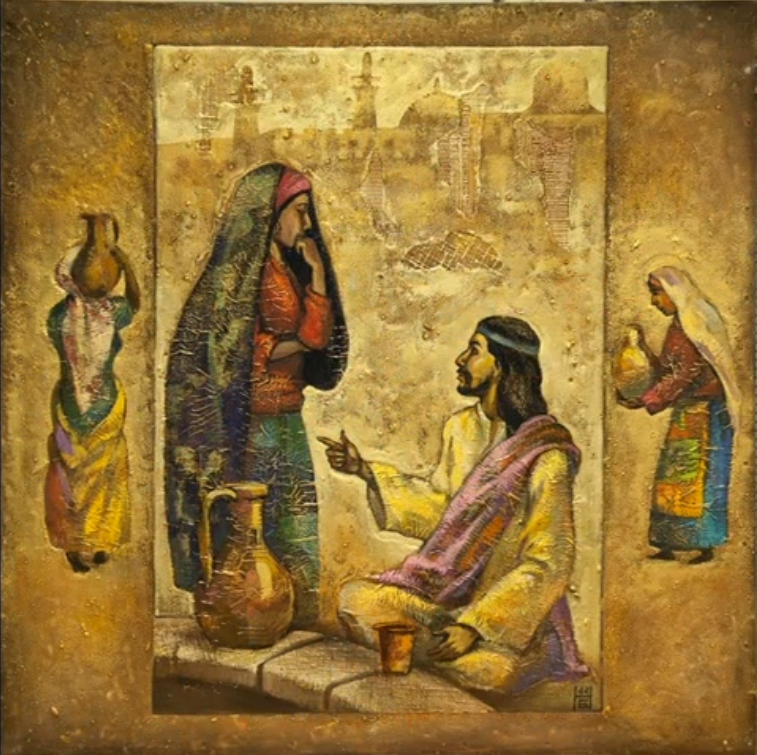
Copyright by Norwegian Bible Society , used with permission.
For other images of Nelly Bube in TIPs, see here.
Translation commentary on John 4:28
To the people is literally “to the men,” but all translations agree that “men” is here used in a generic sense.
Quoted with permission from Newman, Barclay M. and Nida, Eugene A. A Handbook on the Gospel of John. (UBS Handbook Series). New York: UBS, 1980. For this and other handbooks for translators see here .
SIL Translator’s Notes on John 4:28
4:28
Then: The Greek word that the Berean Standard Bible translates as Then is more literally “therefore” or “so.” Here it introduces what the woman did next as a result of her conversation with Jesus.
the woman left her water jar: The woman left her water jar at the well. Perhaps she wanted to hurry, or forgot it, or perhaps she did not want to bring it back again to get water.
The water jar was made of clay that someone baked to become dry and hard. Here are other ways to translate this jar:
water pot
-or-
water vessel
went back into the town: The woman went back to the town where she lived. The town’s name was Sychar. See the note on 4:5a.
the people: This refers to the people in Sychar, the town’s people.
© 2020 by SIL International®
Made available under the terms of a Creative Commons Attribution-ShareAlike 4.0 License (CC BY-SA) creativecommons.org/licenses/by-sa/4.0.
All Scripture quotations in this publication, unless otherwise indicated, are from The Holy Bible, Berean Standard Bible.
BSB is produced in cooperation with Bible Hub, Discovery Bible, OpenBible.com, and the Berean Bible Translation Committee.
Leave a Reply
You must be logged in to post a comment.