Owls are found worldwide except in the Antarctic and on some islands. They are active at night and are characterized by flat faces and short hooked beaks that they can open very wide. They swallow their prey whole and later regurgitate the undigested parts as small balls. They also have the ability to turn their heads more than 180 degrees.
There are two basic owl families, both of which are found in the land of Israel. One family is the Tytonidae, which are the Barn and Grass Owls. They have heart-shaped whitish faces, usually outlined by a dark line, and small dark eyes. The other family is the Strigidae, the typical owls. This family contains a large variety of species, all of which have large eyes that may vary in color from light brown through orange to yellow. This family includes the eared or horned owls, the fairly rare fishing owls, and owls that vary in size from the midget scops owl (less than 20 centimeters [8 inches]) through to the giant eagle owl (over 70 centimeters [28 inches]).
Eight species of owl are fairly common in the land of Israel. Most are very seldom seen by humans, but they are quite well known by their different and distinct calls. In biblical times the nights would have been much quieter than in most modern places, and the strange night sounds probably would have interested people, causing some speculation about what was making the sound. The different owls would thus probably have had different names even if people had never seen them. In fact it is unlikely that they would have been able to associate most of the calls with the owls that were seen.
Some commentators associate the word lilith with a female demon referred to in Babylonian legends. However, even if this is accepted, it is likely that this demon was also associated with some type of night bird. In many Middle Eastern cultures, demons and monsters have been identified with owls, probably as the result of their strange sounds at night.
In modern Hebrew lilith is the name of the tawny owl. Some Bedouin say that the trilled call of another owl, the Scops Owl Otus scops (one of the most common owls in Israel), is the hooting of a female demon quietly rejoicing that she has found prey. The root of this name is similar to the Hebrew word for “night” but is actually a Babylonian word. It is also similar to the way some modern Palestinians describe the sound of hooting.
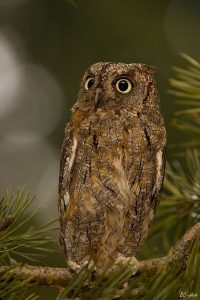
The scops owl is a tiny eared owl that is a mottled gray in color. By day it perches close to the trunk of a tree, where its mottled coloring blends in with the tree bark, making the owl look like the stump of a broken branch. It has a soft, trilled call.
It is associated with doom, destruction, and demons.
An expression, such as “owl demon” or “owl witch”, is probably the best solution. In sub-Saharan Africa, where the scops owl is well known, the local name plus a word for demon or witch can be used.
The word tsavu‘a occurs only twice in the Bible one of them being in the phrase ‘ayit tsavu‘a (Jeremiah 12:9). The word ‘ayit is usually taken to mean a screamer and in Genesis 15:11 it is obviously a bird hence the interpretation “bird of prey.” tsavu‘a is taken to mean “speckled blotched”. Thus the “speckled screamer” is taken by some scholars to mean “speckled bird of prey” and by others to mean “hyena.” However, there are also scholars who relate ‘ayit to a different Hebrew root that means “to attack greedily” and take ‘ayit to mean “prey” or even “carrion”. These latter scholars interpret ‘ayit tsavu‘a to mean “prey for hyenas” or “carrion for hyenas.” It is recommended that this exegesis be followed. Another possible rendering of the phrase could even be a place of scavenging hyenas.
There is considerable doubt about the meaning of the Hebrew word tsiyim and different translations have marmots, wild animals, wild cats, desert animals and even sharks and dolphins. It is clear that the word refers to a specific dangerous wild animal (possibly which lives in the desert) often associated with destruction and with jackals. Although not mentioned at all in the English versions there are many scholars zoologists among them who interpret this word as referring to the hyena.
The uncertainty surrounding the word relates to the fact that nobody is sure what other Hebrew words tsiyim is related to. Some relate it to a word for “desert”, thus “desert creature”. This interpretation does not exclude the hyena and in fact since the references seem to be to a specific animal rather than to desert animals in general the contexts would all fit “hyena” well. The trend among scholars today is to associate it with a word that disappeared early from Hebrew meaning “to wail or yelp”. The fairly obvious conclusion from this would be that the word means “the wailer”, that is the hyena.
The Striped Hyena Hyaena hyaena has been a very well-known and common animal in the Middle East since time immemorial. One would expect to find references to it in the Bible.
Hyenas emerge at night from holes and hollows under logs. They are best known as scavengers. They eat carcasses and bones of all kinds and forage in refuse dumps around cities, towns, and villages. However, they also hunt and are opportunistic, killing young goats, sheep, and baby gazelles. They often occupy abandoned houses or tombs.
Their weird calls at night vary from loud whoops and howls when they mark territory and contact family members to moans when they chase away rival scavengers and to yelps and wails when they are frightened away by humans or other predators.
The striped hyena is also found in northeast Africa the Arabian Peninsula and India. Like all hyena species it looks like a big dog with a large head. Its front legs are longer than its back legs and it has a stiff upright mane that stretches from between its ears all the way down its back to the end of its tail. It is a brownish gray color with dark indistinct stripes that become spots and blotches on its neck.
Since we cannot be one hundred percent sure that tsiyim refers to hyenas neither can we be sure of the connotations of the word. However from what is known about hyenas and their significance to other Semitic peoples we can draw some conclusions. As scavengers that eat carcasses hyenas thrive in times of famine or war. They are thus associated with both types of catastrophe. Their weird noises at night are often associated with demons and stories abound of ghosts that return in the form of hyenas. And finally probably because they are known to eat human corpses that have not been properly buried most people view them with repugnance. Anywhere in the Middle East to call someone a hyena is a terrible insult.
A different, but very similar species of hyena, the Spotted Hyena Crocuta crocuta, is found throughout eastern, central, and southern Africa. Another species, the Brown Hyena Hyaena brunnea, is found in southwestern Africa. In these areas, therefore, a word for hyena will be easy to find.
In areas where some kind of wild scavenging dog or wolf is known, the name for this animal can be used. Elsewhere one may use a phrase like “wild dog” or a transliteration and give a fuller description in the glossary or word list.
Following are a number of back-translations as well as a sample translation for translators of Isaiah 34:14:
Kupsabiny: “Hyenas shall meet there with other animals. Wild goats shall be bleating out there and other animals of the night shall rest/sleep there.” (Source: Kupsabiny Back Translation)
Newari: “wilderness-dwelling animals will settle there along with foxes, wild female goats will call them their friends, Even night animals, having a place to rest, will come there to rest.” (Source: Newari Back Translation)
Hiligaynon: “The wild animals and fierce and untamed dogs will- meet there. The untamed goats there will-call their companions, and the demon that comes-out at night will-go there to rest.” (Source: Hiligaynon Back Translation)
In biblical times and even today there are three species of fox found in Israel and one type of jackal. An additional type of fox was found in Egypt. In the Bible the Hebrew word shu‘al and its Greek equivalent alōpēx refer to any of these animals. These are members of the same animal family which includes the wolf and the dog. The word “jackal” was borrowed from the Arabic jakal which is from the same Semitic root as the Hebrew word shu‘al. In the days of the King James Version the word “jackal” had not yet been introduced into the English language and so in that version “fox” is used throughout for shu‘al.
Click or tap here for the rest of this entry in United Bible Societies’ All Creatures Great and Small: Living things in the Bible
Modern scholars are almost unanimous in agreeing that the word ’iyim (plural of ’iy) is derived from a root meaning “to howl” and that it refers to howling jackals in particular. The word usually occurs in conjunction with the word tsiyim (“hyenas”) which is derived from a root meaning “to wail”. The pair together could justifiably be interpreted as “wild animals wailing and howling.” This is usually taken to refer to hyenas and jackals.
The context will usually indicate which animal is being referred to in a particular passage. It is possible that the fox was known as the small shu‘al and the jackal as the large one.
In early Hebrew the plural form tanin from tan meant a type of snake. This usage is found in Exodus 7:9 et al. The same word was the name of a mythical monster or sea serpent. This usage occurs in Genesis 1:21 et al. However, it is well accepted now that, in later Hebrew, tan is a poetic name for the jackal. It derives from a stem meaning to recite, or lament. In the passages where snakes or the monster tanin is referred to the context usually indicates that it cannot refer to jackals.
Fox: All foxes look like small, long-haired dogs with pointed noses. The Red Fox Vulpes vulpes (also Vulpes flavescens) is now very common all over Europe, North Africa, the Middle East, Central Asia, China, Japan, North America, and Australasia, having been introduced into the latter two continents to be hunted on horseback with packs of dogs. The red fox is a smallish animal, about 1 meter (3 feet) from nose to tip of the tail. It is usually reddish with white underparts and a bushy tail. Red foxes feed mainly on mice and rats but also eat chickens, game birds, and fallen fruit. They may occasionally eat carrion (dead animals), but are not scavengers in the usual sense of the word.
The Desert Fox Vulpes ruppelli and the Egyptian Fox Vulpes nilotica are slightly smaller and yellowish brown, but they are otherwise very similar to the red fox. The Fennec Vulpes zerda is a very small fox with large ears. It is now found in the Middle East and Egypt and was probably found in Israel also in earlier times. It feeds on insects and mice.
Foxes live in pairs, singly or in small family groups when they have young. During the day they live in holes in the ground usually dug by some other animal and come out at night to feed. When chased by dogs they are very clever at escaping, often doubling back on their tracks and then jumping sideways and heading in a new direction, thus confusing the scent trail. They also run up streams and thus avoid laying a scent trail altogether.
Jackal: The jackal found in Israel is the Golden or Oriental Jackal Canis aureus. It is also sometimes referred to as the Indian jackal. This animal is larger than the fox. It is yellowish brown with black tips to the long fur on its back.
Jackals eat almost anything and are great opportunists moving very fast with clever tactics when they have to. They have been known to steal bread from people’s houses and baby animals even from dangerous wild pigs. They are scavengers, eating household rubbish as well as carrion, especially the remains of carcasses killed by lions, but they also eat beetles and birds’ eggs and kill small mammals game birds and domestic chickens and ducks.
In some of the literature there is reference to the fact that jackals live in packs. This is not strictly correct. They live in pairs or small family groups but they may associate temporarily in larger groups when many pairs are attracted to the same burrows, carrion, refuse dumps, or potential prey. In these larger temporary groups they may cooperate and act together like a pack.
Jackals live in burrows made by other animals or in abandoned human houses or shelters and emerge to feed at night. They yap, howl, and wail at great length at the entrance to their burrow, especially on moonlit nights, with one pair triggering a response from neighboring pairs.
Both foxes and jackals are extremely intelligent animals, and their quick-witted, crafty opportunism is legendary in the Middle East, Africa, and Europe. The fables of Aesop, a North African philosopher and storyteller, which feature the crafty fox, date from about the time of Daniel. The fox also figures in Greek and Roman fables. Similar fables about opportunistic jackals have been widespread in Africa and the Middle East for centuries.
In ancient Arabic literature and in the Talmud and Midrash the word “lion” stands for a truly great and powerful person. In contrast “jackal” is used to designate an insignificant but self-important person. Since this figurative usage of “lion” (or “lioness”) is also common in the Bible there is a strong probability that the term “jackal” or “fox” used as a metaphor in the Bible for a person carries the connotation of self-important insignificance.
However the main symbolism associated with the jackal in the Bible is related to its habit of living among ruins and feeding on carcasses. To say that a certain place would become the dwelling place of jackals meant that the place would become deserted and lie in ruins, as the result of war. The jackal was thus a symbol of death and desolation as well as insignificance and opportunistic craftiness.
In areas where jackals are known, but not foxes, the word for jackal can be used for both. Similarly, if foxes are known but not jackals, the one word will suffice. In areas where neither foxes nor jackals are found, there may be related animals such as the Coyote Canis latrans or various types of wild dog or small wolf. In those few areas where even these are not found, one may use an expression such as “wild dog” or a transliteration.
Isaiah 13:21f.: In this verse there are four words for howling wild animals that inhabit deserted buildings: tsiyim, ’ochim, ’iyim, tanim . All except tsiyim probably mean “jackal”; however, to maintain the parallelism of the Hebrew poem, it is better to translate both tsiyim and ’iyim as “hyenas”. These verses will then be translated as:
Wailing hyenas will settle there,
Howling jackals will fill their houses.
Hyenas will wail in their fortresses,
And jackals howl in their luxurious palaces.
The word ’ochim occurs only here in the Bible. It is derived from a Hebrew word meaning “to howl”. “Owls” is a possibility, but “jackals” fits the context better, as it then preserves the parallelism of “jackals” and “hyenas”.
Judges 15:4: Since jackals are easier to trap because they are more easily attracted to baits of meat, most modern translations interpret shu‘al as jackal in this passage.
Nehemiah 4:3: Since the fox is smaller and lighter than the jackal, fox is the preferred interpretation here. The meaning is thus something like “Even if a little fox were to climb on these walls they would collapse.” Where foxes or jackals are not known, an expression for a small dog could be used in this context.
Psalms 63:10: Since the reference is to the enemy soldiers dying in battle and becoming carrion (that is, lying unburied), the interpretation of shu‘al should be “jackals”.
Song of Songs 2:15: This verse is very difficult to interpret. While foxes may occasionally eat fallen grapes, or grapes low down on a vine, they cannot accurately be described as “ruiners of vineyards”. It seems more likely that what is in focus is the fact that for Israelites jackals symbolize ruin.
Jeremiah 51:34 : Although many English versions translate tan in this verse as “dragon” or “serpent”, it seems likely that “jackal” is better; jackals often swallow their food in a great hurry without chewing properly, and then vomit it later when they are under cover and eat it a second time more slowly.
This verse continues the description of the abandoned land of Edom taken over by wild animals. Again, a precise identification of these creatures in not possible (so NJPSV footnote|prj:NJPS.Isa 34.14 for verses 14-15).
And wild beasts shall meet with hyenas: Wild beasts and hyenas gather together. For wild beasts, see 13.21; for hyenas see 13.22. In Hebrew there is alliteration with the words for wild beasts (tsiyyim) and hyenas (ʾiyyim).
The satyr shall cry to his fellow: For satyr see 13.21, where we recommend rendering it as “wild goat.” Good News Translation says “demons” to underline the mythical nature of this creature, which is especially relevant in the context of the next line. The singular form of satyr has a collective meaning here. Cry to his fellow pictures a noisy gathering of these animals. It may be rendered “call to one another.”
Yea, there shall the night hag alight, and find for herself a resting place: The Hebrew particle rendered yea is an emphatic marker. In English it is better rendered “also” or “too” (New Revised Standard Version) here since yea is an archaic word. A night hag is a witch or demon that appears at night. The Hebrew term for night hag is lilith, which is transliterated in New Jerusalem Bible, New American Bible, New Jewish Publication Society’s Tanakh, and Bible en français courant. New Jewish Publication Society’s Tanakh adds a footnote stating that it is “a kind of demon.” New American Bible notes that it is “a female demon thought to roam about the desert.” The Israelites feared many of these imaginary creatures and regarded them with much superstition. They believed these creatures inhabited desert places, often coming out only at night and avoiding human contact. Good News Translation says “night monster” (with a footnote), and Die Bibel im heutigen Deutsch has “night ghosts.” Hope argues that this demon was probably associated with some type of night bird, most likely the scops owl, so he recommends saying “owl demon” or “owl witch.” Revised English Bible is similar with “nightjar,” a bird that flies and feeds at night. The Hebrew verb rendered alight simply refers to something coming to rest. The parallel expression find for herself a resting place is similar in meaning.
Translation examples for this verse are:
• Wild animals and hyenas will gather together,
bush goats will call to one another;
the owl demon will rest there also,
finding a place of repose.
• Wild beasts and hyenas will be there together,
[wild] goats will call to one another;
Lilith the night demon will seek repose there also,
finding a resting place.
Quoted with permission from Ogden, Graham S. and Sterk, Jan. A Handbook on Isaiah. (UBS Helps for Translators). New York: UBS, 2011. For this and other handbooks for translators see here .



.jpg)
_-_cropped.jpg)


Leave a Reply
You must be logged in to post a comment.