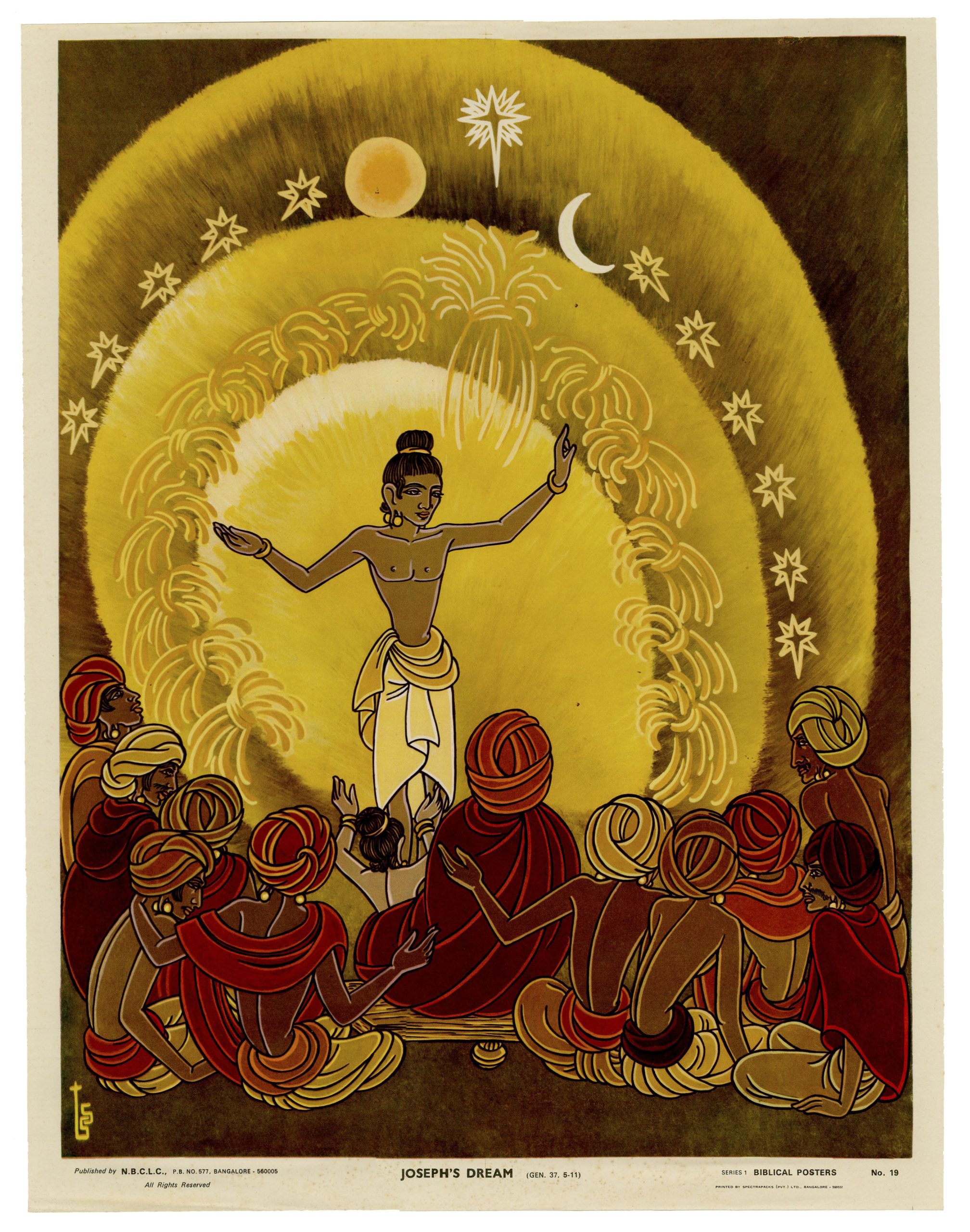
8His brothers said to him, “Are you indeed to reign over us? Are you indeed to have dominion over us?” So they hated him even more because of his dreams and his words.
The Greek and Hebrew that is translated as “brother” in English is translated in Kwere as sekulu, in Elhomwe as mbalaawo´, and in Mandarin Chinese as gēgē (哥哥), all “older brother.”
Note that Kwere also uses lumbu — “older sibling” in some cases. (Source for Kwere and Elhomwe: Pioneer Bible Translators, project-specific translation notes in Paratext; Chinese: Jost Zetzsche)
In Lama it is translated as “older or younger brother.” (Source: Neal Brinneman)
The Greek and Hebrew that is translated in English as “hate” or a form thereof is translated in Tabasco Chontal as “don’t want to see [the person who is hated].” (Source: John Beekman & Harwood Hess in Notes on Translation, March 1963, p. 1ff.)
Many languages distinguish between inclusive and exclusive first-person plural pronouns (“we”). (Click or tap here to see more details)
The inclusive “we” specifically includes the addressee (“you and I and possibly others”), while the exclusive “we” specifically excludes the addressee (“he/she/they and I, but not you”). This grammatical distinction is called “clusivity.” While Semitic languages such as Hebrew or most Indo-European languages such as Greek or English do not make that distinction, translators of languages with that distinction have to make a choice every time they encounter “we” or a form thereof (in English: “we,” “our,” or “us”).
For this verse, both the Jarai translation and the Adamawa Fulfulde translation use the exclusive pronoun (excluding Joseph).
Following are a number of back-translations as well as a sample translation for translators of Genesis 37:8:
Kankanaey: “Upon their hearing that, those brothers of his said, ‘Do you (sing.) say/think that you (sing.) will become a king so-that you (sing.) will rule-over us (excl.)? Oh come on now!’ And they hated him even-more because of that-aforementioned that he had dreamed and what he said about that.” (Source: Kankanaey Back Translation)
Newari: “His elder brothers said to him — ‘What! will you actually be our king? And will you rule over us?’ After that, because of his dream, they hated him even more.” (Source: Newari Back Translation)
Hiligaynon: “His siblings said, ‘What? You (sing.) will-become a king and will-be-a-leader over us (excl.)?’ So they became- even more -angry with Jose.” (Source: Hiligaynon Back Translation)
English: “His brothers said to him, ‘Do you think that some day you will rule over us? Are you saying that some day you are going to be our king?’ They hated him even more than before because of what he had told them about his dream.” (Source: Translation for Translators)
Click or tap here to see the rest of this insight.
Like a number of other East Asian languages, Japanese uses a complex system of honorifics, i.e. a system where a number of different levels of politeness are expressed in language via words, word forms or grammatical constructs. These can range from addressing someone or referring to someone with contempt (very informal) to expressing the highest level of reference (as used in addressing or referring to God) or any number of levels in-between. One way Japanese shows different degree of politeness is through the choice of a second person pronoun (“you” and its various forms) as shown here in the widely-used Japanese Shinkaiyaku (新改訳) Bible of 2017. The most commonly used anata (あなた) is typically used when the speaker is humbly addressing another person.
In these verses, however, omae (おまえ) is used, a cruder second person pronoun, that Jesus for instance chooses when chiding his disciples. (Source: S. E. Doi, see also S. E. Doi in Journal of Translation, 18/2022, p. 37ff. )
Brothers said: the brothers’ questions are rhetorical and sarcastic. In some languages said may need to be rendered “asked him,” if a question form is used (see Good News Translation).
Are you indeed to reign over us?: the Hebrew construction says “Do you become king and rule [same word as king] over us?” For a model translation see Good News Translation. From here to the end of verse 10, the first person plural pronouns are exclusive.
Or are you indeed to have dominion over us?: have dominion translates a general verb meaning to govern or control. New Jerusalem Bible translates “ ‘So you want to be king over us,’ his brothers retorted, ‘you want to lord it over us?’ ” Biblia Dios Habla Hoy has “You mean that you are going to be our king, and that you are going to dominate us?”
So they hated him yet more: this expression is similar to that in Gen 37.5.
For his dreams and for his words: that is, “because of his dreams and for what he told them about his dreams.”
Quoted with permission from Reyburn, William D. and Fry, Euan McG. A Handbook on Genesis. (UBS Helps for Translators). New York: UBS, 1997. For this and other handbooks for translators see here .

Leave a Reply
You must be logged in to post a comment.