Following are a number of back-translations as well as a sample translation for translators of Genesis 13:16:
Kankanaey: “I will also cause-to-become-many your (sing.) descendants like the dust that is not countable.” (Source: Kankanaey Back Translation)
Newari: “I will cause you to have as many descendants as the dust of the earth. Only the one who is able to count the dust of the earth will be able to count the number of your descendants.” (Source: Newari Back Translation)
Hiligaynon: “I will-give you many descendants that their numbers is like dust. The dust can- not -be-counted, so your descendants also can- not -be-counted.” (Source: Hiligaynon Back Translation)
English: “I will cause your descendants to be as numerous as particles of dust! It will be easier to count the particles of dust than it will be to count your descendants.” (Source: Translation for Translators)
Click or tap here to see the rest of this insight.
Like a number of other East Asian languages, Japanese uses a complex system of honorifics, i.e. a system where a number of different levels of politeness are expressed in language via words, word forms or grammatical constructs. These can range from addressing someone or referring to someone with contempt (very informal) to expressing the highest level of reference (as used in addressing or referring to God) or any number of levels in-between.
One way Japanese shows different degree of politeness is through the choice of a first person singular and plural pronoun (“I” and “we” and its various forms) as shown here in the widely-used Japanese Shinkaiyaku (新改訳) Bible of 2017. The most commonly used watashi/watakushi (私) is typically used when the speaker is humble and asking for help. In these verses, where God / Jesus is referring to himself, watashi is also used but instead of the kanji writing system (私) the syllabary hiragana (わたし) is used to distinguish God from others.
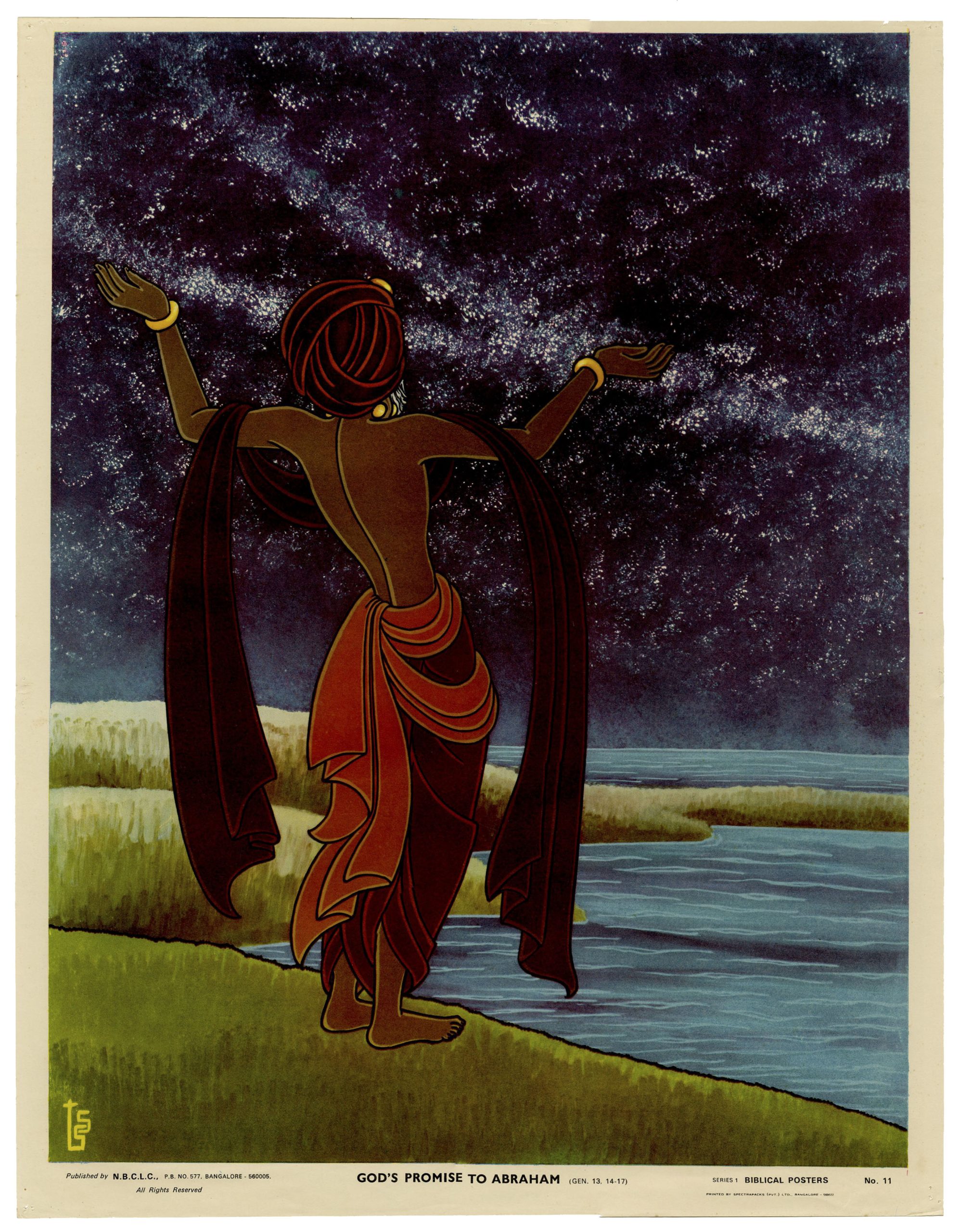
I will make your descendants as the dust of the earth: the comparison with the dust of the earth, as the next clause shows, is in regard to number. Just as the dust of the earth is plentiful, so will Abram’s descendants be. This comparison is doubtless far more vivid in the dry hills of the country around Bethel than in a tropical rain forest. In some languages adjustments will be required to make the nature of the comparison clear. Good News Translation makes the quantity of descendants clear at the beginning: “I am going to give you so many descendants….” We may also say “I will make you the ancestor [father] of a great number of descendants….”
In some languages it is awkward to use dust as the basis for the comparison, since dust may be thought of as a mass. Hence it may be necessary to change dust to some other material of earth origin that cannot be counted. For example, it may be possible to replace dust with grains of sand, clumps of dirt, or pebbles, or to speak of dust in a way that can be counted, such as Good News Translation “specks of dust.” In some languages there are regular idioms for speaking of things that are too many to count, which are based not on the picture of dust but on pictures of other familiar things. Translators may consider whether these regular idioms are suitable for use in translation at this point. In one language, for instance, the idiom is “as many as the hairs on a dog.” As noted in what follows, the point of the comparison has nothing to do with the physical characteristics of dust but with the impossibility of counting its huge number of particles.
If one can count the dust of the earth: this is a condition that cannot be accomplished, since it is not possible to count the dust of the earth because it is too numerous. If it were possible to count all the dust on the earth, your descendants also can be counted, which is to say that, if the counting of dust is impossible, so is the counting of Abram’s descendants. This part of the sentence gives an explanation of the meaning of the comparison in a way that will seem to some people unnecessary and superfluous, since it only repeats what is understood from the picture. Therefore some translators will want to restructure the verse to avoid stating what is obvious; for example, “I will make your offspring so numerous that no one will be able to count them. It would be like someone trying to count the specks of dust on the earth” or “I will make those who come from you very very many, so that nobody can count them. It will be impossible to count them all, just as it is impossible to count the specks of dust.”
On the other hand, if the picture is not perfectly clear in itself, the explanation in the second half of the verse will be essential to make its meaning clear. And some further restructuring may be required here to make the explanation itself clear. For example, we may say “If you can count how many bits of dirt there are on earth, you can also count the number of descendants I will give you” or “Can you count all the pebbles on earth? No. Neither will you be able to count the descendants I will give you.”
Quoted with permission from Reyburn, William D. and Fry, Euan McG. A Handbook on Genesis. (UBS Helps for Translators). New York: UBS, 1997. For this and other handbooks for translators see here .

Leave a Reply
You must be logged in to post a comment.