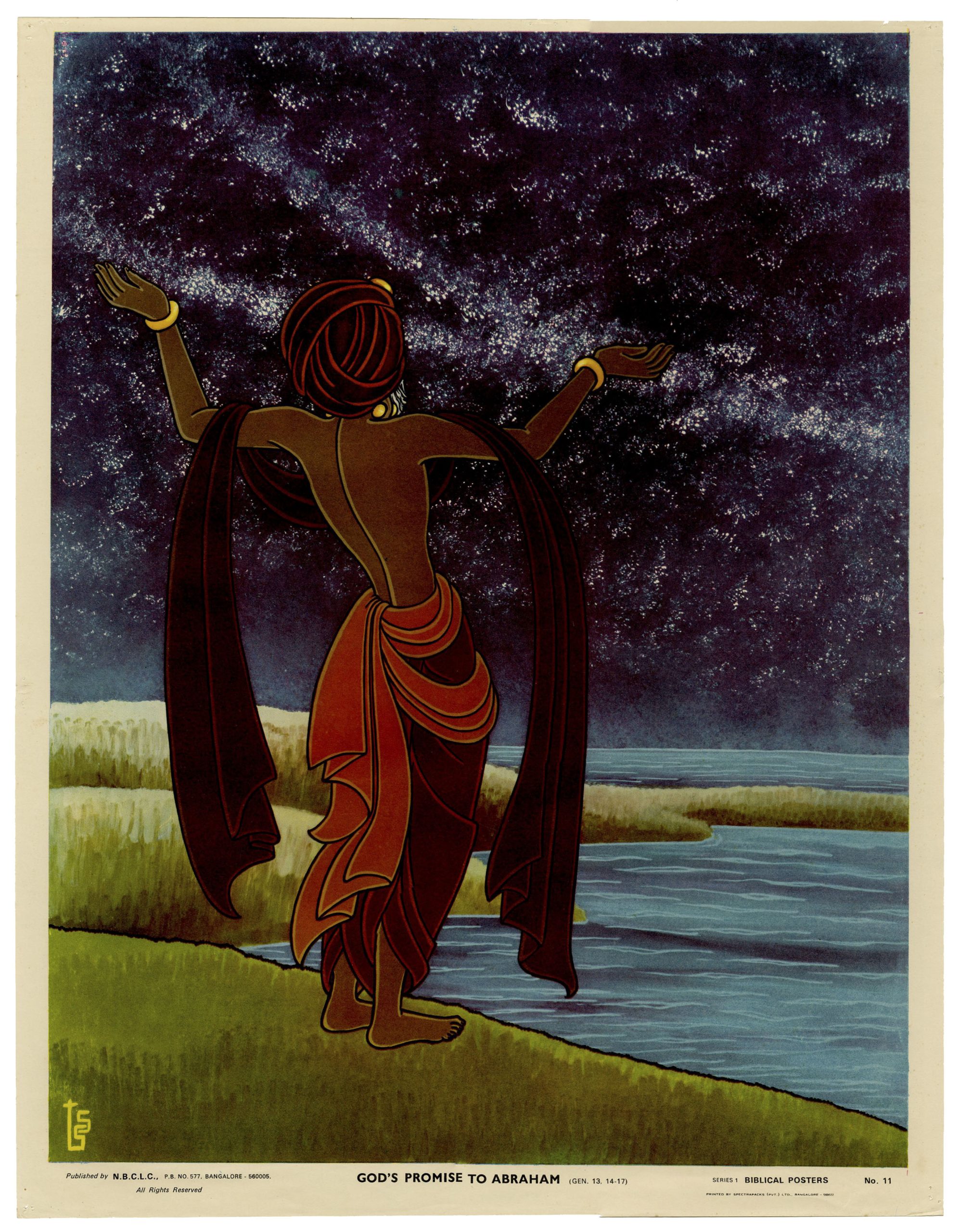
Following are a number of back-translations as well as a sample translation for translators of Genesis 13:15:
Kankanaey: “Because all that you (sing.) are-able-to-see-in-the-distance, I will give to you (sing.) and your (sing.) descendants so-that that will be your (pl.) land forever.” (Source: Kankanaey Back Translation)
Newari: “I will give to you and your descendants as much land as you can see. This will be yours forever.” (Source: Newari Back Translation)
Hiligaynon: “All the land that your view/sight can-reach I will-give to you and to your descendants, and it will-be yours (pl.) forever/[lit. until whenever.]” (Source: Hiligaynon Back Translation)
English: “I will give to you and your descendants all the land that you see; I will give it to you forever.” (Source: Translation for Translators)
Click or tap here to see the rest of this insight.
Like a number of other East Asian languages, Japanese uses a complex system of honorifics, i.e. a system where a number of different levels of politeness are expressed in language via words, word forms or grammatical constructs. These can range from addressing someone or referring to someone with contempt (very informal) to expressing the highest level of reference (as used in addressing or referring to God) or any number of levels in-between.
One way Japanese shows different degree of politeness is through the choice of a first person singular and plural pronoun (“I” and “we” and its various forms) as shown here in the widely-used Japanese Shinkaiyaku (新改訳) Bible of 2017. The most commonly used watashi/watakushi (私) is typically used when the speaker is humble and asking for help. In these verses, where God / Jesus is referring to himself, watashi is also used but instead of the kanji writing system (私) the syllabary hiragana (わたし) is used to distinguish God from others.
For all the land which you see: for in this context introduces a reason. Most English translations do not require anything equivalent to for. In some languages this clause is more appropriately placed after I will give to you and to your descendants for ever, and so we may translate “I will give to you and to your descendants all the land you can see around you, and it will be theirs for ever.” Descendants translates “seed,” a singular noun with collective meaning. For the same usage see comments on 3.15. For ever translates a Hebrew expression that here means an unlimited duration of time in the future, and so “always,” or “forever.”
Quoted with permission from Reyburn, William D. and Fry, Euan McG. A Handbook on Genesis. (UBS Helps for Translators). New York: UBS, 1997. For this and other handbooks for translators see here .

Leave a Reply
You must be logged in to post a comment.