14And God said, “Let there be lights in the dome of the sky to separate the day from the night, and let them be for signs and for seasons and for days and years,
The Hebrew that is translated as “And God said, ‘Let there be…” in English is translated in Yoruba as “God commanded that there should be…” (Bibeli Mimọ Yorùbá, 2010).
Solomon Abegunde explains (in The Bible Translator 1991, p, 242ff. ): “When God speaks, for instance, in the [Yoruban] way of thinking he speaks with the authority of a king. He does not need to ask permission from anybody to do what he wants to do. Translators should be aware of this as they translate the words ‘Let there be’ in Genesis 1. The extension of his personality comes out more forcefully if the Hebrew is rendered ‘Be’ and the verb is translated ‘commanded’ rather than ‘said.'”
The Hebrew and Ge’ez that is translated as “firmament,” “expanse,” or “dome” in English is translated in Roviana as galegalearane: “the open space between the earth and the sky,” in Moru as “empty space” and in Hausa as sararin sama or “space of the sky” (Sabon Rai Don Kowa, publ. 2020).
In Idoma it is translated as okpanco — “the top of the sky.” “According to tradition, when the world began, the okpanco was low. A woman was pounding yams and her pestle kept hitting okpanco and it started going higher and higher.”
In Naskapi it is translated as “sky skin” — “like a caribou skin.”
(Sources: Roviana: Carl Gross; Moru: Jan Sterk; Hausa: Andy Warren-Rothlin; Idoma: Rob Koops; Naskapi: Doug Lockhart in Word Alive 2013 )
In Lingala it is translated as “surface.” Sigurd F. Westberg (in The Bible Translator 1956, p. 117ff. ) explains: “The ‘firmament’ in Genesis 1 gave us another problem. Its meaning in English is certainly not immediately obvious. The dictionary tells us that the Hebrew means something close to our English word ’expanse.’ It seems, however, that the Hebrew idea may not always have been as abstract as that, for Isaiah says that the Lord ‘stretcheth out the heavens as a curtain, and spreadeth them out as a tent to dwell in.’ But the Greek word used in the Septuagint gives the idea of a firm and solid structure, and this is the idea that is carried out in our English word ‘firmament.’ Modern translations into English, Swedish, Norwegian and French take one or the other of these two leads. It is the predicament of the translator that he dare not hesitate too long between ideas. (…) In this case we tried to arrive at ’expanse’ by the use of a word meaning ’width,’ but we found that it is not really understandable except as it is associated with the noun of which it indicates the width. It cannot be used alone. The word we finally used means ‘surface,’ but it also has the idea of something stretched out or smoothed out. It is more concrete than we should like, but it does not require identity with a concrete object as does the word for width’.’
In Newari it is translated as “upper part of water” (Gen. 1:6 is translated “height between two portions of water”) (source: Newari Back Translation), in Bariai as “barrier” (source: Bariai Back Translation), and in Hiligaynon as “division” (source: Hiligaynon Back Translation).
In Tenharim a translation for “firmament” was not deemed possible because there were no overlaps in the world view of the Tenharim speakers and that of the cosmology of Genesis. LaVera Betts (in: Notes on Translation, September 1971, p. 16ff.) explains: “[In their view,] heaven’s edge is curbed and solid. It can become meshed releasing the water above it onto the clouds, which to the Parintintín [the Tenharim speakers] are gathered wind, in order for this water to be dispersed in the form of rain. An entrance, position and description unknown, is available to the occupants of the layers of heaven through which they may pass to the world. To each layer of heaven and heaven as a whole they apply the same word: yvaga.
“The sun, moon, and stars attach to the world’s side of heaven’s edge. The sun and moon have separate paths-the moon making a half revolution and returning, and the sun making a complete revolution. No all-inclusive term for the heavenly bodies, earth, and the expanse between them so far has been encountered in Parintintín. Nor has there been found a suitable term for this expanse alone. During the day the expanse could be called the open/clear space: mytuêa; but at night it disappears into heaven and night takes its place. Its occurrence, then, is contingent on the presence of light and therefore inappropriate for expressing firmament (Genesis 1:6).
“To translate ‘firmament’ as a vault the translator possibly could have used heaven’s edge which, although suiting their world view grandly, poses problems in the translator’s mind especially as to the restricted meaning it would force on the translation for them. That a good shaman is believed to be able to bring heaven down immediately over the earth reveals that to them the expanse over the earth is empty, or compressible and flexible, and the ‘vault’ movable.
“The possible translation of atmosphere for firmament was settled upon and the term used was ‘wind’: yvytua. The phrase ‘and God called the firmament heaven’ was deleted. A possible alternate ‘and God called the place of the wind heaven’ also was not used as Coriolano [the indigenous translator] did not know where the wind went when it is not seen in the form of clouds nor felt; however, he insisted the wind is everlasting — unlike one’s breath which is not lasting. Animates do not breathe air/wind but their hearts pump their own breath.”
See also 1 Meqabyan 27:4 (Ethiopian Maccabees) where it is described as a “sackcloth” in Ge’ez.
1:1 A very, very long time ago, God created the heavens and the earth.
1:2 The earth was not yet formed and contained nothing, it was completely void. Water flowed endlessly and the entire earth was completely dark. God looked over all this. The Spirit of God, [like a bird], hovered over the water.
1:3 God spoke, saying, “Let there be light.” And the darkness became light.
1:4 God looked at the darkness and the light and saw that it was good.
1:5 God called the light ‘Day’ and the darkness ‘Night.’ Evening passed and morning came and that was day one.
1:6 Then God said, “Let there be a great dome to separate the waters above from the waters below.”
1:7 So God made a great dome to keep the waters above separate from the waters below.
1:8 God called the dome above ‘Heaven.’ Evening passed and morning came and that was day two.
1:9 God said, “Let there be dry land.” And the water gathered and dry land appeared.
1:10 God called the dry land ‘earth’ and the waters He called ‘seas.’ God looked at the earth and seas and saw that it was good.
1:11 God said “Let the earth produce plants of every kind. Let the earth grow grass, plants that make grain, and fruit trees. The fruit trees will make fruit with seeds in it. Let these plants grow on the earth.”
1:12 And it happened; the earth produced plants of all different kinds. Grass sprang up abundantly across the land, stalks with grains of all types [corn, rice, wheat, oat], trees of all varieties sprang up yielding fruits of all different kinds [orange, mango, banana, plums, guavas, guinep] everywhere [tomatoes, pineapple, strawberries, watermelon] [of all different sizes and shapes]. These plants sprang over all across the land, reproducing themselves through seeds. God looked over this and saw that it was good.
1:13 Evening passed and morning came and that was day three.
1:14 God spoke to the heavens, “Let there be lights in the sky to separate the day from the night. These lights will indicate the seasons, days and years.
1:15 The lights from heaven will give light to the earth.”
1:16 God made two great lights: the greater [brighter] light to rule the day, and the lesser [dimmed] light to rule the night, along with the stars.
1:17 God placed these lights in the sky to give light to the earth.
1:18 The greater [brighter] light ruled over the day and the lesser [dimmed] light ruled over the night and separated light and darkness. God looked at this and saw that it was good.
1:19 Evening passed and morning came and that was day four.
1:20 God spoke to the waters below and the heavens above, “Let the seas be filled with living creatures and let birds fly above in the heavens.”
1:21 God created huge sea creatures and many different animals swarmed the waters [shrimp, lobster, octopus, turtles, crocodile, whales] the sky was filled with different winged animals of its own kind [great and small- dove, crow, eagle, parrot, hummingbird]. God looked at this and saw that it was good.
1:22 God looked at the heavens and the earth and blessed them, “Be fruitful and multiply and fill the seas, let the birds multiply across the earth.”
1:23 Evening passed and morning came and that was day five.
1:24 God spoke to the earth “Let there be living creatures of different kinds: farm animals [cows, sheep, goat], crawling insects [bugs, worms, snakes], and wild animals of different kind [lion, leopard, elephant, ostrich, kangaroo, alligator]
1:25 So God created all these different types of animals. God looked at this and saw that it was good.
1:26 Then God thought of creating man [human]. Why? To be stewards [responsible] for the earth. To take care of birds in the sky, the animals in the sea and the creatures all over the earth.
1:27 God created man and woman in His own image and likeness.
1:28 God blessed them saying, “Be fruitful and multiply, fill the earth. Let man and woman rule over the earth, over the fishes in the sea and the birds in the sky, and the animals on the land. Be stewards of the earth.”
1:29 God said to the man and the woman, “Look at all the plants and trees, I give you all the plants that bear fruits and grains to eat freely.
1:30 All green grass, grains and fruit trees I give to all the animals, every bird and crawling insect, to eat from freely. Every plant is theirs because they have the breath of life which I have given them.” And they all went ahead and ate freely.
1:31 God looked at all He created and saw that it was good. Evening passed and morning came and that was day six.
Back-translation by Amakedia Wallen, coordinated by Tashi Widmer
The Hebrew and Ge’ez that is translated in English as “light” is translated in Newari as “white light.” (Source: Newari Back Translation)
In Tenharim the translation is mytuêa or “open/clear space.” LaVera Betts (in: Notes on Translation, September 1971, p. 16ff.) explains: “According to Catarina, the chief’s wife, the moon is a woman and the stars, also considered snails, are her children. In Gen 1:14, therefore, ‘the lights in the firmament of heaven’ is translated literally ‘the lamps/illuminating things on the heaven’ to eliminate the idea of the moon, etc. being animate. To express the idea of light (Gen. 1:3), then, without the presence yet of the sun, moon, or stars, the term open/clear space: mytuêa, was used. Neither the heavenly bodies nor artificial lights nor their obvious rays have to be seen in order for this term to be appropriate. It is a term indicating merely the opposite of no light, that is, the opposite of darkness; and since there were no objects to fill in the space, it still is true in the other sense of the term. Other terms meaning light involved the presence of the sun, moon, stars, or artificial lighting.”
In Idoma, the normal word for “light” is “fire,” so ofíajɛ or “shining” was used instead (source: Andy Warren-Rothlin).
The Hebrew in Genesis 1:14 that is translated as “lights in the dome of the sky” or similar in English is translated in Tenharim as “the lamps/illuminating things on the heaven.” LaVera Betts (in: Notes on Translation, September 1971, p. 16ff.) explains: “According to Catarina, the chief’s wife, the moon is a woman and the stars, also considered snails, are her children. In Gen 1:14, therefore, ‘the lights in the firmament of heaven’ is translated literally ‘the lamps/illuminating things on the heaven’ to eliminate the idea of the moon, etc. being animate.”
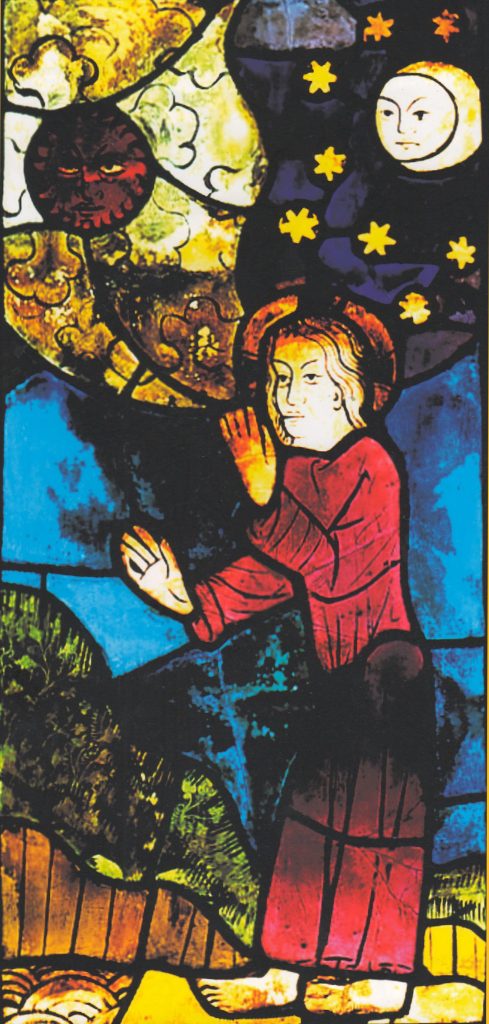
The following is a stained glass window from the Three choir windows in the Marienkirche, Frankfurt (Oder), Germany, of the 14th century, depicting God creating the celestial bodies:
Source: Der gläserne Schatz: Die Bilderbibel der St. Marienkirche in Frankfurt (Oder), Neuer Berlin Verlag, 2005, copyright for this image: Brandenburgisches Landesamt für Denkmalpflege und Archäologisches Landesmuseum
Stained glass is not just highly decorative, it’s a medium which has been used to express important religious messages for centuries. Literacy was not widespread in the medieval and Renaissance periods and the Church used stained glass and other artworks to teach the central beliefs of Christianity. In Gothic churches, the windows were filled with extensive narrative scenes in stained glass — like huge and colorful picture storybooks — in which worshipers could ‘read’ the stories of Christ and the saints and learn what was required for their religious salvation. (Source: Victoria and Albert Museum )



Leave a Reply
You must be logged in to post a comment.