And the dogs began to devour the sheep, and the wild boars and the foxes were devouring them, until the Lord of the sheep raised up a ram from among the sheep, which led them.
Enoch (also: 1 Enoch) is canonical scripture for the Ethiopian Orthodox Tewahedo Church and Eritrean Orthodox Tewahedo Church. The only complete copy of an early version of Enoch is available in Ge’ez (Classical Ethiopic), here used with permission by the Bible Society of Ethiopia.
The Greek, Ge’ez, and Hebrew that is translated as “fox” in English is translated in Mam as “weasel.” Ron Ross explains: “Foxes is often a difficult concept to express in this part of the world. The Mayas don’t seem to know them. In the Mam project we finally put ‘weasel’ rather than ‘coyote,’ which were basically our choices.”
In Toraja-Sa’dan it is translated as sindallung or “civet cat.” H. van der Veen (in The Bible Translator 1950, p. 21 ff. ) explains: “This animal is a real chicken thief, and is a type of cat with a head resembling that of a fox.”
In Noongar, it is translated as mokiny or “dingo” (in Luke 9:58) (source: Warda-Kwabba Luke-Ang) and in Newari as “small jackal” (source: Newari Back Translation).
In Sümi Naga, the replacement of “fox” with “dog” was cited in 2026 as one of the reasons for the rejection of a new “Easy-to-Read” Bible in that language (see this article ).
“Sheep are known throughout most of the world, even though, as in Central Africa, they are a far cry from the fleecy wool-producing animals of colder climates. Where such animals are known, even by seemingly strange names, e.g. ‘cotton deer’ (Yucateco) or ‘woolly goat’ (Inupiaq), such names should be used. In some instances, one may wish to borrow a name and use a classifier, e.g. ‘an animal called sheep.’ In still other instances translators have used ‘animal which produces wool’, for though people are not acquainted with the animals they are familiar with wool.” (Source: Bratcher / Nida)
In Dëne Súline, it is usually translated as “an evil little caribou.” To avoid the negative connotation, a loan word from the neighboring South Slavey was used. (Source: NCEM, p. 70)
Note that the often-alleged Inuktitut translation of “sheep” with “seal” is an urban myth (source Nida 1947, p. 136).
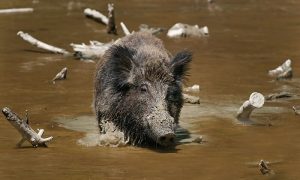
There is general agreement about the meaning of the Latin word aper. The animal referred to is the European Wild Boar Sus scrofa, which was once plentiful in forested areas of Europe and the Middle East from the Atlantic Coast to as far east as the Tian Shan Range in China.
Although wild boars are the ancestors of domestic pigs, they are much more active and robust animals. They are taller, almost a meter (3 feet) at the shoulder, and much more hairy all over. Their underside is covered in hairs longer than those on the rest of their body. Their color varies from gray to black. Adult males have short tusks that are used both for digging and for protection. They have flat mobile snouts that are also used for digging. The piglets, up to twelve in a litter, are covered with dark stripes and spots running from head to tail. The adults are extremely protective of the younger animals and are fearlessly aggressive. This makes them very dangerous animals. Wild boars are omnivorous, eating mainly roots, but also eating grass, leaves, insects, and small animals and birds. They need to live close to water, as they rely on the cooling effects of wallowing in mud to regulate their body temperature. In Israel they were found in the Huleh swamps, and even now they can be found in the Jordan Valley and in some remote wadis.
Like domestic pigs wild boars are considered by Jews to be unclean. They are also associated with ferocity and aggressiveness. In Egypt Assyria Babylonia and later in Persia Greece and Rome the boar’s head was a common symbol of military might.
Wild pigs similar to Sus scrofa are found in Africa and Asia. They include the Giant Forest Hog Hylochoerus meinertzerhageni of the equatorial regions of Africa; the Bush Pig Potamochaerus porcus, found in the savannah areas of sub-Saharan Africa; and the Crested Wild Boar (Soor) Sus cristatus, found on the Indian subcontinent, and in Myanmar, Thailand, Laos, and southwestern China. All of these share the aggressive nature of the wild boar.
In Indonesia and some Philippine islands the nearest equivalent is the Babirusa Babyrousa babyrussa. However, since this animal is not nearly as large or as fierce as the wild boar, translations in these areas should probably use an expression meaning “big, fierce babirusa”.
In the southern United States, Mexico, and adjacent areas of Latin America as far south as southern Brazil and Paraguay, the closest equivalent to the wild boar is the animal known as the collared peccary, javelina, or Musk Hog Tayassu angulatus. This animal is not as large or as fierce as the wild boar, so a more descriptive expression such as “big, fierce peccary” might be the best way of translating the word.
While Psalms 80:13 has the word chazir, normally translated “pig”, the context makes it clear that this is a wild animal, and “wild boar” is the better translation.


Leave a Reply
You must be logged in to post a comment.