
Image taken from the Wiedmann Bible. For more information about the images and ways to adopt them, see here .
For other images of Willy Wiedmann paintings in TIPs, see here.

ἔπεσά τε εἰς τὸ ἔδαφος καὶ ἤκουσα φωνῆς λεγούσης μοι, Σαοὺλ Σαούλ, τί με διώκεις;
7I fell to the ground and heard a voice saying to me, ‘Saul, Saul, why are you persecuting me?’
The following artwork is part of a series of 56 paintings on biblical themes by Kazakh artist Nelly Bube (born 1949):
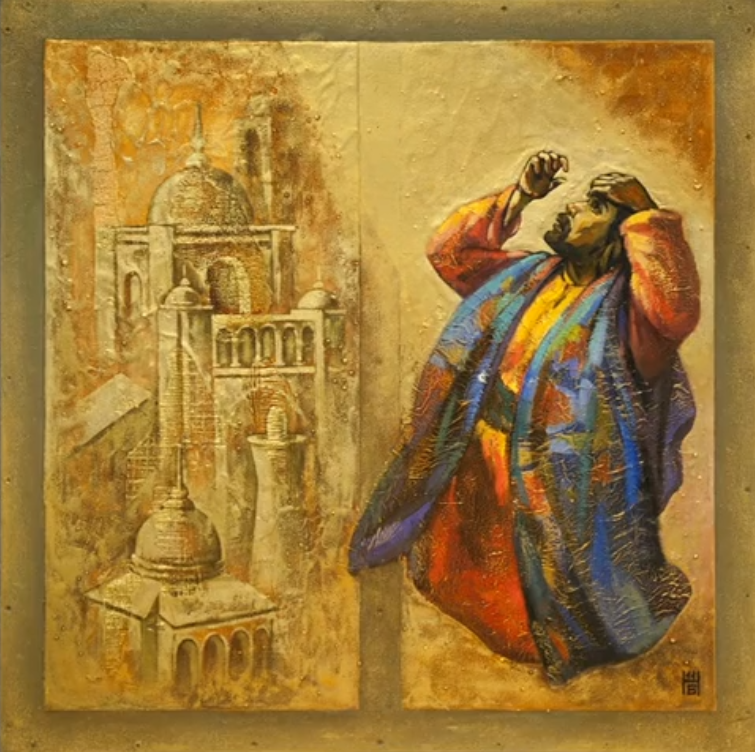
Copyright by Norwegian Bible Society , used with permission.
For other images of Nelly Bube in TIPs, see here.
Following are a number of back-translations of Acts 22:7:
Like a number of other East Asian languages, Japanese uses a complex system of honorifics, i.e. a system where a number of different levels of politeness are expressed in language via words, word forms or grammatical constructs. These can range from addressing someone or referring to someone with contempt (very informal) to expressing the highest level of reference (as used in addressing or referring to God) or any number of levels in-between.
One way Japanese shows different degree of politeness is through the choice of a first person singular and plural pronoun (“I” and “we” and its various forms) as shown here in the widely-used Japanese Shinkaiyaku (新改訳) Bible of 2017. The most commonly used watashi/watakushi (私) is typically used when the speaker is humble and asking for help. In these verses, where God / Jesus is referring to himself, watashi is also used but instead of the kanji writing system (私) the syllabary hiragana (わたし) is used to distinguish God from others.
(Source: S. E. Doi, see also S. E. Doi in Journal of Translation, 18/2022, p. 37ff. )
See also pronoun for “God”.
On this verse see 9.4. A different word is used for ground in these two verses, but they are synonyms (the word used in 9.4 is a more frequently used word).
Quoted with permission from Newman, Barclay M. and Nida, Eugene A. A Handbook on The Acts of the Apostles. (UBS Handbook Series). New York: UBS, 1972. For this and other handbooks for translators see here .
22:7a
I fell to the ground: Paul fell to the ground because the bright light shone on him. He did not fall because he tripped on something.
In some languages a literal translation would have the wrong meaning. If that is true in your language, translate the correct meaning. For example:
I threw myself to the ground
-or-
I collapsed to the ground
-or-
I at once went-down-on-my-face on the ground
heard a voice say to me: This clause indicates that Paul heard someone speak but did not see him. In some languages, it will be more natural to refer to “someone” rather than a voice. For example:
heard someone say to me
22:7b
Saul, Saul: When God or Jesus wants to speak to someone, he often speaks his name twice. It indicates he wants to say something important. It may also show concern for that person. It does not imply that he was angry. Consider how to indicate that meaning in your language. Other ways to translate this phrase are:
Saul, listen!
-or-
Hey Saul
Saul: This is the Hebrew version of the Greek name Paul. Luke called the apostle Paul Saul until 13:9. 22:4–16 retell the story in 9:1–30, so the name Saul is used again.
why do you persecute Me?: This question demands that Paul think about who he was persecuting. In 22:8 Jesus identifies himself. From this experience, Paul realized that Jesus was the Christ and persecuting his followers was wrong, so he asked, “What should I do?”
This is a rhetorical question. In some languages a literal translation would wrongly indicate or imply that Jesus did not know why Paul persecuted Jesus and his followers. If that is true in your language, you should translate the correct meaning. Some ways are:
You are persecuting me!
-or-
Stop persecuting me. Explain yourself!
persecute Me: The word persecute refers to hurting people or to causing them to suffer because you disagree with them. Other ways to translate this word are:
oppress me
-or-
cause me hardship/suffering
© 2001, 2021 by SIL International®
Made available under the terms of a Creative Commons Attribution-ShareAlike 4.0 License (CC BY-SA) creativecommons.org/licenses/by-sa/4.0.
All Scripture quotations in this publication, unless otherwise indicated, are from The Holy Bible, Berean Standard Bible.
BSB is produced in cooperation with Bible Hub, Discovery Bible, OpenBible.com, and the Berean Bible Translation Committee.
No comments yet.
Leave a Reply
You must be logged in to post a comment.