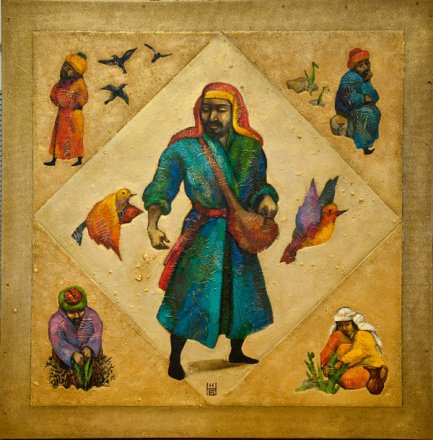
Image taken from He Qi Art . For purchasing prints of this and other artworks by He Qi go to heqiart.com .
For other images of He Qi art works in TIPs, see here.
Following is an painting by Wang Suda 王肅達 (1910-1963):
Copyright by the Catholic University Peking, China
Text under painting translated from Literary Chinese into English: The Second Commandment
Peter swears he doesn’t know the Lord
Image taken from Chinese Christian Posters . For more information on the “Ars Sacra Pekinensis” school of art, see this article , for other artworks of that school in TIPs, see here.
Image taken from He Qi Art . For purchasing prints of this and other artworks by He Qi go to heqiart.com . For other images of He Qi art works in TIPs, see here.
Painting by Nalini Jayasuriya (1927 – 2014), used with permission by the Overseas Ministries Study Center (OMSC) at Princeton Theological Seminary. You can purchase this and many other artworks by artists in residence at the OSMC in high resolution and without a watermark via the OSMC website .
“Nalini M. Jayasuriya was an internationally known artist from Sri Lanka, who exhibited her soul-stirring paintings in Manila, London, Bangkok, Paris, Toronto, Tokyo, Jerusalem and New York. (…) While growing up in Sri Lanka, Nalini never took an art course. As an eight-year old assigned to draw a still life in drawing class, she ended up erasing a hole in her paper, and was told to take her books and leave. She spent the rest of the year’s drawing class time in the library. Her real talent was music; from about age four, she could play almost any piece of music that she heard. At about age fifteen, she wrote a number of poems that were published, and later wrote a secondary-level reader consisting of letters from her cat, Ingy.
“The direction of Nalini’s life changed when, as a young ESL teacher, she was offered an unsolicited British Council grant to study in England. She saw this as one of the many miracles in her life. For three years in London, she experienced a whole new world. She added evening classes to her schedule, including coursework in stained glass and enamel on metal, thinking that she would never again have such an opportunity. Later, she received seven scholarships and fellowships, (none of which she applied for) and she went on to live in thirty-six different countries.
“’I come from a land of rich, ancient, and diverse cultures and traditions. While I carry the enriching influences of both West and East, I express myself through an Asian and Christian consciousness with respect for all confessions of religious faith.’ Nalini Jayasuriya).” (Source )
About this image, Jayasuriya says: “To me, the Great Commission is much more than the words that Jesus spoke to the twelve. So, I have tried to suggest the Power that had to sweep through humanity and through Time, transcending all thought and illumining all experience. So, Christ makes a Statement and an Offering; a Statement of the Abiding Holy Spirit in the form of a Dove, and the Offering of his Life in the symbol of the Cup. This is not a portrait of the young vibrant giver of the Gospels, but an almost elusive vision of a spiritual Presence — a Presence eternally renewing.” (Source : OMSC 2010, p. 34)
Following is a 1973 painting of the JESUS MAFA project, a response to New Testament readings from the Lectionary by a Christian community in Cameroon, Africa. Each of the readings was selected and adapted to dramatic interpretation by the community members. Photographs of their interpretations were made, and these were then transcribed to paintings:
In The Mission to the World, Jesus stands atop a hill proclaiming to his disciples their authority to baptize and teach all that Jesus commanded. His arms are outstretched in a posture of blessing and exhortation. Some disciples remain before him while others are setting out on their journey to complete the task Jesus has set before them. Those departing go in separate directions to spread the gospel to all nations. This scene is a reminder that all Christians are called to spread Jesus’ message of love and justice throughout the world.
From Art in the Christian Tradition, a project of the Vanderbilt Divinity Library, Nashville, TN. Image retrieved March 23, 2026. Original source: librairie-emmanuel.fr.
The Greek that is translated as “fruit of the Spirit” in English is translated in British Sign Language with a sign that depicts the Spirit coming in to a person and then the person giving out. (Source: Anna Smith)
“Fruit of the Spirit” in British Sign Language (source: Christian BSL, used with permission)
In the German New Testament translation by Berger / Nord (publ. 1999) it is translated wer sich vom Heiligen Geist leiten lässt, der kann… or “whoever is guided by the Holy Spirit is able to… .”
The following is a stained glass window from John Hardman Powell (1827–1895) in the Christ Church Cathedral in Dublin, depicting the fruit of the Spirit:
Photo and accompanying text by Andreas F. Borchert, hosted by Wikimedia Commons under a Creative Commons Attribution-Share Alike 3.0 Germany license
“In its centre is the Lord as Good Shepherd along with the Fruit of the Spirit, namely Love (inscription in centre), Joy & Peace (top inscription), and in clockwise direction: Longsuffering, Faith, Gentleness, Goodness, Meekness, Temperance in reference to Galatians 5:22-23, surrounded by medaillons, depicting an angel carrying a scroll with the inscription Gloria in excelsis deo (top, representing joy & peace), and then in clockwise direction: Job (upper right, representing longsuffering), Jonathan (lower right, representing faithfulness), Ruth (bottom, representing goodness and gentleness), Moses (lower left, representing meekness), and John the Baptist (upper left, representing temperance, see Matthew 3:4).”
Stained glass is not just highly decorative, it’s a medium which has been used to express important religious messages for centuries. Literacy was not widespread in the medieval and Renaissance periods and the Church used stained glass and other artworks to teach the central beliefs of Christianity. In Gothic churches, the windows were filled with extensive narrative scenes in stained glass — like huge and colorful picture storybooks — in which worshipers could ‘read’ the stories of Christ and the saints and learn what was required for their religious salvation. (Source: Victoria and Albert Museum )
The Latin Vulgate translation added three “fruits”: “forbearance” (longanimitas), “courtesy” (modestia), and “chastity” (castitas). This meant that all Catholic translations before app. 1950 that were based on the Latin version also had those additional attributes (EnglishDouay-Rheims: longanimity, modesty, chastity; SpanishBiblia Torres Amat: longanimidad, modestia, castidad etc.)
Ronald Knox writes in his translation of the Vulgate (1946): “The Greek only mentions nine of the Twelve Fruits; viz. the first six, together with gentleness, faith, and temperateness. It is possible that the Latin version has accidentally included, in some cases, two renderings of the same Greek word.” Note that neither earlier Latin versions (Vetus Latina) nor the revision of the Vulgate of 1979 / 1986 (Nova Vulgata) have these attributes. (Source: Jost Zetzsche)
The Greek that is translated as “antichrist” in English is translated in Tibetan as ma shi ka’i bstan dgra (མ་ཤི་ཀའི་བསྟན་དགྲ།) or “Christ’s-teaching-enemy.” (Source: gSungrab website )
The following is a stained glass window from the Three choir windows in the Marienkirche, Frankfurt (Oder), Germany, of the 14th century, depicting the antichrist as a wandering preacher:
Source: Der gläserne Schatz: Die Bilderbibel der St. Marienkirche in Frankfurt (Oder), Neuer Berlin Verlag, 2005, hosted by Wikimedia Commons under a public domain license
Stained glass is not just highly decorative, it’s a medium which has been used to express important religious messages for centuries. Literacy was not widespread in the medieval and Renaissance periods and the Church used stained glass and other artworks to teach the central beliefs of Christianity. In Gothic churches, the windows were filled with extensive narrative scenes in stained glass — like huge and colorful picture storybooks — in which worshipers could ‘read’ the stories of Christ and the saints and learn what was required for their religious salvation. (Source: Victoria and Albert Museum )