
Click here to see the image in higher resolution.
Image taken from the Wiedmann Bible. For more information about the images and ways to adopt them, see here .
For other images of Willy Wiedmann paintings in TIPs, see here.


Click here to see the image in higher resolution.
Image taken from the Wiedmann Bible. For more information about the images and ways to adopt them, see here . For other images of Willy Wiedmann paintings in TIPs, see here.

Painting by Sawai Chinnawong, used with permission by the Overseas Ministries Study Center (OMSC) at Princeton Theological Seminary. You can purchase this and many other artworks by artists in residence at the OSMC in high resolution and without a watermark via the OSMC website .
“Sawai Chinnawong of Payap University, Chiang Mai, Thailand, [is] an ethnic Mon whose Buddhist ancestors migrated to Thailand from Myanmar, Mr. Chinnawong committed his life to Christ while in his twenties. Today he is a member of the United Church of Christ of Thailand. His love for art began when he was a child in Thailand when he saw some old men painting on a Buddhist temple wall. He says he would watch them for hours each day. Sawai’s interest in art persisted into adulthood, and he studied art in a vocational school in Bangkok, Thailand. It was at this time that Sawai became a Christian. He says that a missionary was witnessing on the street one day, and soon after, he began to study the Bible every day after art class.
“After completing his art studies, Sawai attended the McGilvary Faculty of Theology at Payap University in Chiang Mai. He was deeply influenced by a series of lectures on the history of Christian Art given there in 1984 by artist and professor Nalini Jayasuriya, another of our OMSC artists. He began creating liturgical art while attending seminary, and designed the artwork for the chapel there. Today his art is appreciated in many places for its portrayal of Christian themes through a Thai graphic idiom that is inspired by Thai culture.
“‘My work represents influences from many styles…I believe Jesus Christ is present in every culture, and I have chosen to celebrate his presence in our lives through Thai traditional cultural forms. My belief is that Jesus did not choose just one people to hear his Word, but chose to make his home in every human heart. And just as his Word may be spoken in every language, so the visual message can be shared in the beauty of the many styles of artistry around the world.’ (Sawai Chinnawong” (Source )
For more images by Sawai Chinnawong in TIPs see here.
The following is a stained glass window in the Chichester Cathedral in England by Marc Chagall from 1967:

Photo by Jules & Jenny, hosted by Wikimedia Common under the cc-by-2.0 license
See this essay about the history of the window .
Stained glass is not just highly decorative, it’s a medium which has been used to express important religious messages for centuries. Literacy was not widespread in the medieval and Renaissance periods and the Church used stained glass and other artworks to teach the central beliefs of Christianity. In Gothic churches, the windows were filled with extensive narrative scenes in stained glass — like huge and colorful picture storybooks — in which worshipers could ‘read’ the stories of Christ and the saints and learn what was required for their religious salvation. (Source: Victoria and Albert Museum )
The Hebrew and Greek that is translated as “root of Jesse” or similar in English is translated as “descendant of the ancient man of God who was called Jesse” in Huehuetla Tepehua, as “a person born in the family line of Jesse” in Yatzachi Zapotec, and as “a son from the people of Jesse the father of David” in Mezquital Otomi. (Source: Waterhouse / Parrott in Notes on Translation October 1967, p. 1ff.)
The following is a stained glass window in St Peter & St Paul church in Salle, England. It was designed ca. 1888 by Ernest Heasman. It is part of a larger window describing Jesus’ family tree :

Photo by Zorba the Geek, hosted by Wikimedia Common under the Creative Commons Attribution-Share Alike 2.0 Generic license
Stained glass is not just highly decorative, it’s a medium which has been used to express important religious messages for centuries. Literacy was not widespread in the medieval and Renaissance periods and the Church used stained glass and other artworks to teach the central beliefs of Christianity. In Gothic churches, the windows were filled with extensive narrative scenes in stained glass — like huge and colorful picture storybooks — in which worshipers could ‘read’ the stories of Christ and the saints and learn what was required for their religious salvation. (Source: Victoria and Albert Museum )
The Greek that is translated as “How often have I desired to gather your children together as a hen gathers her brood under her wings, and you were not willing!” or similar in English is translated in Ankave as “As a chicken extracts its young and gathers them under her breast, although all the time I tried to do the same to you, why did it not please you (to allow me to do so)?” (Source: Richard Speece in Notes on Translation 1988. p. 47ff.)
This is also depicted as a mosaic in Dominus Flevit, a Roman Catholic church on the Mount of Olives:

Image by Anton 17 – Own work, CC BY-SA 3.0.
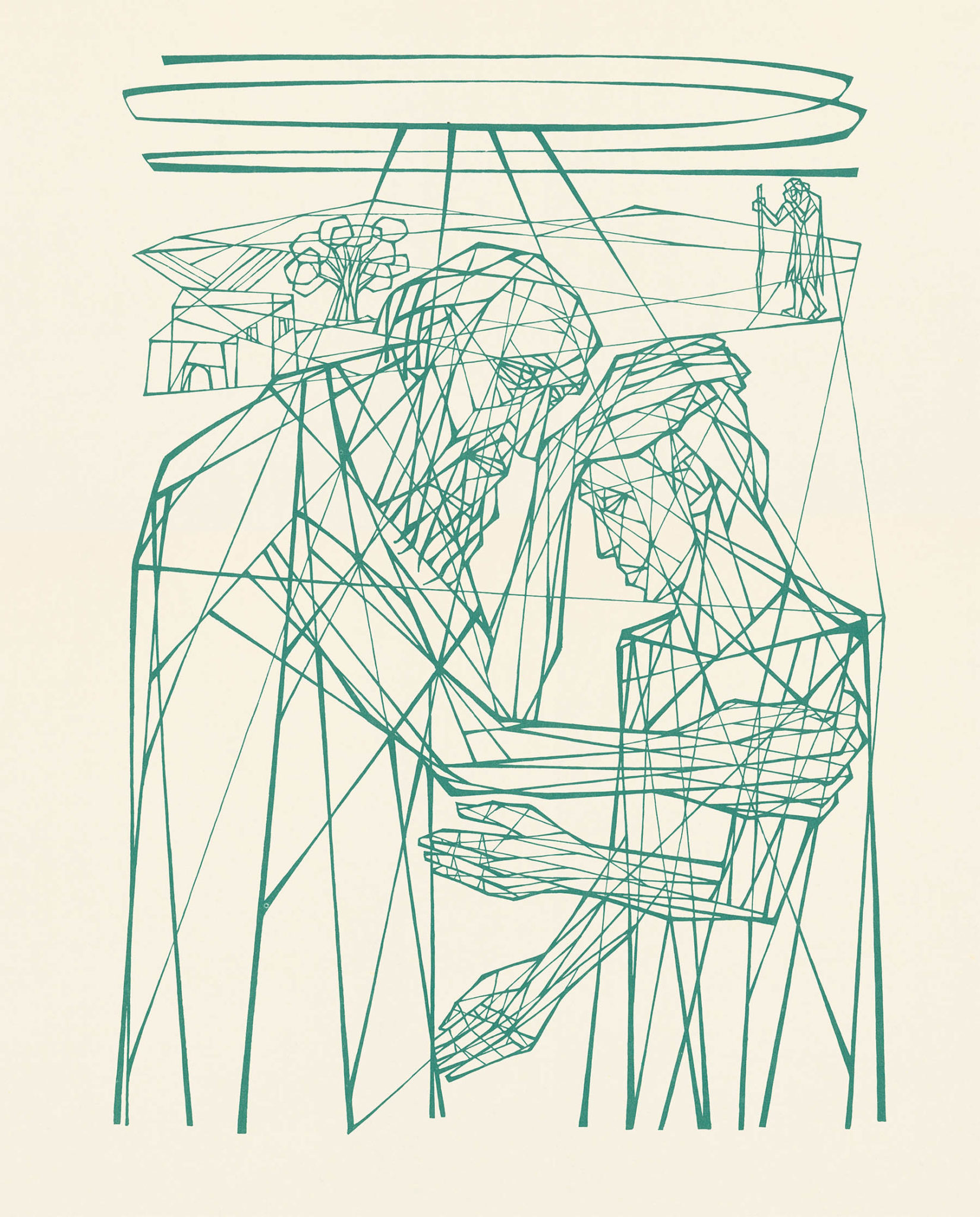
Drawing by Ismar David from The Psalms: A new English translation, linked with permission from Ismar David Archive .
For other images of Ismar David drawings, see here.


