In Gbaya, the notion of “became like dead men” is emphasized with gbéyéŋ, an ideophone used to describe something falling to the ground.
Ideophones are a class of sound symbolic words expressing human sensation that are used as literary devices in many African languages. (Source: Philip Noss)
In Gbaya, the notion of being flat on the ground or falling to the ground is emphasized in the referenced verses with gbéyéŋ, an ideophone that expresses the fact of being flat on the ground, or falling to the ground.
Ideophones are a class of sound symbolic words expressing human sensation that are used as literary devices in many African languages. (Source: Philip Noss)
The following is a stained glass window from 1855 by artist H. Beiler over the altar of the Evangelische Stadtkirche Bad Rappenau, Bad Rappenau, Germany:
Photo by Llez, hosted by Wikimedia Commons under a Creative Commons Attribution-Share Alike 3.0 Unported license
Stained glass is not just highly decorative, it’s a medium which has been used to express important religious messages for centuries. Literacy was not widespread in the medieval and Renaissance periods and the Church used stained glass and other artworks to teach the central beliefs of Christianity. In Gothic churches, the windows were filled with extensive narrative scenes in stained glass — like huge and colorful picture storybooks — in which worshipers could ‘read’ the stories of Christ and the saints and learn what was required for their religious salvation. (Source: Victoria and Albert Museum )
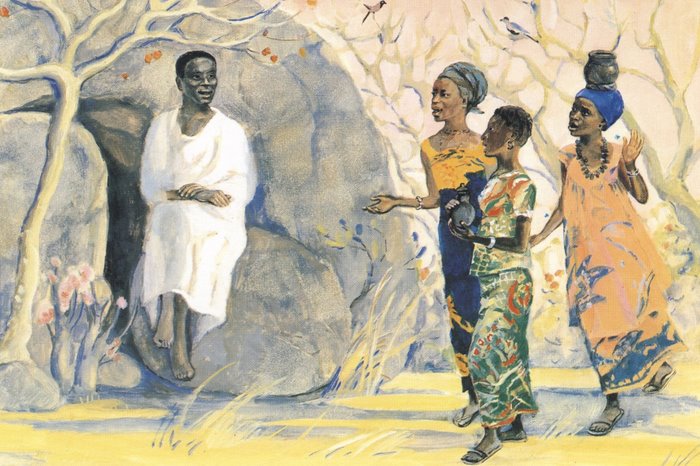
Following is a 1973 painting of the JESUS MAFA project, a response to New Testament readings from the Lectionary by a Christian community in Cameroon, Africa. Each of the readings was selected and adapted to dramatic interpretation by the community members. Photographs of their interpretations were made, and these were then transcribed to paintings:
From Art in the Christian Tradition, a project of the Vanderbilt Divinity Library, Nashville, TN. Image retrieved March 23, 2026. Original source: librairie-emmanuel.fr.
Following are a number of back-translations of Matthew 28:4:
Uma: “The soldiers who were guarding there, there were terribly afraid, they shook, and they couldn’t stand up any longer, they became like dead people.” (Source: Uma Back Translation)
Yakan: “The guards were very afraid therefore/that’s why they really shook and were unconscious as if they were dead people.” (Source: Yakan Back Translation)
Western Bukidnon Manobo: “The soldiers who were watching became very afraid. They were stunned, not being able to move, and trembling.” (Source: Western Bukidnon Manobo Back Translation)
Kankanaey: “When the guards saw that angel, they trembled with their extreme fear and they toppled-over as if they were dead.” (Source: Kankanaey Back Translation)
Tagbanwa: “Those ones who had been caused to guard shook with fear. They went down on their faces, like you might say they were dead, when they saw that angel.” (Source: Tagbanwa Back Translation)
Tenango Otomi: “The soldiers saw the angel and trembled with fright. It seemed as though they died as they fainted.” (Source: Tenango Otomi Back Translation)
Living Water is produced for the Bible translation movement in association with Lutheran Bible Translators. Lyrics derived from the ESV® Bible (The Holy Bible, English Standard Version®).
As Revised Standard Version intimates, for fear of him comes first in the Greek sentence, while the second element is the verb trembled (translated “was stirred” in 21.10 and “shook” in 27.51). These are the expected reactions to the sudden appearance of a divine being, and both are intended to emphasize the tremendous fear that came over the guards. Some translations will say “the guards were so afraid,” but others will have “… afraid of him,” as in the text.
Guards does not translate the same noun used in 27.65, 66; it is a noun made from the same stem as the verb “kept watch” in 27.36 and “keeping watch” in 27.54.
Became like dead men is perhaps an intended contrast to the “dead man” whose tomb they are guarding. He is alive, but they “lay there as dead men” (Die Bibel im heutigen Deutsch). One vivid expression is “fell to the ground paralyzed with fear like dead men.” It is almost essential in many languages to make it explicit that they fell to the ground, since otherwise it would seem they stood in fear without moving.
Quoted with permission from Newman, Barclay M. and Stine, Philip C. A Handbook on the Gospel of Matthew. (UBS Handbook Series). New York: UBS, 1988. For this and other handbooks for translators see here .



Leave a Reply
You must be logged in to post a comment.