The now commonly-used English idiom “fall by the wayside” (meaning failing or falling behind at something) was first coined in 1560 in the Geneva Bible. (Source: Crystal 2010, p. 276)
For other idioms in English that were coined by Bible translation, see here.
Following are a number of back-translations of Matthew 13:4:
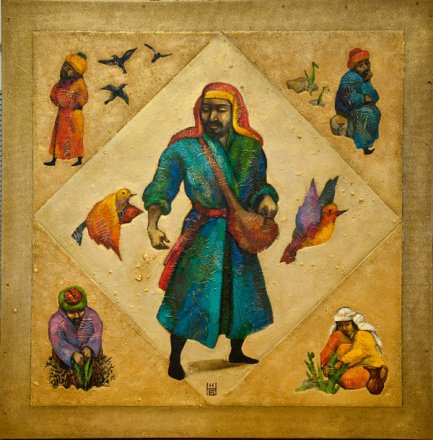
Uma: “In his sowing, there were some sowed-things that fell on the roadway [lit., eye of the road]. Birds came, they pecked it until it was gone.” (Source: Uma Back Translation)
Yakan: “When he was broadcasting, some of the seed spilled onto the road. So-then the birds came and ate it.” (Source: Yakan Back Translation)
Western Bukidnon Manobo: “And in his planting there was some that fell on the path, and this was eaten by the birds.” (Source: Western Bukidnon Manobo Back Translation)
Kankanaey: “When he was broadcasting the seed, some fell on the path and birds were-pecking-it-up.” (Source: Kankanaey Back Translation)
Tagbanwa: “Well since the way he planted was by scattering (seed), some got scattered on the pathway. As-soon-as-he-turned-his-back, he was succeeded by birds for they then ate it.” (Source: Tagbanwa Back Translation)
Tenango Otomi: “As he went along sowing the wheat, some of the seeds landed on the path. Then birds went and ate the seeds.” (Source: Tenango Otomi Back Translation)
Living Water is produced for the Bible translation movement in association with Lutheran Bible Translators. Lyrics derived from the ESV® Bible (The Holy Bible, English Standard Version®).
The parables reflect everyday life in first-century Palestine. For example, the typical way of sowing grain before plowing the field is accurately described in this parable. Moreover, a grain field would often have a path going alongside it or even through it (see Deut 23.25; Matt 12.1).
As we pointed out above, sowed can be “scattered the seed (on the fields).”
Along the path (so also Good News Translation) translates a Greek construction which may mean either “beside the path but not on it” (see New Jerusalem Bible “on the edge of the path”) or “on the path” (New English Bible “on a footpath,” Moffatt “on the road”). The present context also demands the meaning “path” or “footpath” (New English Bible) rather than “road” (Barclay, Moffatt). To translate “road” would imply that a passageway large enough for vehicles is involved, whereas the reference is to a narrow pathway through a field. This may have to be made explicit, as in “along the path through the field.”
The birds (so most translations) represents a literal rendering of the Greek text which has the definite article “the.” However, in many languages, including perhaps English, it is more natural to drop the article (New American Bible “where birds came”).
Devoured translates an intensive form of the verb “eat.” It is used, for example, of the dragon in Revelation 12.4. Note also its usage in Mark 12.40 and Luke 15.30. It means to eat greedily, or hungrily, or completely, or like an animal. To convey the intensity of devoured, Good News Translation has “ate it up,” and Barclay has “snapped them up.” Similarly many translators will look for some expression that conveys more than “ate,” perhaps “ate them all up.”
Quoted with permission from Newman, Barclay M. and Stine, Philip C. A Handbook on the Gospel of Matthew. (UBS Handbook Series). New York: UBS, 1988. For this and other handbooks for translators see here .
some seed: The seeds that the farmer sowed were some type of grain seeds. It was probably wheat or barley. If you need to say what kind of seed the farmer was planting, here are some suggestions:
• Use a general word for grain.
• Use a specific word for wheat or barley, which were grown in Israel in that time.
• Compare this to something that is commonly grown in your area. For example:
a farmer went out to plant something like rice
fell along the path: The Greek phrase that the Berean Standard Bible translates as along the path describes an area where the soil was not cultivated and was hard. Because of the method of planting, some seeds accidentally fell on such places. In these areas birds could easily find the seeds and eat them.
The Greek word that the Berean Standard Bible translates as along normally means “beside.” However, in this context, it is probably more natural in many languages to translate it as “on.” For example:
fell on a footpath (New Living Translation (2004))
the path: This word refers to a footpath through or alongside a field. People who walk there trample on the soil and make it hard.
13:4c
the birds: The phrase the birds refers to birds in general and does not refer to any birds mentioned before. Introduce the birds in the story in the most natural way in your language. For example:
birds
-or-
some birds
came: It may be more natural in your language to use the verb “fly” rather than the verb came. For example:
the birds flew ⌊there⌋
-or-
swooped down (Phillips’ New Testament in Modern English)
devoured it: The Greek word that the Berean Standard Bible translates as devoured refers to eating something completely.
Here are some other ways to translate this phrase:
ate it up (New International Version)
-or-
ate all of them
If you have a specific word or phrase that describes the way that birds eat, such as the English word “pecked,” you should use that word here. For example:
pecked them until they were gone
-or-
gobbled them up (Phillips’ New Testament in Modern English)
it: The pronoun it refers to the seeds. If you used the plural form “seeds” in 13:3b, you should use the plural pronoun here. For example:


Leave a Reply
You must be logged in to post a comment.