The following artwork is part of a series of 56 paintings on biblical themes by Kazakh artist Nelly Bube (born 1949):
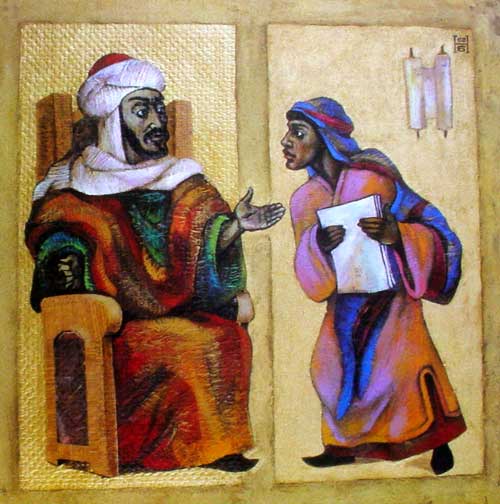
Copyright by Norwegian Bible Society , used with permission.
For other images of Nelly Bube in TIPs, see here.

εἶπεν δὲ ἐν ἑαυτῷ ὁ οἰκονόμος, Τί ποιήσω, ὅτι ὁ κύριός μου ἀφαιρεῖται τὴν οἰκονομίαν ἀπ᾽ ἐμοῦ; σκάπτειν οὐκ ἰσχύω, ἐπαιτεῖν αἰσχύνομαι.
3Then the manager said to himself, ‘What will I do, now that my master is taking the position away from me? I am not strong enough to dig, and I am ashamed to beg.
The following artwork is part of a series of 56 paintings on biblical themes by Kazakh artist Nelly Bube (born 1949):
Copyright by Norwegian Bible Society , used with permission.
For other images of Nelly Bube in TIPs, see here.
Following are a number of back-translations of Luke 16:3:
Exegesis:
eipen de en heautō ho oikonomos ‘the manager said to (lit. ‘in’) himself,’ i.e. debated inwardly.
ti poiēsō ‘what shall I do,’ i.e. ‘what am I to do,’ i.e. with a view to his future, not with regard to the rendering of his account.
hoti ho kurios mou aphaireitai tēn oikonomian ap’ emou ‘since my master is taking the stewardship from me.’ hoti means here ‘since,’ ‘now that,’ as the clause refers to causes which are already known. For kurios cf. on 1.6. oikonomia refers here and in v. 4 to the function, or, the job, in v. 2 to the way in which the function is performed.
skaptein ouk ischuō ‘I cannot dig,’ i.e. ‘I am not strong enough to dig,’ a proverbial saying, indicating that one cannot do heavy manual labour.
epaitein aischunomai ‘I am ashamed to beg,’ i.e. to be a professional beggar, obviously the alternative for one who cannot earn his living with his own hands.
aischunomai ‘to be ashamed,’ ‘to be too proud to,’ with following infinitive.
Translation:
For said to himself see 3.8; for master see on “Lord” in 1.6, sub (a).
Is taking the stewardship (or, this/my work) away from me, or, ‘dismisses (lit. causes-to-cease) me as steward’ (Balinese, similarly Tzeltal), ‘will let-me-go’ (Ekari, Tae’ 1933), ‘will remove me from (my) steward’s duties’ (Thai 1967, similarly Shona 1966), ‘has decided that I can no longer be his manager, or, cannot continue to manage his property.’
I am not strong enough to dig, or, continuing, as it were, the initial question, ‘Dig? I have not the strength for it’ (Bible de Jérusalem). Dig, or, ‘hoe’ (Indonesian languages, Bible de Jérusalem); some specification may be required, e.g. ‘dig in the fields,’ ‘till the soil.’
I am ashamed to beg, i.e. begging will cause me shame, ‘beg? I would be ashamed’ (Bible de Jérusalem); or, worded reversely, “I am … too proud to beg” (New English Bible). Cf. also “shame” in 13.17. To beg, or, ‘to ask for money/gifts,’ ‘to ask-for alms (cf. 11.41), or, pity’ (Bahasa Indonesia, Tae’), ‘to go (around) begging’ (Sranan Tongo).
Quoted with permission from Reiling, J. and Swellengrebel, J.L. A Handbook on the Gospel of Luke. (UBS Handbook Series). New York: UBS, 1971. For this and other handbooks for translators see here . Make sure to also consult the Handbook on the Gospel of Mark for parallel or similar verses.
Paragraph 16:3–4
16:3a
In Greek, this verse begins with a conjunction that many versions translate as “and.” It probably introduces an action that occurred after some time had passed, after the manager had been able to think about his situation. For that reason, versions such as the NET Bible and New Revised Standard Version translate it as “Then.” The Berean Standard Bible and several other versions do not translate this conjunction. Introduce this verse in a way that is natural in your language.
The manager said to himself: The phrase The manager said to himself introduces something that the manager thought. It represents a conversation that he carried on with himself in his own mind. A similar idea occurs in 15:17.
16:3b
What shall I do…?: This is probably a rhetorical question. The manager was thinking to himself. He was expressing uncertainty about what he could do now that he no longer had his job. He was wondering how to get money to buy the food and other things that he needed. Some ways to translate this question are:
• As a rhetorical question. For example:
What should I do? (God’s Word)
• As a statement. For example:
I wonder what I should do now.
-or-
I am uncertain what to do now. ⌊I need to find another way to support myself.⌋
Translate the manager’s uncertainty in a way that is natural in your language.
16:3c
now that my master is taking away my position: In Greek and in the Berean Standard Bible, the verb is taking away is in the present tense. It indicates that the action was still happening. The rich man had told him that he could not continue to be his manager. However, the manager’s work would not actually be finished until he had turned in the financial accounts. Consider what verb tense you would use to express this situation in your language.
In some languages a position is not something that can be “taken away” from someone. Use an expression that is natural in your language. Another way to translate it in English is:
My master is not going to employ me any longer.
my master: The words my master refer here to the manager’s employer. The manager was a hired servant rather than a slave. Use an expression that is natural for a hired man to use to refer to his employer.
General Comment on 16:3b–c
In some languages it may be more natural to reverse the order of 16:3b and 16:3c. For example:
16cMy master is taking away my job. 16bWhat shall I do now?
16:3d
I am too weak to dig: The expression I am too weak to dig may refer to work such as digging ditches or digging in the fields with a shovel or hoe. It was also used to refer to any kind of hard physical labor. In this context it also implies that it was a type of work that people were paid to do.
If the literal expression does not have the right meaning in your language, here are some other ways to translate this clause:
• Make explicit a specific kind of digging that is known to be hard. For example:
I don’t have the strength to dig ditches (New Living Translation (2004))
-or-
I am not strong enough to use a shovel/hoe
• Use an expression that refers more generally to hard physical labor. For example:
I am too weak to work in the fields
-or-
I am not able to do manual labor
16:3e
and too ashamed to beg: This clause indicates that the manager would feel shame or embarrassment if he needed to become a beggar and ask people for money. Another way to express this idea is:
I am too proud to become a beggar
General Comment on 16:3d–e
The two clauses in 16:3d and 16:3e give two options that the manager considered in order to support himself. In some languages it may be good style to express these two alternatives by using a question or by changing the order of the phrases within each verse part. For example:
Dig? I am not strong enough. Go begging? I should be too ashamed. (New Jerusalem Bible)
-or-
As for digging ditches, I am not strong enough, and as for begging, it would be shameful.
© 2009, 2010, 2013 by SIL International®
Made available under the terms of a Creative Commons Attribution-ShareAlike 4.0 License (CC BY-SA) creativecommons.org/licenses/by-sa/4.0.
All Scripture quotations in this publication, unless otherwise indicated, are from The Holy Bible, Berean Standard Bible.
BSB is produced in cooperation with Bible Hub, Discovery Bible, OpenBible.com, and the Berean Bible Translation Committee.
No comments yet.
Leave a Reply
You must be logged in to post a comment.