The Greek in John 2:6 that is translated into English as “each holding twenty or thirty gallons” where the Greek ē (ἢ) or “or” is directly translated and relates to an approximation cannot be directly translated in languages where the equivalent of “or” can only relate to mutually exclusive options. In Anyin, for instance, the solution is “Each jar, if it does not contain twenty gallons of water, it can contain thirty.”
Image taken from He Qi Art . For purchasing prints of this and other artworks by He Qi go to heqiart.com . For other images of He Qi art works in TIPs, see here.
Following is a hand-colored stencil print on momigami by Sadao Watanabe (1968):
Image taken with permission from the SadaoHanga Catalogue where you can find many more images and information about Sadao Watanabe. For other images of Sadao Watanabe art works in TIPs, see here.
Stained glass is not just highly decorative, it’s a medium which has been used to express important religious messages for centuries. Literacy was not widespread in the medieval and Renaissance periods and the Church used stained glass and other artworks to teach the central beliefs of Christianity. In Gothic churches, the windows were filled with extensive narrative scenes in stained glass — like huge and colorful picture storybooks — in which worshipers could ‘read’ the stories of Christ and the saints and learn what was required for their religious salvation. (Source: Victoria and Albert Museum )
Painting by Xu Jihua 徐濟華 (1912-1937)
Housed in the Société des Auxiliaires des Missions Collection – Whitworth University
Image taken from Chinese Christian Posters . For more information on the “Ars Sacra Pekinensis” school of art, see this article , for other artworks of that school in TIPs, see here.
In the EnglishGood News Bible (2nd edition of 1992), this occurrence of the Greek hoi Ioudaioi, traditionally “the Jews” in English, is translated with a term that refers to the Jewish people or is not translated at all if it implicitly refers to the Jewish people (for example “Passover” instead of “Passover of the Jews”). For an explanation of the differentiated translation in English as well as translation choices in a number of languages, see the Jews.
The Greek in John 2:6 that is translated as “water-jars holding twenty or thirty gallons” or similar in English is translated in Lalana Chinantec as “each pot held about eight small waterpots.” (Source: Larson 1998, p. 108)
Following are a number of back-translations of John 2:6:
Uma: “In that house, there were six water containers made of stone. Those water containers were used to keep water for washing feet and hands, following the custom of the Yahudi people. The amount of their contents, [was] about one hundred liters each.” (Source: Uma Back Translation)
Yakan: “There were there six stone jars for holding water for washing for the Yahudi following their customs for purification. One jar could hold approximately five (big) cans (usually five gallon cans understood).” (Source: Yakan Back Translation)
Western Bukidnon Manobo: “According to the doctrine of the Jews it is necessary that there be water for washing before they eat. Therefore there were prepared there six stone jars. Each one of these could hold about one hundred liters of water.” (Source: Western Bukidnon Manobo Back Translation)
Kankanaey: “There is a custom of the Jews concerning the proper way to wash-hands. Thus there were six large rice-wine-jars set (there) so that that’s what they would use. The capacity of one, it was about (lit. it goes to) five cans.” (Source: Kankanaey Back Translation)
Tagbanwa: “There were there six water-jars which could each contain thirty gallons of water. The water contained was used for washing hands according to their Jewish custom of cleansing.” (Source: Tagbanwa Back Translation)
Tenango Otomi: “There were there six big jars made of stone. These were used by the Jews, being filled with water for washing the hands of the people. Each one could hold eighty or one hundred liters of water.” (Source: Tenango Otomi Back Translation)
Living Water is produced for the Bible translation movement in association with Lutheran Bible Translators. Lyrics derived from the ESV® Bible (The Holy Bible, English Standard Version®).
Most translations continue the paragraph begun in verse 1 through verse 10. But Goodspeed and Good News Translation, in keeping with contemporary English style, begin a new paragraph whenever a new speaker is introduced (1-3,4,5). Moreover, a new topic is introduced at verse 6. A paragraph break is therefore logical from the viewpoint of discourse structure, especially since this verse is a remark by the author of the Gospel.
The Greek word order of this verse can be seen by consulting Revised Standard Version: “Now six stone jars were standing there, for the Jewish rites of purification, each holding twenty or thirty gallons.” In introducing new information in English, it is more natural to go from the general to the specific, and so Good News Translation reorders this sentence: The Jews have rules about ritual washing, and for this six stone jars were there, each one large enough to hold between twenty and thirty gallons. That is, Good News Translation mentions the general information about the Jewish religious rules, and then on the basis of this, it explains the purpose of the six stone water jars.
A number of complications may be involved in rendering the Jews have rules about ritual washing. In the first place, a phrase such as ritual washing may be equivalent to “being acceptable to God by washing,” but such an expression may be difficult to combine readily with the meaning of “rules.” One way of expressing these relations is “In the way in which the Jews worship God, they have many rules about how to wash themselves” or “In order for Jews to make themselves acceptable to God they must obey many rules about how to wash” or “The Jews must wash themselves and things very carefully, if they are to worship God in the way they think is right.” Die Bibel im heutigen Deutsch renders “They (=the water jars) are used for the purification required by Jewish Law.”
Some scholars see a symbolic meaning in the number six (that is, the imperfection of Judaism), but such symbolic significance is not at all clear and for purposes of translation is unimportant.
The fact that the jars are stone, rather than earthenware, is important. According to Jewish law, earthenware jars, if contaminated, had to be broken, but contaminated stone jars could simply be washed.
The relation between the parts of the phrase six stone water jars must be made more explicit in some languages, for example, “six large jars made of stone and used for holding water.”
Between twenty and thirty gallons (see Revised Standard Version, New English Bible, Jerusalem Bible, Goodspeed) is literally “two or three measures.” Most scholars take a “measure” to be equal to about nine or ten gallons, but some understand it to be equal to about eight or nine gallons (New American Bible “fifteen to twenty-five gallons”; Moffatt “about twenty gallons”). It is entirely appropriate in some languages to adapt the measure of between twenty and thirty gallons to a rough equivalent in “liters,” for example, “between 80 and 120 liters.” It is important not to use an expression which would narrowly restrict the measure to twenty-five gallons. What is intended here is simply an approximate measure; therefore one may say in some languages “approximately twenty to thirty gallons” or “about twenty or thirty gallons.” In languages which do not use gallons or liters, one may translate by an appropriate measure, such as, “about (so-and-so) number of bamboos,” an expression occurring in a number of languages in Southeast Asia.
Quoted with permission from Newman, Barclay M. and Nida, Eugene A. A Handbook on the Gospel of John. (UBS Handbook Series). New York: UBS, 1980. For this and other handbooks for translators see here .



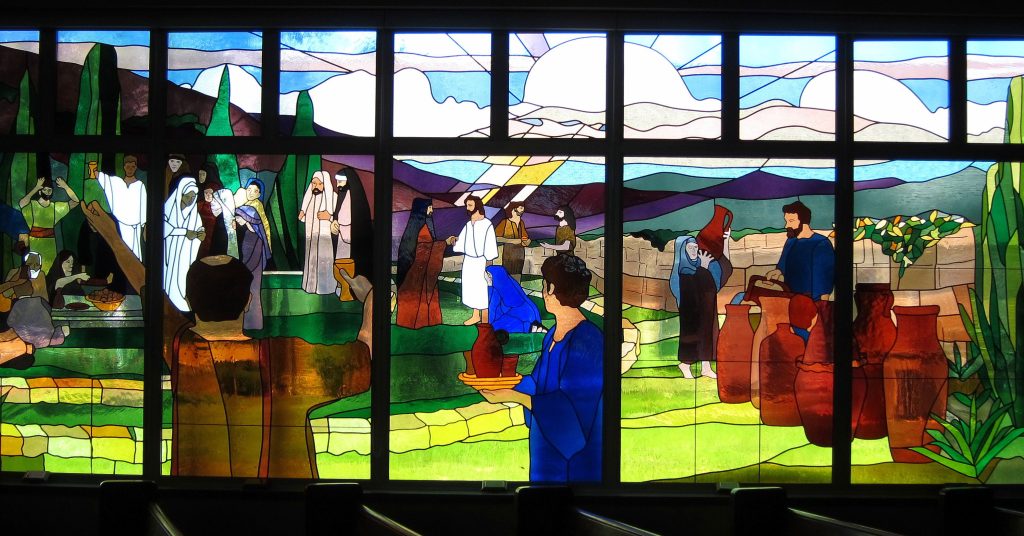

_-_stained_glass,_the_Wedding_at_Cana.jpg)
Leave a Reply
You must be logged in to post a comment.