Image taken from He Qi Art . For purchasing prints of this and other artworks by He Qi go to heqiart.com . For other images of He Qi art works in TIPs, see here.
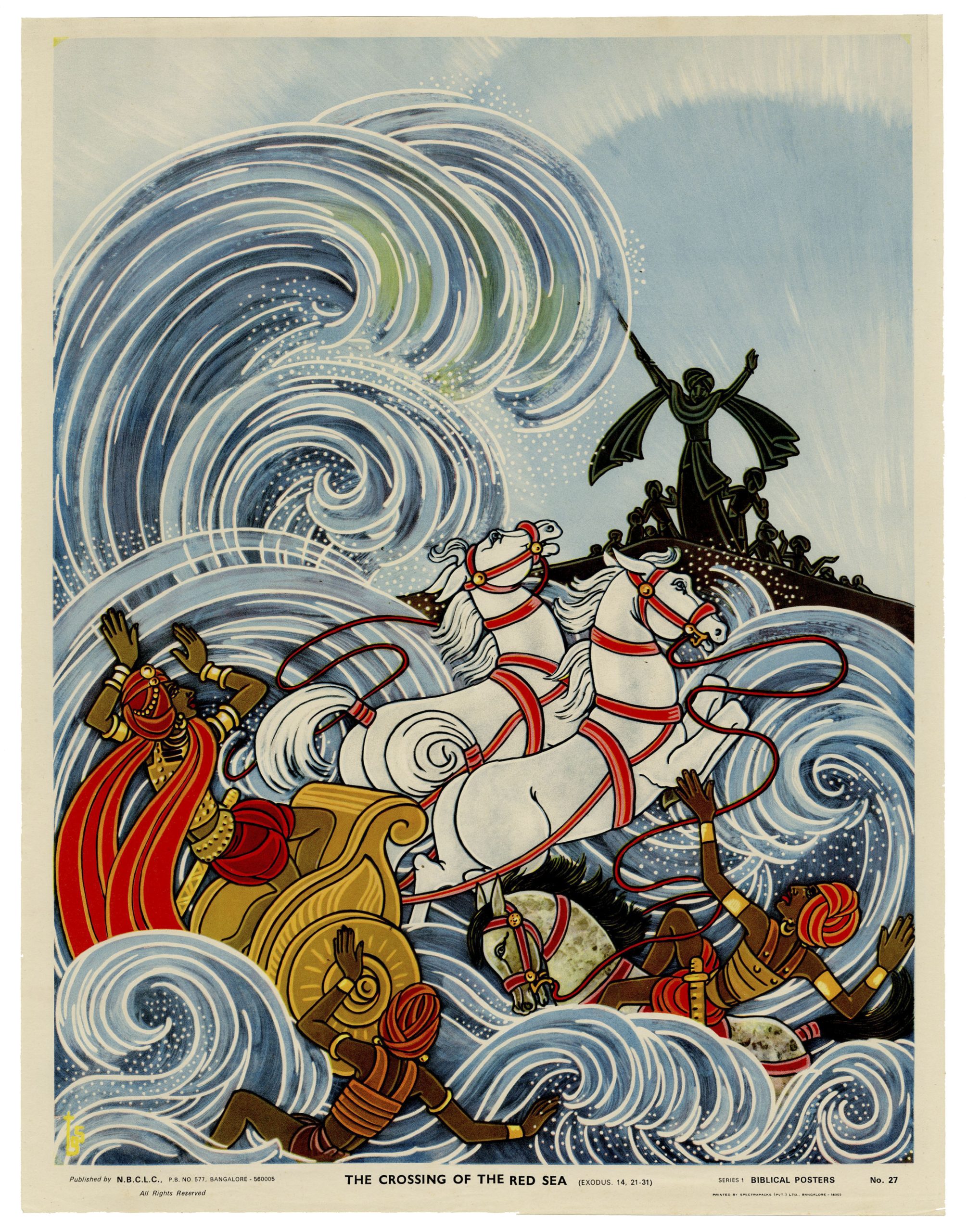
Following is an artwork by Sister Marie Claire , SMMI (1937–2018) from Bengaluru, India:
For more information about images by Sister Marie Claire and ways to purchase them as lithographs, see here .
For other images of Sister Marie Claire paintings in TIPs, see here.
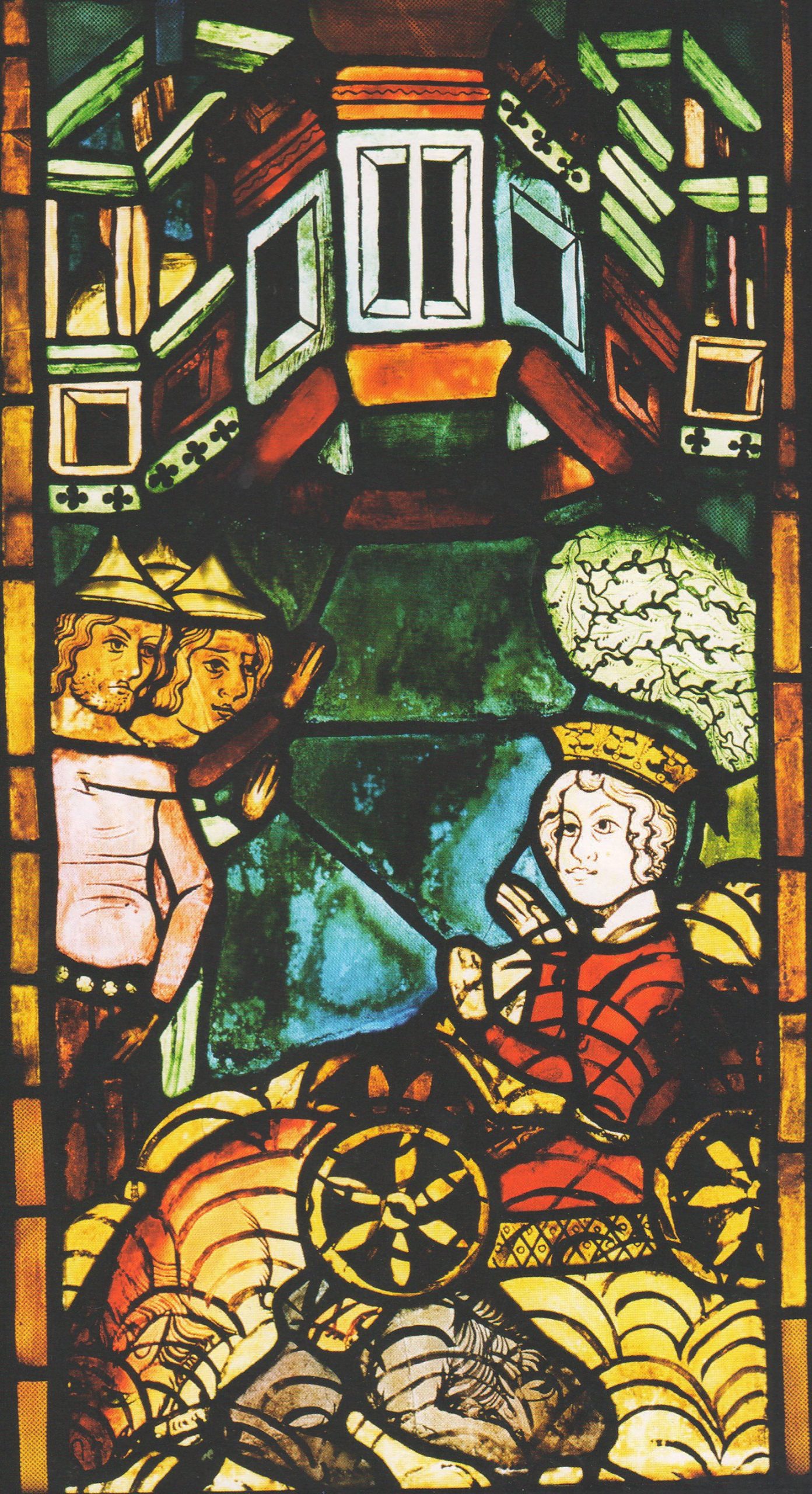
The following is a stained glass window from the Three choir windows in the Marienkirche, Frankfurt (Oder), Germany, of the 14th century:
Source: Der gläserne Schatz: Die Bilderbibel der St. Marienkirche in Frankfurt (Oder), Neuer Berlin Verlag, 2005, copyright for this image: Brandenburgisches Landesamt für Denkmalpflege und Archäologisches Landesmuseum
Stained glass is not just highly decorative, it’s a medium which has been used to express important religious messages for centuries. Literacy was not widespread in the medieval and Renaissance periods and the Church used stained glass and other artworks to teach the central beliefs of Christianity. In Gothic churches, the windows were filled with extensive narrative scenes in stained glass — like huge and colorful picture storybooks — in which worshipers could ‘read’ the stories of Christ and the saints and learn what was required for their religious salvation. (Source: Victoria and Albert Museum )
The various Greek, Aramaic, Ge’ez, and Latin and Hebrew terms that are translated as “sea,” “ocean,” or “lake” in English are all translated in Chichewa with one term: nyanja. Malawi, where Chichewa is spoken, has a lot of lakes but does not share a border with the ocean. (Source: Mawu a Mulungu mu Chichewa Chalero Back Translation)
In Malagasy culture, the sea is perceived as sacred because it was a path taken by the ancestors. That is why the Malagasy word for the “sea” is ranomasina, which literally means “the sacred water.” The word masina actually has two different meanings: “salted” and “sacred/holy.” Salt is used for the conservation of some foods, such as meat or fish, that are to be set aside for later use. In this sense, the Malagasy phrase for “Holy Spirit” has the literal meaning of “Salted Spirit.” (Source: Brigitte Rabarijaona in The Bible Translator 2022, p. 103ff.)
“Sea” (or: “ocean”) is translated in Tepeuxila Cuicatec as “water land” and in Xicotepec De Juárez Totonac as “very big lake.” (Source: Viola Waterhouse in Notes on Translation August 1966, p. 86ff.)
Following are a number of back-translations as well as a sample translation for translators of Exodus 14:29:
Kupsabiny: “But the Israelites had gone on dry ground with walls of water being on both sides.” (Source: Kupsabiny Back Translation)
Newari: “But the Israelites went through the sea on dry ground. A wall of water stood on their right and on their left.” (Source: Newari Back Translation)
Hiligaynon: “But the Israelinhon on-the-other-hand went-through on dry land in the middle of the sea, wherein the water seemed-as-if a stone-wall on both sides/[lit. side and side].” (Source: Hiligaynon Back Translation)
Bariai: “But the Israel people walked and crossed over and went to the other side on dry ground. And the ocean became like a railing/barrier at the edge of their path on this side and that side.” (Source: Bariai Back Translation)
Opo: “And people of Israel, when they had crossed other side, they went on a place which be dry, and water stopped as fence on the right and left their.” (Source: Opo Back Translation)
English: “But we Israeli people had already crossed through the sea by walking on dry ground, with the water being like two walls, one on the right side and one on the left side.” (Source: Translation for Translators)
This verse repeats what is said in verse 22 and should be understood as contrasting the deliverance of the Israelites with the death of Egyptians. It does not mean that the Israelites walked through the sea a second time. The only difference is that verse 22 uses the word for “went into” rather than the word for walked. To repeat the same thing again is not unusual in Hebrew narrative, and here it should be understood simply as a summary statement. The waters being a wall to them, the Israelites, suggests that the same waters that destroyed the Egyptians actually protected the Israelites. But the repetition of what is said in verse 22 does not necessarily suggest that the Israelites were still walking on dry ground even after the sea had covered over the Egyptians.
Contemporary English Version‘s model for this verse is a good one:
• But the sea had made a wall of water on each side of the Israelites; so they walked through on dry land.
Quoted with permission from Osborn, Noel D. and Hatton, Howard A. A Handbook on Exodus. (UBS Helps for Translators). New York: UBS, 1999. For this and other handbooks for translators see here .



Leave a Reply
You must be logged in to post a comment.