The Greek that is translated as “three men” or similar in English is translated in the German New Testament translation by Berger / Nord (publ. 1999) with “two men.” The translators note (p. 530) that “just as in Acts 10:7 the soldier has only been sent for protection and does not count.”
In Acts 11:11 Berger/Nord have “two messengers and one soldier.”
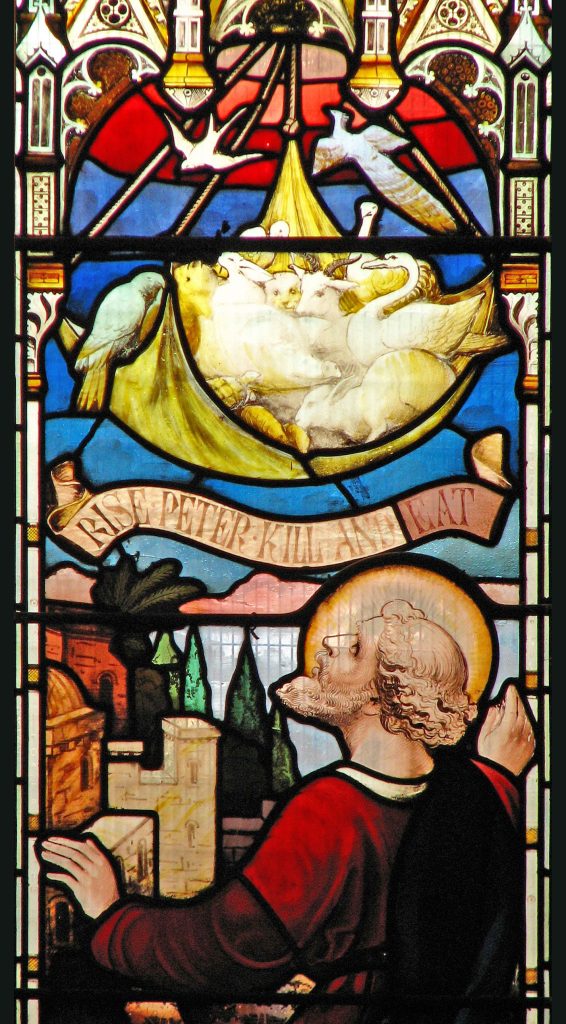
Stained glass is not just highly decorative, it’s a medium which has been used to express important religious messages for centuries. Literacy was not widespread in the medieval and Renaissance periods and the Church used stained glass and other artworks to teach the central beliefs of Christianity. In Gothic churches, the windows were filled with extensive narrative scenes in stained glass — like huge and colorful picture storybooks — in which worshipers could ‘read’ the stories of Christ and the saints and learn what was required for their religious salvation. (Source: Victoria and Albert Museum )
Following are a number of back-translations of Acts 11:11:
Uma: “At that time also, three men arrived at my dwelling house. Those there were not Yahudi people, who had been ordered from the town of Kaisarea to go to Yope to look for me.” (Source: Uma Back Translation)
Yakan: “While that (was going on), there arrived at the house where I was staying three men who were sent to me from the place Kesarea.” (Source: Yakan Back Translation)
Western Bukidnon Manobo: “And then there were three people which arrived at the house where I was staying. They were not Jews, and they had been sent to me from the village of Caesarea.” (Source: Western Bukidnon Manobo Back Translation)
Kankanaey: “‘And that being so, three men suddenly-arrived at the house where-I-was-staying. They had-been-sent from Cesarea to go call me.” (Source: Kankanaey Back Translation)
Tagbanwa: “Just when that was disappearing, there were three people from Cesarea who arrived at that house where I was staying, who had come to fetch me.” (Source: Tagbanwa Back Translation)
In place of I was some manuscripts have “we were,” which may have been the original reading, since it is easy to see why a scribe would change “we were” to I was (to conform to v. 5), but not vice versa.
Quoted with permission from Newman, Barclay M. and Nida, Eugene A. A Handbook on The Acts of the Apostles. (UBS Handbook Series). New York: UBS, 1972. For this and other handbooks for translators see here .

Leave a Reply
You must be logged in to post a comment.