
The Hebrew and Greek that is translated as “messenger” in English is translated in Noongar as moort yana-waangki or “person walk-talk” (source: Warda-Kwabba Luke-Ang).
Jezebel
The Hebrew and Greek that is transliterated as “Jezebel” in English is translated in Spanish Sign Language with the sign depicting “striking serpent” representing her deceitfulness. (Source: Steve Parkhurst)
“Jezebel” in Spanish Sign Language, source: Sociedad Bíblica de España
For more information on translations of proper names with sign language see Sign Language Bible Translations Have Something to Say to Hearing Christians .
Learn more on Bible Odyssey: Jezebel and Jezebel from an African-American Perspective ..
Elijah at Mount Horeb - A Still Small Voice
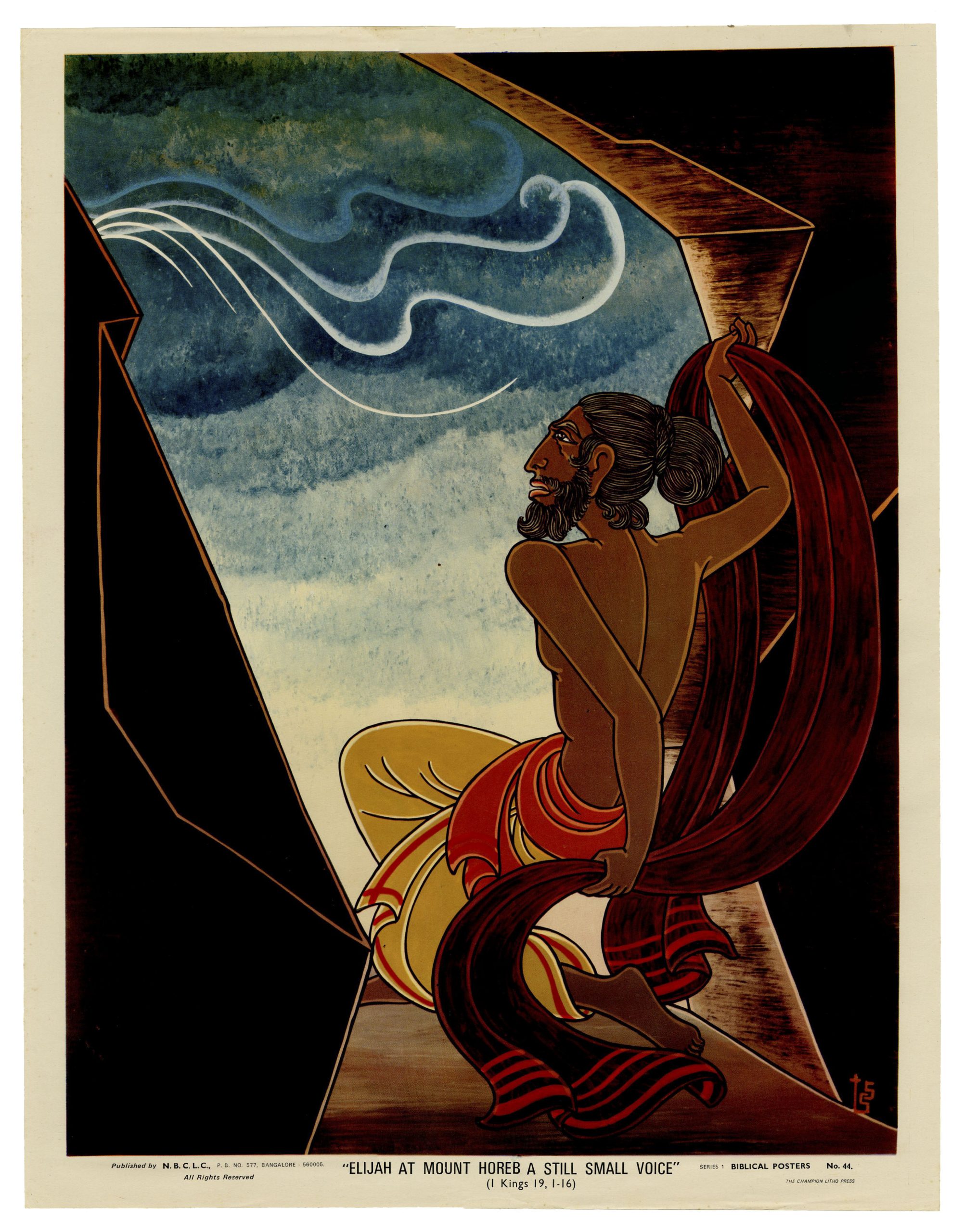
Artwork by Sister Marie Claire , SMMI (1937–2018) from Bengaluru, India.
For more information about images by Sister Marie Claire and ways to purchase them as lithographs, see here .
For other images of Sister Marie Claire paintings in TIPs, see here.
Elijah
The name that is transliterated as “Elijah” in English means “God-LORD,” “strength of the LORD,” “my God is YHWH.” “the LORD God.” (Source: Cornwall / Smith 1997 )
In Spanish Sign Language it is translated as “whirlwind” (according to 2 Kings 2:11) (Source: John Elwode in The Bible Translator 2008, p. 78ff. )
“Elijah” in Spanish Sign Language, source: Sociedad Bíblica de España
Click or tap here to see how other sign languages are translating “Elijah”
In American Sign Language it is translated with a depiction of being taken up to heaven with a chariot of fire. (Source: ASL Sign Language Directory )
“Elijah” in American Sign Language (source )
Likewise in Estonian Sign Language, but with a different sign (source: Liina Paales in Folklore 47, 2011, p. 43ff.)

“Elijah” in Estonian Sign Language (source )
In Finnish Sign Language it is translated with the sign signifying “fire” (referring to 1 Kings 18:38). (Source: Tarja Sandholm)
“Elijah” in Finnish Sign Language (source )
For more information on translations of proper names with sign language see Sign Language Bible Translations Have Something to Say to Hearing Christians .
Following is a Russian Orthodox icon of Elijah from the late 13h century.


Orthodox Icons are not drawings or creations of imagination. They are in fact writings of things not of this world. Icons can represent our Lord Jesus Christ, the Virgin Mary, and the Saints. They can also represent the Holy Trinity, Angels, the Heavenly hosts, and even events. Orthodox icons, unlike Western pictures, change the perspective and form of the image so that it is not naturalistic. This is done so that we can look beyond appearances of the world, and instead look to the spiritual truth of the holy person or event. (Source )
Learn more on Bible Odyssey: Elijah .
complete verse (1 Kings 19:2)
Following are a number of back-translations as well as a sample translation for translators of 1 Kings 19:2:
- Kupsabiny: “Then Jezebel sent a person to go and tell Elijah, ‘May lightning strike me if I have not killed you before this time tomorrow like you killed those prophets.’” (Source: Kupsabiny Back Translation)
- Newari: “So Jezebel sent a messenger to Elijah to speak like this, "Just as you killed our prophets, may god kill me if by this time tomorrow I have not killed you just like that."” (Source: Newari Back Translation)
- Hiligaynon: “So Jezebel sent a message to Elias saying, ‘May the gods punish me severely if by this time tomorrow I can- not still -kill you, like what you did to the prophets.’” (Source: Hiligaynon Back Translation)
- English: “So Jezebel sent this message to Elijah: ‘By this time tomorrow I will have killed you, just like you killed all those prophets of Baal. If I do not do that, I hope the gods will kill me.’” (Source: Translation for Translators)
2nd person pronoun with low register (Japanese)
Click or tap here to see the rest of this insight.
Like a number of other East Asian languages, Japanese uses a complex system of honorifics, i.e. a system where a number of different levels of politeness are expressed in language via words, word forms or grammatical constructs. These can range from addressing someone or referring to someone with contempt (very informal) to expressing the highest level of reference (as used in addressing or referring to God) or any number of levels in-between. One way Japanese shows different degree of politeness is through the choice of a second person pronoun (“you” and its various forms) as shown here in the widely-used Japanese Shinkaiyaku (新改訳) Bible of 2017. The most commonly used anata (あなた) is typically used when the speaker is humbly addressing another person.
In these verses, however, omae (おまえ) is used, a cruder second person pronoun, that Jesus for instance chooses when chiding his disciples. (Source: S. E. Doi, see also S. E. Doi in Journal of Translation, 18/2022, p. 37ff. )
See also first person pronoun with low register and third person pronoun with low register.
Honorary "rare" construct denoting God ("punish")
Click or tap here to see the rest of this insight.
Like a number of other East Asian languages, Japanese uses a complex system of honorifics, i.e. a system where a number of different levels of politeness are expressed in language via words, word forms or grammatical constructs. These can range from addressing someone or referring to someone with contempt (very informal) to expressing the highest level of reference (as used in addressing or referring to God) or any number of levels in-between.
One way Japanese shows different degree of politeness is through the usage of an honorific construction where the morpheme rare (られ) is affixed on the verb as shown here in the widely-used Japanese Shinkaiyaku (新改訳) Bible of 2017. This is particularly done with verbs that have God as the agent to show a deep sense of reverence. Here, basse-rare-ru (罰せられる) or “punish” is used.
(Source: S. E. Doi, see also S. E. Doi in Journal of Translation, 18/2022, p. 37ff. )
Translation commentary on 1 Kings 19:2
Then: The common Hebrew conjunction at the beginning of this verse may be taken in a temporal sense, as in Revised Standard Version and New Revised Standard Version, or as a logical connector (New International Version “So”). Others leave it untranslated. Translators should follow whichever is most natural in the receptor language in this context.
So may the gods do to me, and more also: This is a fixed formula expressing an oath that occurs often in 1-2 Samuel and 1–2 Kings. See the comments on 1 Kgs 2.23. Here, of course, Jezebel uses the plural gods instead of the singular “God,” since she is a pagan and not a worshiper of the one God of Israel. The words to me are not in most manuscripts of the Masoretic Text, but they are in the Septuagint. Regardless of which text translators follow here, these words are implicit in the Hebrew and may be made explicit in the receptor language.
I do not make your life as the life of one of them: Life, here and in verses 3-4, translates the Hebrew noun nephesh, which is often rendered “soul” in traditional translations (but see the comments at 1 Kgs 1.12). Them refers to the prophets of Baal, mentioned in the previous verse, and not to the gods. Good News Translation makes this clear by restating this as “I don’t do the same thing to you that you did to the prophets.”
Quoted with permission from Omanson, Roger L. and Ellington, John E. A Handbook on 1-2 Kings, Volume 1. (UBS Helps for Translators). New York: UBS, 2008. For this and other handbooks for translators see here .
Leave a Reply
You must be logged in to post a comment.