The Hebrew and Greek that is typically transliterated as “Baal” in English is translated in Spanish Sign Language with the sign for “idol.” (Source: Steve Parkhurst)
The Hebrew and Latin that is transliterated as “Amos” in English is translated in Spanish Sign Language with the sign for “renovate / renew,” particularly referring to Amos 9:11. (Source: Steve Parkhurst)
In Swiss-German Sign Language it is translated with the sign that depicts Amos’ move from the Southern Kingdom of Judah into the Northern Kingdom of Israel to prophesy against it.
In Hungarian Sign Language it is translated with a sign reflecting the meaning and significance of the Hebrew name: burden-bearer or one who carries a load. While the biblical text does not explicitly define the name, its meaning indirectly alludes to the prophet’s ministry, as he proclaimed heavy judgments (burdens) against Israel. “I will crush you as a cart crushes, when loaded with grain.” (Amos 2:13). (Source: Jenjelvi Biblia and HSL Bible Translation Group)
“Amos” in Hungarian Sign Language — note that only the first part refers to “Amos,” the second and third parts refer to “prophet” and “book” (source )
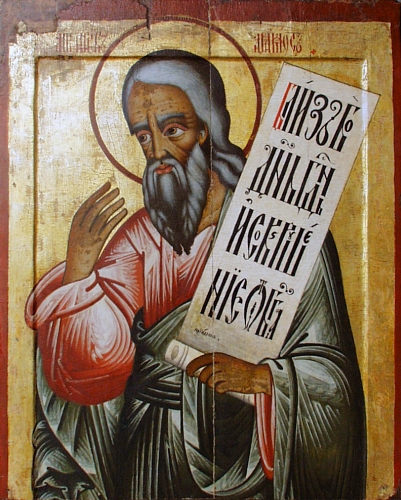
Following is a Russian Orthodox icon of Amos from the 18th century (found in the Transfiguration Church, Kizhi Monastery, Karelia, Russia). The words on the scroll are extracted from Isaiah 13:6: “For the day of the Lord is near; it will come like destruction from the Almighty!”
Orthodox Icons are not drawings or creations of imagination. They are in fact writings of things not of this world. Icons can represent our Lord Jesus Christ, the Virgin Mary, and the Saints. They can also represent the Holy Trinity, Angels, the Heavenly hosts, and even events. Orthodox icons, unlike Western pictures, change the perspective and form of the image so that it is not naturalistic. This is done so that we can look beyond appearances of the world, and instead look to the spiritual truth of the holy person or event. (Source )
The name “Hagar” or “Abataza” means “flight” and derived from that “fugitive,” “immigrant,” “sojourner.” (Source: Cornwall / Smith 1997 )
The term that is transliterated as “Hagar” in English is translated in American Sign Language with the sign for the letter H and “escaped,” referring to Genesis 21:14. (Source: Ruth Anna Spooner, Ron Lawer)
“Hagar” in American Sign Language, source: Deaf Harbor
In Spanish Sign Language it is translated with a sign that combines “Egypt” and “servant,” referring to the fact that Hagar was a slave from Egypt (see Genesis 16:1). (Source: Steve Parkhurst)
The Hebrew that is transliterated as “Bathsheba” in English is translated in Spanish Sign Language with the signs for “woman” and “bath” referring to 2 Samuel 11:2. (Source: Steve Parkhurst)
The Greek that is transliterated as “Mary (of Bethany)” in English is translated in Spanish Sign Language with a signs for “woman” and “listen,” referring to Luke 10:39. (Source: Steve Parkhurst)
The term that is transliterated as “Joseph” in English is translated in American Sign Language with a sign that relates to a) the coat he wore (see Gen 37:3), b) the holding of his clothes by Potiphar’s wife (see Gen 39:12), and c) the many times Joseph experienced grief. (Source: Ruth Anna Spooner, Ron Lawer)
“Joseph” in American Sign Language, source: Deaf Harbor
In Spanish Sign Language it is translated with a sign that signifies “dream,” referring to Jacob’s dream at Bethel (see Genesis 28:10 and the following verses). (Source: Steve Parkhurst)
The Hebrew and Greek that is transliterated as “Asherah” in English is translated in Spanish Sign Language with the signs for “woman” and “idol.” (Source: Steve Parkhurst)
The Hebrew and Greek that is transliterated as “Rahab” in English is translated in Spanish Sign Language with the sign for “prostitute” referring to Joshua 2:1. (Source: Steve Parkhurst)