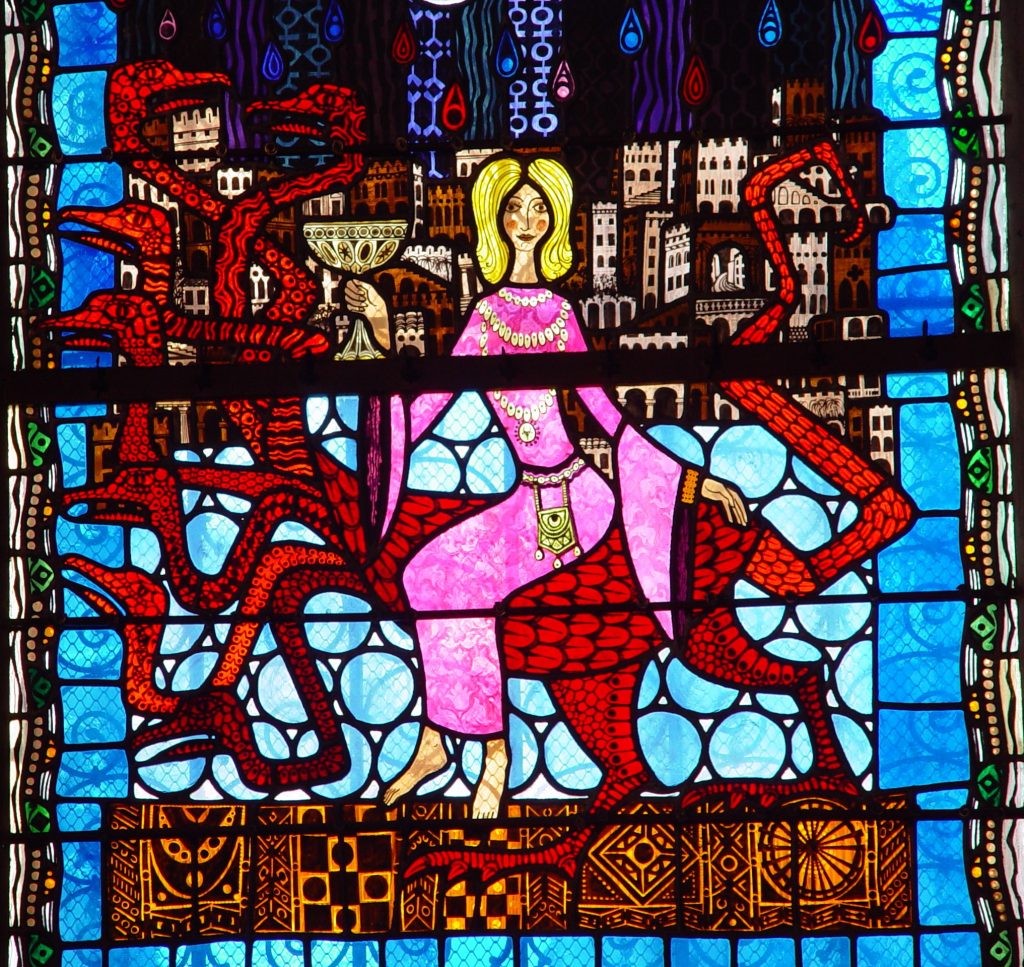
The following is a stained glass window by William Wailes from the Cathédrale Notre-Dame in Clermont-Ferrand, France:
Source: Art in the Christian Tradition , a project of the Vanderbilt University Divinity Library, Nashville, TN. Original source: image donated by Jim Womack and Anne Richardson
Stained glass is not just highly decorative, it’s a medium which has been used to express important religious messages for centuries. Literacy was not widespread in the medieval and Renaissance periods and the Church used stained glass and other artworks to teach the central beliefs of Christianity. In Gothic churches, the windows were filled with extensive narrative scenes in stained glass — like huge and colorful picture storybooks — in which worshipers could ‘read’ the stories of Christ and the saints and learn what was required for their religious salvation. (Source: Victoria and Albert Museum )
Following are a number of back-translations of Revelation 17:10:
Uma: “Five of those kings have fallen. One is still ruling. And one has not yet started to rule. When he arrives, he must rule a short time.” (Source: Uma Back Translation)
Yakan: “Five of those kings are no longer. One is still reigning up to now and the seventh is not yet reigning. But when he reigns in the future, his reign will last only a short while.” (Source: Yakan Back Translation)
Western Bukidnon Manobo: “Five of these kings have died, one still rules today, another has not yet begun to rule. And when he reigns, his rule will be very short and he will be removed.” (Source: Western Bukidnon Manobo Back Translation)
Kankanaey: “And another of its meanings, it is seven kings. Five of them have already been removed, one is-ruling now, and there is one more who will come to rule in a future day, but his ruling will be for only a short-while.” (Source: Kankanaey Back Translation)
Tagbanwa: “What is also being illustrated in this is seven kings. Five of the kings have already been defeated. One of them is still reigning. That seventh hasn’t yet arrived. When he arrives, he won’t stay-around/last for long.” (Source: Tagbanwa Back Translation)
Tenango Otomi: “And also these seven heads come out to mean seven rulers. And already have died five of the rulers. One of them is ruling now. The other still has not taken up his position. But when he sits to take his position, it will not be long that he governs.” (Source: Tenango Otomi Back Translation)
This calls for a mind with wisdom: see 13.18. The translation can say “This requires a wise thinker,” “… wise thinking,” or “… a person with great insight.”
The seven heads are seven mountains: throughout this explanation the verb “to be” is used, as in “heads are mountains” and so forth. In some languages it will be better to say “represent,” “stand for,” or “symbolize.”
Seven mountains on which the woman is seated: this is a clear reference to the city of Rome. It is to be noticed that the same verb “be seated on” is used in verses 1 and 3. In certain languages that, like English, distinguish between hills and mountains, translators should pick a term for “hills” that refers to a usually rounded natural elevation of land that is lower than a mountain. The hills referred to are generally lower than 1000 feet.
Revised Standard Version and Good News Translation differ on where verse 10 begins. Revised Standard Version follows the verse division of King James Version and American Standard Version; Good News Bible follows the UBS Greek New Testament. New Revised Standard Version is now like Good News Bible.
They are also seven kings: the fuller statement may be preferable: “the heads also represent seven kings.” It is generally agreed that these seven kings were kings, or emperors, of Rome who succeeded one another; they are not kings of seven different countries. For the translation of kings see 1.5 and elsewhere.
Five of them have fallen: the verb “to fall” here does not necessarily mean that they were killed or deposed, but simply that they died, they no longer live. The verb (in Hebrew) is used of Abner in 2 Sam 3.38. So the translation can say “five of them have already died.”
One is: this means “one of them is now king.”
The other has not yet come: this one is the last of the seven, so the translation can say “the last one is yet to appear.”
When he comes he must remain only a little while: the emphasis is on the short length of his reign: “when he appears, he will be king for a little while only.” As often in the New Testament, and in this book in particular, the verb translated “must” indicates God’s control of human affairs (see 1.1). In that case one may say “he will be allowed to be king (or, high chief) for a little while only” or “God will let him rule for only a little while.”
Quoted with permission from Bratcher, Robert G. and Hatton, Howard A. A Handbook on The Revelation to John. (UBS Handbook Series). New York: UBS, 1993. For this and other handbooks for translators see here .
There are also seven kings: There is a verse numbering issue here. The Good News Translation and some versions include this sentence at the end of 17:9. You should place this sentence where the major language version does.
This clause is a second explanation of the symbolic meaning of the seven heads.
kings: Here the word kings may refer to many kinds of powerful leaders. They may not be the leaders of distinct countries. The word could even refer to rulers of empires. (An empire consists of more than one country.)
17:10b
Five have fallen: Here the words have fallen may figuratively indicate that these five kings are either:
(1) no longer ruling,
(2) no longer alive.
These verses do not say why they have fallen. You should not explain why they have fallen. For example:
Five of them have already gone (New Jerusalem Bible)
17:10c
one is: Here the word is probably indicates that this king was ruling either:
(1) at the time when the vision is fulfilled,
(2) at the time when John saw the vision.
You should not explain when this occurs. Other ways to translate this phrase are:
one still rules (Good News Translation)
17:10d
has not yet come: This phrase probably indicates that this king had not yet begun to reign. For example:
has not yet come ⌊to the throne⌋ -or-
has not yet become ⌊a ruler⌋
17:10e
he must remain for only a little while: Here the word must indicates that God is in control and has determined that this will happen. The phrase remain for only a little while indicates that God will let this king rule for only a short time. Other ways to translate this clause are:
he will rule for only a little while (Contemporary English Version) -or-
his reign will be brief (New Living Translation (2004)) -or-
Living Water is produced for the Bible translation movement in association with Lutheran Bible Translators. Lyrics derived from the ESV® Bible (The Holy Bible, English Standard Version®).

Leave a Reply
You must be logged in to post a comment.