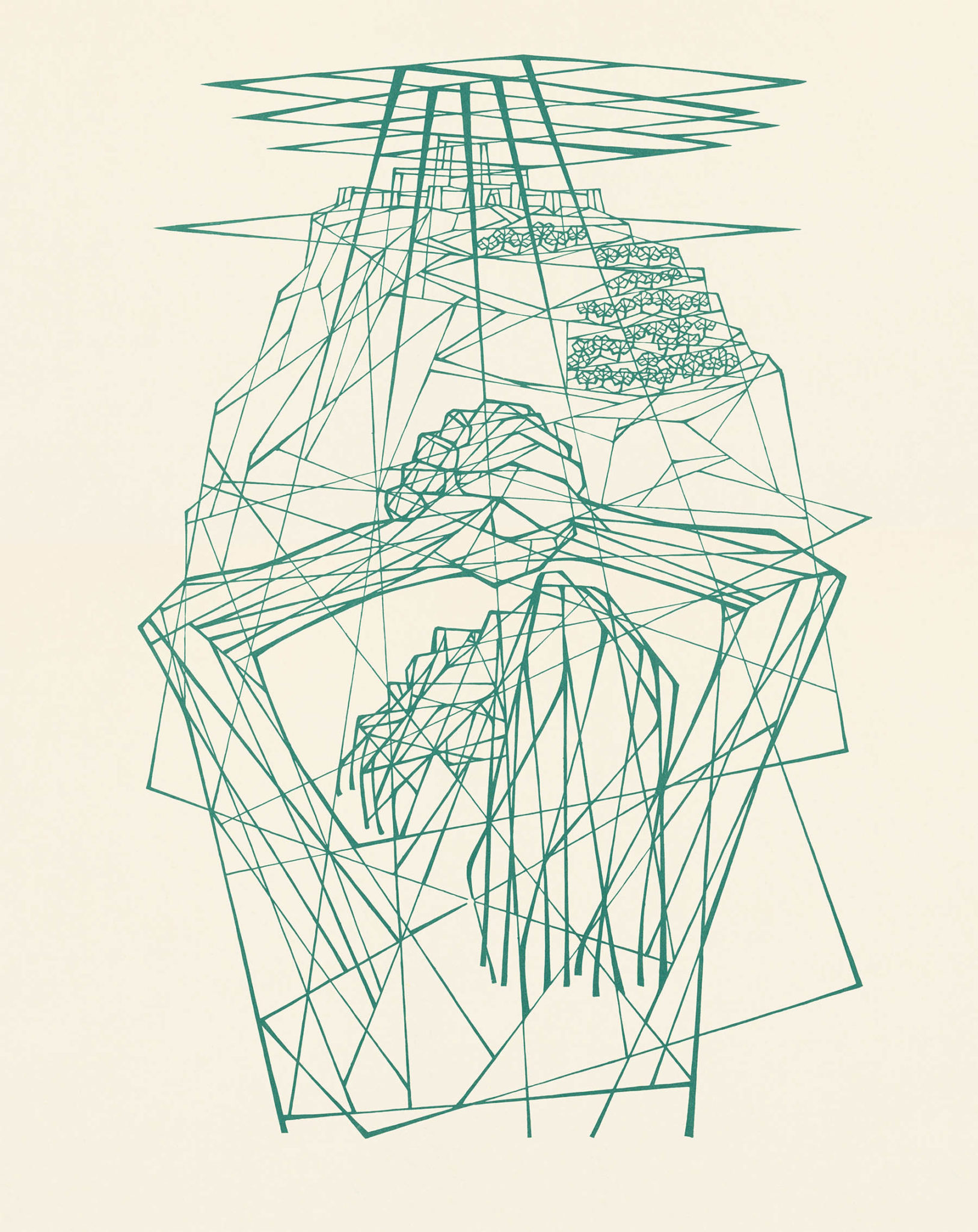
Drawing by Ismar David from The Psalms: A new English translation, linked with permission from Ismar David Archive .
For other images of Ismar David drawings, see here.

שִׁ֗יר לַֽמַּ֫עֲל֥וֹת אֶשָּׂ֣א עֵ֭ינַי אֶל־הֶהָרִ֑ים מֵ֝אַ֗יִן יָבֹ֥א עֶזְרִֽי׃
Psalm 121
Assurance of God’s Protection
A Song of Ascents.
1I lift up my eyes to the hills—
from where will my help come?
Drawing by Ismar David from The Psalms: A new English translation, linked with permission from Ismar David Archive .
For other images of Ismar David drawings, see here.
The Hebrew in Psalm 121:1 that is translated as “I lift up my eyes to the hills” or similar in English was judged as too archaic an expression in a direct translation in Swedish and was instead translated as Jag ser upp emot bergen or “I look up at the mountains” from the 1970’s on. (See Bertil Albrektson in The Bible Translator 1978, p. 101ff. )
See also my eyes are not raised too high and I turned my eyes to the mountains (image).
Following are a number of back-translations as well as a sample translation for translators of Psalm 121:1:
The psalmist begins by saying I lift up my eyes to the hills, and then asks where his help will come from. There is no certainty about the location of these hills; Anderson thinks they are the mountains on the route from Jerusalem to the psalmist’s home, and Taylor takes the journey to be the reverse of this. Some believe that these are the hills of or near Jerusalem, while others see an allusion to the “high places” where the pagan gods were believed to live. Dahood takes it to be heaven itself, where Yahweh lives. The only way to translate the Hebrew is to say “the mountains (or, the hills),” without any specific identification. The Hebrew phrase “to lift up one’s eyes” means, in English, “to look up at.” The question in verse 1b is a way of introducing the information that comes in the answer, in verse 2. It should be translated as a question whose answer is supplied by the psalmist himself. Bible en français courant translates it “Is there anyone who will be able to help me?” (It should be noticed that Revised Standard Version From whence is redundant; whence already means “from where.”) The relation of the answer in verse 2 to the question in verse 1b will be determined by what one understands the hills in verse 1a to represent. If they represent heaven, as Dahood believes (and see 123.1), or the mountains near Jerusalem, then the question implies that the psalmist’s help will come from those hills, for that is where Yahweh lives. But if the hills are understood as the dwelling place of pagan gods, the question implies that the psalmist’s help will not come from those hills but will come from Yahweh, who created heaven and earth.
Die Bibel im heutigen Deutsch and BÍBLIA para todos Edição Comum (Portuguese common language version) translate verse 1 as a statement: “I look to the hills, where my help comes from.” This is possible and in some languages may be the best way to translate the verse. Line a of verse 1 appears in many translations as a statement unrelated to the rest of the psalm. If the translator follows such versions as Good News Translation, it may be necessary to make the connection between the two lines of verse 1 clearer; for example, “When I look to the mountains, I ask myself where my help will come from,” or as direct address, “where will my help come from?” (see Biblia Dios Habla Hoy). In some languages it will be necessary to ask the question as “Who will help me?”
The answer to the question comes in verse 2, with the psalmist himself as the speaker. It would be more natural if the answer were given by someone else; so some commentators (Taylor, Dentan), instead of the Hebrew my help, change the text to “your help.” New English Bible tries to achieve the same result by translating “Help,” without any possessive adjective. But the Hebrew text should be translated as it is. Yahweh is the psalmist’s helper; he is the Creator of heaven and earth (see the same phrase in 115.15) and so has all the power needed to protect the psalmist. If the question in verse 1 is made in personal terms, “Who will help me?” the answer in verse 2 should also be personal: “The LORD will help me” or “The LORD is the one who will help me.”
Quoted with permission from Bratcher, Robert G. and Reyburn, William D. A Handbook on the Book of Psalms. (UBS Helps for Translators). New York: UBS, 1991. For this and other handbooks for translators see here .
The following is a presentation by the Psalms: Layer by Layer project, run by Scriptura . The first is an overview and the second an introduction into the exegesis of Psalm 121.
Copyright © Scriptura
Copyright © Scriptura
No comments yet.
Leave a Reply
You must be logged in to post a comment.