
broom tree

A number of scholars identify rothem as the White Broom Retama raetam, a tough desert shrub found in the Holy Land and Arabia. Earlier, Moldenke (Plants of the Bible. Chronica Botanica. Ronald Press, 1952) contended that rothem refers to a parasitic plant called dog’s club. In the story of Elijah’s flight from Jezebel, the mention of the broom tree in 1 Kings 19:4 provides detail to the image of desolation brought to mind by the word “wilderness” earlier in the verse. The references to rothem in Psalm 120:4 (“. . . with glowing coals of the broom tree”) and Job 30:4 (“. . . and to warm themselves the roots of the broom”) have led scholars to conclude that it is indeed the broom shrub, since it makes a very hot fire, due to the oil in the stems and leaves. The place name Rithmah (“place of rothem”) referred to in Numbers 33:18f. may also refer to the broom. The white broom is found on hills, rocky places, ravines and sandy places throughout the Holy Land, especially near the Dead Sea, in Gilead, on Mount Carmel, in the Syrian desert, and on the Phoenician coast.

The white broom, which is more of a large bush than a shrub, can reach a height of 2 meters (7 feet). It has many small branches, few leaves, and clusters of white flowers that make the shrub a beautiful sight on a hillside.

In 1 Kings 19:4 the New Jerusalem Bible renders rothem as “furze bush,” also known as “gorse,” in an attempt to use a name known to English gardeners, but neither “gorse” nor “furze” are familiar to botanically ignorant city-dwellers of the twenty-first century. Hence, some modern versions use a generic term in 1 Kings, such as “large bush” (Contemporary English Version), “tree” (Good News Bible, and “bush” (New Century Version). In areas where plants are still known by species names, translators can select a shrub that grows in dry, barren areas (assuming it is big enough to offer shade), or transliterate from the Hebrew (rothem) or a major language (for example, retem in Arabic). Otherwise, they can use “small tree” or “shrub.”

In Psalm 120:4 a local kind of wood that produces a very hot fire could be used, since the text is rhetorical, and needs an image of something very hot.

The reference to broom in Job 30:4 poses major textual and exegetical problems, which explains the variety of renderings in modern Bibles. New Revised Standard Version, updated edition reads “they pick mallow and the leaves of bushes, and to warm themselves the roots of the broom.” Good News Bible and the New International Version have these poor folk eating the roots of the broom tree. However, reliable sources tell us that the root of the broom tree is poisonous. That is why Moldenke suggested that it must be another plant, namely the parasite Dog’s Club Cynomorium coccineum, which grows up out of the roots of the broom tree. However, there is good evidence that the writer intended to say the roots were “burned” (as in New Revised Standard Version, updated edition), not “eaten” (as in Good News Bible and New International Version).
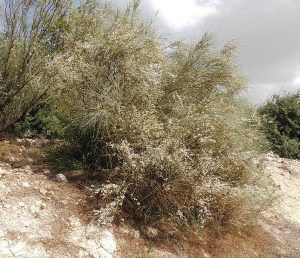
Broom bush, Wikimedia Commons

Source: Each According to its Kind: Plants and Trees in the Bible (UBS Helps for Translators)

In the Contemporary Chichewa translation (2002/2016) it is translated as “mopane tree .” These trees grow in Southern African countries. They can grow up to 18 meters high and their leaves have a butterfly shape. They’re good for firewood and timber as they are in the category of hardwood trees because they can live for up to 100 years. (Source: Mawu a Mulungu mu Chichewa Chalero Back Translation)

fire without flame or smoke

In Gbaya, the notion of a fire without flames or smoke is emphasized in the referenced verses with the ideophone yoŋgoŋgo.

Ideophones are a class of sound symbolic words expressing human sensation that are used as literary devices in many African languages. (Source: Philip Noss)

complete verse (Psalm 120:4)

Following are a number of back-translations as well as a sample translation for translators of Psalm 120:4:

  • Chichewa Contempary Chichewa translation, 2002/2016:
    “He will punish you with sharp arrows of people of war,
    and with burning charcoal of a mopane tree.” (Source: Mawu a Mulungu mu Chichewa Chalero Back Translation)
  • Newari:
    “He will punish you with the sharp arrows of soldiers
    and flaming charcoal.” (Source: Newari Back Translation)
  • Hiligaynon:
    “He will-punish you (plur.) with the pointed arrows of a soldier and flaming coals.” (Source: Hiligaynon Back Translation)
  • Laarim:
    “He will shoot you (plur.) with the sharp arrows,
    and he will burn you (plur.) with a very hot charcoal.” (Source: Laarim Back Translation)
  • Nyakyusa-Ngonde (back-translation into Swahili):
    “Na mishale mikali ya mpigana vita,
    ambayo wameibabua katika moto ambao unawaka sana.” (Source: Nyakyusa Back Translation)
  • English:
    “He will shoot sharp arrows at you like soldiers do,
    and he will burn you with red-hot coals from the wood of a broom tree.” (Source: Translation for Translators)

Translation commentary on Psalm 120:3 - 120:4

By means of the rhetorical device of a question and an answer, the psalmist describes how God will punish his enemies. Verse 3 in Hebrew is literally “What will he give to you and what will he add to you?” This question reflects the language used in a curse: “May God do so to you, and add to you” (see Ruth 1.17; 1 Sam 3.17; 14.44; 25.22). Here the question means “How will he punish you?” New Jerusalem Bible, however, translates “What can you profit, what can you gain?” This is possible but not very probable. See Bible en français courant “What punishment will God inflict on you…?” and Die Bibel im heutigen Deutsch “How will God punish you…?”

As Revised Standard Version shows, only in line c of verse 3 are the psalmist’s enemies named, you deceitful tongue. In most cases it will be better to place this first, as Good News Translation does: “You liars….” And Revised Standard Version, by using the passive voice of the verb, translates in an impersonal sense, What shall be given … what more shall be done…? (see also Traduction œcuménique de la Bible). It is preferable to take it in a personal sense, as Good News Translation, Bible en français courant, Die Bibel im heutigen Deutsch, and others do. As in the case of all rhetorical devices, the translator must ask what the function of the question is in this verse, and supply a structure which will serve the same purpose in the receptor language. The question form in verse 3 represents an emphatic statement whose content comes in verse 4. Accordingly in many languages a question in verse 3 will be wrongly understood. In such cases it may be better to say, for example, “You liars, God will do something awful to you; he will certainly punish you.”

The answer (verse 4) may be taken literally, but more probably sharp arrows and glowing coals are figures for harsh punishment, extreme suffering. Weiser comments: “The two metaphors … are as much as to say ‘murder and fire,’ that is, death and destruction.” The Hebrew text in verse 4a identifies the coals as being of the broom tree, which is mentioned in 1 Kings 19.4-5; Job 30.4. It is not necessary to identify the tree, unless the broom tree is well known to the readers. So Good News Translation “red-hot coals,” and New Jerusalem Bible and New English Bible “red-hot charcoal.” In many languages the punishment of sharp arrows and glowing coals will not be clear. Therefore it may be necessary to make explicit who is to be punished, either in generic or in specific terms; for example, “by shooting you with sharp arrows and burning you with hot coals.”

Quoted with permission from Bratcher, Robert G. and Reyburn, William D. A Handbook on the Book of Psalms. (UBS Helps for Translators). New York: UBS, 1991. For this and other handbooks for translators see here .