Orthodox Icons are not drawings or creations of imagination. They are in fact writings of things not of this world. Icons can represent our Lord Jesus Christ, the Virgin Mary, and the Saints. They can also represent the Holy Trinity, Angels, the Heavenly hosts, and even events. Orthodox icons, unlike Western pictures, change the perspective and form of the image so that it is not naturalistic. This is done so that we can look beyond appearances of the world, and instead look to the spiritual truth of the holy person or event. (Source )
For purchasing artworks by Kateryna Shadrina go to IconArt Gallery .
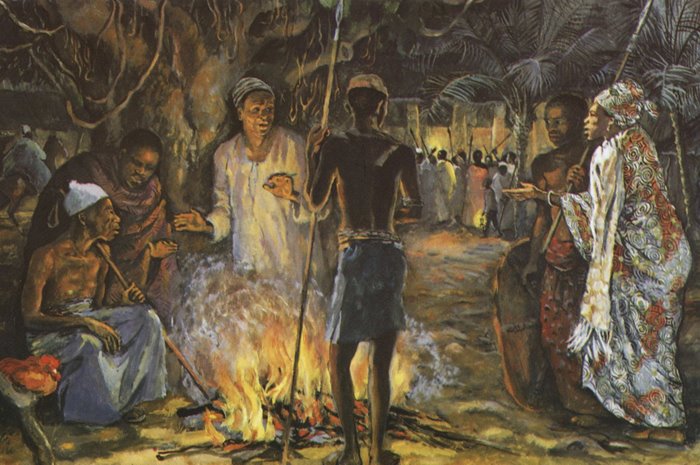
Following is a 1973 painting of the JESUS MAFA project, a response to New Testament readings from the Lectionary by a Christian community in Cameroon, Africa. Each of the readings was selected and adapted to dramatic interpretation by the community members. Photographs of their interpretations were made, and these were then transcribed to paintings:
From Art in the Christian Tradition, a project of the Vanderbilt Divinity Library, Nashville, TN. Image retrieved March 23, 2026. Original source: librairie-emmanuel.fr.
Barclay Newman, a translator on the teams for both the Good News Bible and the Contemporary English Version, translated passages of the New Testament into English and published them in 2014, “in a publication brief enough to be non-threatening, yet long enough to be taken seriously, and interesting enough to appeal to believers and un-believers alike.” The following is the translation of Luke 22:54-65:
Peter kept his distance after Jesus was arrested
and led away to the house of the high priest.
Some people were sitting around a fire
in the courtyard of the house, and Peter joined them.
“This man was with Jesus!” blurted out a servant girl.
“I don’t even know the guy!” insisted Peter.
“You’re one of them!” someone said with a smirk.
“Not me!” denied Peter.
An hour or so later, another man swore,
“This man was with Jesus—they’re both from Galilee.”
“I don’t know what you’re talking about!”
came Peter’s denial.
At that very moment, while Peter was still speaking,
he heard the sound of a rooster crowing.
The Lord looked in Peter’s direction,
and Peter remembered those solemn words,
“Before a rooster crows tomorrow morning,
you’ll say three times you don’t even know me.”
Peter left and wept bitterly.
Meanwhile, the guards insulted and struck Jesus.
They put a blindfold on him and sneered as they said,
“Tell us who hit you?”
And this was not the worst they did to him.
exelthōn ‘after going outside,’ i.e. out of the high priest’s house.
eklausen pikrōs ‘he wept bitterly,’ a well known metaphor referring not to the way in which one weeps but expressing the deep anguish/sorrow which causes the weeping.
Translation:
And, or, ‘then,’ ‘thereupon.’
Bitterly, or, ‘sorrowfully’ (Bahasa Indonesia), ‘sobbing-violently’ (Balinese); or a generic term for high degree, cf. e.g. ‘wept very much’ (Sranan Tongo, Sundanese).
Quoted with permission from Reiling, J. and Swellengrebel, J.L. A Handbook on the Gospel of Luke. (UBS Handbook Series). New York: UBS, 1971. For this and other handbooks for translators see here . Make sure to also consult the Handbook on the Gospel of Mark for parallel or similar verses.
he went outside: The phrase he went outside indicates that Peter left the courtyard of the high priest’s house. Here is another way to translate this:
And Peter left the courtyard (New Living Translation (2004))
wept bitterly: The word wept refers to loud weeping and sobbing. The word bitterly refers to the intense sorrow and regret that Peter felt. It indicates that Peter regretted that he had denied Jesus. He was very sorry about what he had done. Use a natural phrase in your language.



Leave a Reply
You must be logged in to post a comment.