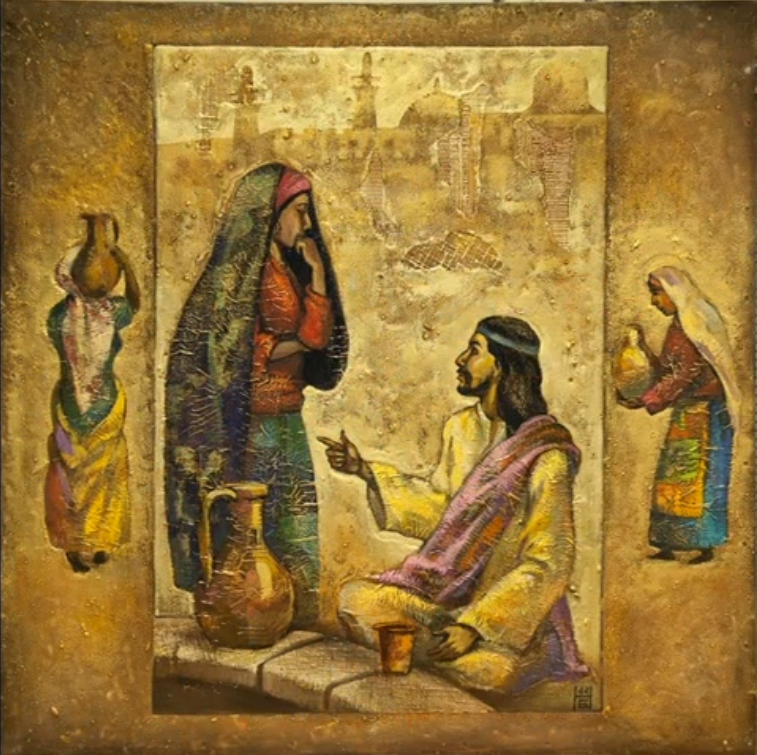
The woman at the well


Following is a painting in the Hamzanama style:

The woman at the well, 2017-2018, Paul Abraham with Manish Soni, Opaque watercolour and natural pigments on hand-made paper, © Sarmaya Arts Foundation. (2018.33.5)

Following is a painting by Ketut Lasia (b. 1945):

Ketut Lasia is one of the last traditional Balinese painters in the Ubud style. As an adult, Lasia converted from Hinduism to Christianity, and he paints primarily biblical scenes. You can find artwork from Ketut Lasia in a variety of formats for sale at Fine Art America .

See also He deliberately took time to draw near to social outcasts (image).

complete verse (John 4:30)

Following are a number of back-translations of John 4:30:

  • Uma: “That is why they went outside the town wanting to meet Yesus.” (Source: Uma Back Translation)
  • Yakan: “So-then the people went out of the town and went there to see Isa.” (Source: Yakan Back Translation)
  • Western Bukidnon Manobo: “And they left because they would go to Jesus.” (Source: Western Bukidnon Manobo Back Translation)
  • Kankanaey: “And they went to where Jesus was.” (Source: Kankanaey Back Translation)
  • Tagbanwa: “When they heard what that woman was saying, the people from that town went in one big crowd to go to Jesus at the well.” (Source: Tagbanwa Back Translation)
  • Tenango Otomi: “The people left the town to go where Jesus was.” (Source: Tenango Otomi Back Translation)

He deliberately took time to draw near to social outcasts (image)

“Jesus is dressed in a different style of clothing than the style of the woman who is shown as a Lanna Thai northerner. It is unusual for him to talk to a person from a different region, especially a woman. The clothes, the roof of the house in the background, and the dipper for water all indicate that this is in northern Thailand.”

Drawing by Sawai Chinnawong who employs northern and central Thailand’s popular distinctive artistic style originally used to depict Buddhist moral principles and other religious themes; explanation by Paul DeNeui. From That Man Who Came to Save Us by Sawai Chinnawong and Paul H. DeNeui, William Carey Library, 2010. . For more images by Sawai Chinnawong in TIPs see here.

See also The woman at the well (image).

Learn more on Bible Odyssey: Woman at the Well .

Translation commentary on John 4:30

Once again Good News Translation makes the pronominal reference (Greek “him”) explicit as a reference to Jesus.

Quoted with permission from Newman, Barclay M. and Nida, Eugene A. A Handbook on the Gospel of John. (UBS Handbook Series). New York: UBS, 1980. For this and other handbooks for translators see here .

SIL Translator’s Notes on John 4:30

4:30

So they left the town and made their way toward Jesus: The pronoun they refers to the town’s people whom the woman spoke to. In some languages you may not want to use a pronoun. For example:

The people left the town to go to the place where Jesus was.
-or-
Everyone in town went out to see Jesus. (Contemporary English Version)

© 2020 by SIL International®
Made available under the terms of a Creative Commons Attribution-ShareAlike 4.0 License (CC BY-SA) creativecommons.org/licenses/by-sa/4.0.
All Scripture quotations in this publication, unless otherwise indicated, are from The Holy Bible, Berean Standard Bible.
BSB is produced in cooperation with Bible Hub, Discovery Bible, OpenBible.com, and the Berean Bible Translation Committee.