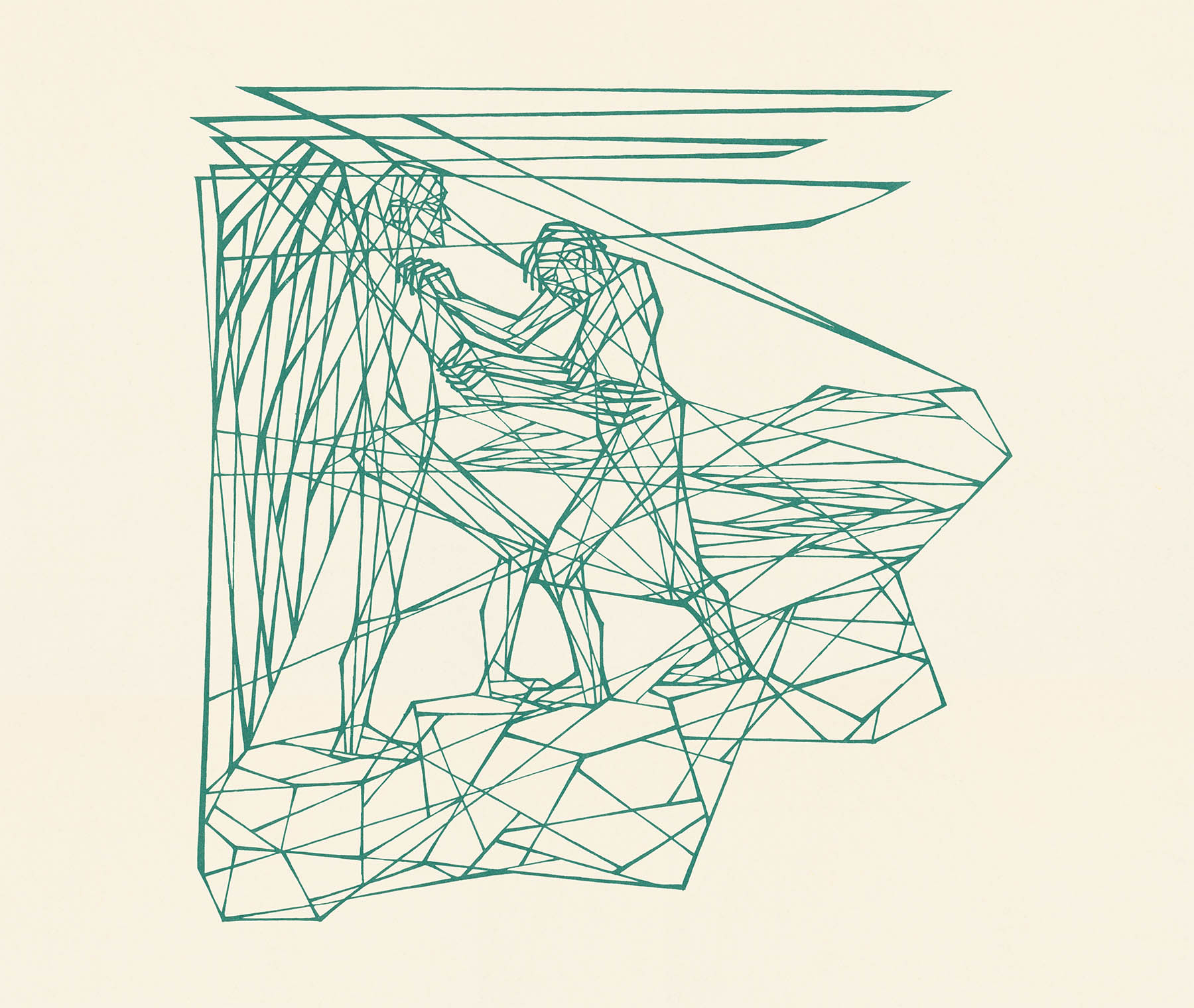
Drawing by Ismar David from The Psalms: A new English translation, linked with permission from Ismar David Archive .
For other images of Ismar David drawings, see here.

וַיִּוָּתֵ֥ר יַעֲקֹ֖ב לְבַדּ֑וֹ וַיֵּאָבֵ֥ק אִישׁ֙ עִמּ֔וֹ עַ֖ד עֲל֥וֹת הַשָּֽׁחַר׃
24Jacob was left alone, and a man wrestled with him until daybreak.
Drawing by Ismar David from The Psalms: A new English translation, linked with permission from Ismar David Archive .
For other images of Ismar David drawings, see here.

Hand colored stencil print on washi by Sadao Watanabe (1970).
Image taken with permission from the SadaoHanga Catalogue where you can find many more images and information about Sadao Watanabe. For other images of Sadao Watanabe art works in TIPs, see here.
The following artwork is part of a series of 56 paintings on biblical themes by Kazakh artist Nelly Bube (born 1949):

Copyright by Norwegian Bible Society , used with permission.
For other images of Nelly Bube in TIPs, see here.
The following is a stained glass window in the Sacred Heart Cathedral in Chiang Mai, Thailand:

Photo by Jost Zetzsche
Stained glass is not just highly decorative, it’s a medium which has been used to express important religious messages for centuries. Literacy was not widespread in the medieval and Renaissance periods and the Church used stained glass and other artworks to teach the central beliefs of Christianity. In Gothic churches, the windows were filled with extensive narrative scenes in stained glass — like huge and colorful picture storybooks — in which worshipers could ‘read’ the stories of Christ and the saints and learn what was required for their religious salvation. (Source: Victoria and Albert Museum )
The name that is transliterated as “Jacob” in English means “he will supplant,” “he that follows after,” “a heeler,” “one who trips up,” “takes hold by the land.” (Source: Cornwall / Smith 1997 )
It is translated in Spanish Sign Language with a sign that signifies “lentil,” referring to the soup he gave his brother in exchange for his birthright (see Genesis 25:34). Note that another Spanish Sign Language sign for Jacob also users the sign for Jewish. (Source: Steve Parkhurst)
“Jacob” in Spanish Sign Language, source: Sociedad Bíblica de España
In German Sign Language it is a sign that shows the touching of the hip, described in Genesis 32:25:
“Jacob” in German Sign Language (source: Taub und katholisch )
In Finnish Sign Language it is translated with the signs signifying “smooth arm” (referring to the story starting at Genesis 27:11). (Source: Tarja Sandholm)
“Jacob” in Finnish Sign Language (source )
In Hungarian Sign Language it is translated with a sign signifying Jacob grabbing the heel of Esau during their birth (referring to Genesis 25:26). (Source: Jenjelvi Biblia )
“Jacob” in Hungarian Sign Language (source )
For more information on translations of proper names with sign language see Sign Language Bible Translations Have Something to Say to Hearing Christians .
See also Esau.
Learn more on Bible Odyssey: Jacob .
Following are a number of back-translations as well as a sample translation for translators of Genesis 32:24:
And Jacob was left alone: the text does not say which side of the Jabbok Jacob is now on. This will depend on the understanding of verses 22-23; the interpretation recommended here is that Jacob did not cross over the Jabbok with his family and possessions, and that he was still on the north side of the river. The alternative interpretation that Jacob took his family across and then returned to send his possessions across would have the same result. The words left alone seem to be more appropriate to a situation where Jacob was separated from his family by the river.
And a man wrestled with him until the breaking of the day: this sentence is abrupt. There is no transition to bring Jacob into contact with the stranger, whose sudden appearance may explain why Jacob did not cross the river after the rest of his party had gone across. Good News Translation avoids this abruptness by placing the first sentence of this verse as the final sentence of verse 23. In a new paragraph Good News Translation says “Then a man came and….” Translators may find that the encounter between Jacob and the stranger must be presented in some such manner. In some languages a transitional expression such as “During the night…” may be required. The sudden appearance of the stranger is brought out in a number of translations that say “Then a man appeared and….”
A man translates the ordinary Hebrew word for a man in contrast with a woman. Although Jacob clearly understands in verse 30 that this person is supernatural, the text at this point calls him a man, not an angel or God.
Wrestled: the particular Hebrew word is used only here and in the next verse. It is related to a word for “dust,” “get dusty,” as two people do when wrestling on the ground. There is a play on words between wrestled (yeʾabeq), Jabbok (yabboq) and Jacob (yaʿaqob). Two men engaged in wrestling try to throw each other to the ground. In societies where such contests are unknown, a descriptive phrase must be used; for example, “he came and struggled with Jacob” or “he and Jacob tried to push each other over.” In some languages a man wrestled with him… may need to be filled out; for example, “Then a man came and took hold of him, and they-two were wrestling until nearly daybreak.”
Until the breaking of the day is literally “until the rising of the dawn.” The expression refers to the early period of dawn, when the eastern sky begins to become light. This is some time before the sun actually rises.
Quoted with permission from Reyburn, William D. and Fry, Euan McG. A Handbook on Genesis. (UBS Helps for Translators). New York: UBS, 1997. For this and other handbooks for translators see here .
No comments yet.
Leave a Reply
You must be logged in to post a comment.