Hand colored stencil print on momigami by Sadao Watanabe (1989).
Image taken with permission from the SadaoHanga Catalogue where you can find many more images and information about Sadao Watanabe. For other images of Sadao Watanabe art works in TIPs, see here.
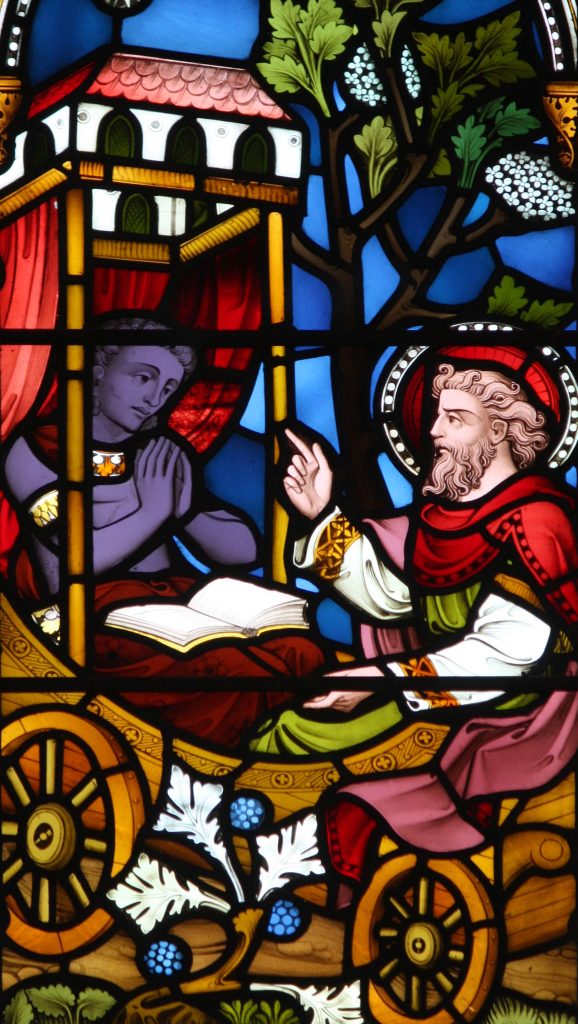
The following is a stained glass window from the Exeter College Chapel in Oxford:
Stained glass is not just highly decorative, it’s a medium which has been used to express important religious messages for centuries. Literacy was not widespread in the medieval and Renaissance periods and the Church used stained glass and other artworks to teach the central beliefs of Christianity. In Gothic churches, the windows were filled with extensive narrative scenes in stained glass — like huge and colorful picture storybooks — in which worshipers could ‘read’ the stories of Christ and the saints and learn what was required for their religious salvation. (Source: Victoria and Albert Museum )
Following are a number of back-translations of Acts 8:37:
Uma: “[[Filipus said: ‘If you (sing.) really believe in him, you (sing.) may/can be baptized by me.’ The Ethiopia person said: ‘I believe that Yesus Kristus is the Son of God.’]]” (Source: Uma Back Translation)
Yakan: “Pilip said to him, ‘You can be baptized if you believe in Isa with your whole heart (lit. entirely your liver).’ He answered, he said, ‘Yes, I really believe that Isa Almasi is the Son of God.’)” (Source: Yakan Back Translation)
Western Bukidnon Manobo: “And Philip answered, ‘It can be if your believing is real.’ And the official answered, ‘I believe, I believe that Jesus Christ is the Son of God.'” (Source: Western Bukidnon Manobo Back Translation)
Kankanaey: “‘If you (sing.) definitely believe in Jesus, it is possible,’ said Felipe in reply. ‘I do believe,’ said the official. ‘I believe that Jesu Cristo is the Child of God.'” (Source: Kankanaey Back Translation)
Tagbanwa: “Felipe replied, ‘Yes, it’s certainly okay, if you have now understood and your believing/obeying of this Good News really is genuine.’ ‘It really is genuine,’ said that taga Etiope. ‘I really believe that as for Jesu-Cristo, he truly is the Son of God.'” (Source: Tagbanwa Back Translation)
Illustration by Horst Lemke (1922-1985) for the GermanGute Nachricht für Sie – NT68, one of the first editions of the Good News Bible in German of 1968. Lemke was a well-known illustrator who illustrated books by Erich Kästner , Astrid Lindgren and many others.
This verse is placed in brackets by the Good News Translation and is omitted by most modern translations of the New Testament as not being an original part of the book of Acts. Its content is in keeping which the thought of the book of Acts, but it is not to be found in the earliest and best Greek manuscripts available. If it had been an original part of Acts, it is difficult to see why a scribe would have omitted it.
In so many languages a term for believe must have some grammatical object—for example, “believe in Jesus Christ.”
Quoted with permission from Newman, Barclay M. and Nida, Eugene A. A Handbook on The Acts of the Apostles. (UBS Handbook Series). New York: UBS, 1972. For this and other handbooks for translators see here .
Living Water is produced for the Bible translation movement in association with Lutheran Bible Translators. Lyrics derived from the ESV® Bible (The Holy Bible, English Standard Version®).



Leave a Reply
You must be logged in to post a comment.