The following artwork is part of a series of 56 paintings on biblical themes by Kazakh artist Nelly Bube (born 1949):
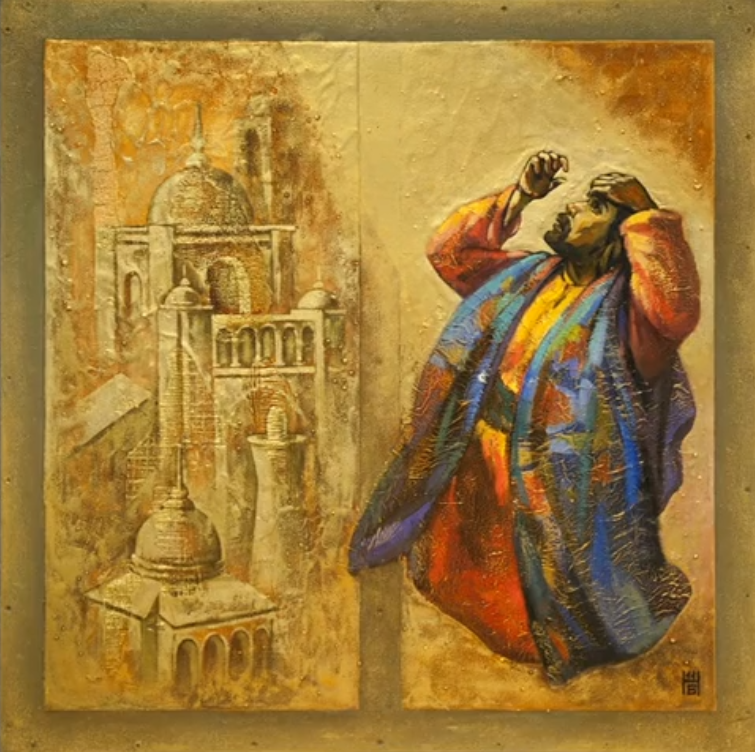
Copyright by Norwegian Bible Society , used with permission.
For other images of Nelly Bube in TIPs, see here.

οἱ δὲ σὺν ἐμοὶ ὄντες τὸ μὲν φῶς ἐθεάσαντο τὴν δὲ φωνὴν οὐκ ἤκουσαν τοῦ λαλοῦντός μοι.
9Now those who were with me saw the light but did not hear the voice of the one who was speaking to me.
The following artwork is part of a series of 56 paintings on biblical themes by Kazakh artist Nelly Bube (born 1949):
Copyright by Norwegian Bible Society , used with permission.
For other images of Nelly Bube in TIPs, see here.
Following are a number of back-translations of Acts 22:9:
On this verse see 9.7. In the earlier account the companions of Paul all hear, though they did not see the light.
Quoted with permission from Newman, Barclay M. and Nida, Eugene A. A Handbook on The Acts of the Apostles. (UBS Handbook Series). New York: UBS, 1972. For this and other handbooks for translators see here .
22:9a
My companions: This phrase in Greek phrase is literally “the ones being with me.” They were traveling with Paul. They were probably men. They may have been assisting Paul in his work, or they may have been strangers who happened to be traveling the same road at that time. Other ways to translate this phrase are:
those who were with me (Revised Standard Version)
-or-
The men with me (Good News Translation)
saw the light:
This refers to the light shining on Paul.
22:9b
could not understand the voice: The Greek words are literally “did not hear the voice.” But there is a difference in the Greek grammar from the words in 9:7. There are two ways to interpret the Greek words here:
(1) The Greek words here mean did not understand the words. For example:
did not understand the voice (English Standard Version)
(Berean Standard Bible, New International Version, New American Standard Bible, New Living Translation (2004), God’s Word, NET Bible, English Standard Version)
(2) The Greek words here mean did not hear the voice. For example:
did not hear the voice (Revised Standard Version)
(Revised Standard Version, Good News Translation, New Jerusalem Bible, New American Bible, Revised Edition, Contemporary English Version, Revised English Bible, New Century Version, King James Version)
It is recommended that you follow interpretation (1) because of the different grammar here.
© 2001, 2021 by SIL International®
Made available under the terms of a Creative Commons Attribution-ShareAlike 4.0 License (CC BY-SA) creativecommons.org/licenses/by-sa/4.0.
All Scripture quotations in this publication, unless otherwise indicated, are from The Holy Bible, Berean Standard Bible.
BSB is produced in cooperation with Bible Hub, Discovery Bible, OpenBible.com, and the Berean Bible Translation Committee.
No comments yet.
Leave a Reply
You must be logged in to post a comment.