The Hebrew and Latin that is transliterated as “Micah” in English is translated in Hungarian Sign Language with a sign that suggests that the prophet directly interprets the word of God to the people. (Source: Jenjelvi Biblia and HSL Bible Translation Group)
“Micah” in Hungarian Sign Language — note that only the first part refers to “Micah,” the second and third parts refer to “prophet” and “book” (source )
In Spanish Sign Language it is translated with the sign for “humility” or “obey,” referring to Micah 6:8. (Source: Steve Parkhurst)
The Hebrew and Latin that is transliterated as “Obadiah” in English means “a servant of the LORD,” “a worshiper of YHWH.” (Source: Cornwall / Smith 1997 )
In Hungarian Sign Language it is translated with a sign referring to the struggle between soul and body. The figure of Obadiah and his prophetic ministry exemplify faithfulness, courageous stance, and steadfastness. In the book of Obadiah, the struggle between soul and body appears as the contrast between pride and humility: “The pride of your heart has deceived you, you who live in the clefts of the rocks and make your home on the heights, you who say to yourself, ‘Who can bring me down to the ground?'” (Obadiah 1:3). The struggle between soul and body is also manifested in how we relate to those who suffer. The body would choose selfishness, while the soul chooses compassion: “You should not gloat over your brother in the day of his misfortune, nor rejoice over the people of Judah in the day of their destruction” (Obadiah 1:12). (Source: Jenjelvi Biblia and HSL Bible Translation Group)
“Obadiah” in Hungarian Sign Language — note that only the first part refers to “Obadiah,” the second and third parts refer to “prophet” and “book” (source )
In Swiss-German Sign Language it is translated with a sign that depicts the book of Obadiah as the shortest book in the Old Testament.
The Hebrew and Latin that is transliterated as “Amos” in English is translated in Spanish Sign Language with the sign for “renovate / renew,” particularly referring to Amos 9:11. (Source: Steve Parkhurst)
In Swiss-German Sign Language it is translated with the sign that depicts Amos’ move from the Southern Kingdom of Judah into the Northern Kingdom of Israel to prophesy against it.
In Hungarian Sign Language it is translated with a sign reflecting the meaning and significance of the Hebrew name: burden-bearer or one who carries a load. While the biblical text does not explicitly define the name, its meaning indirectly alludes to the prophet’s ministry, as he proclaimed heavy judgments (burdens) against Israel. “I will crush you as a cart crushes, when loaded with grain.” (Amos 2:13). (Source: Jenjelvi Biblia and HSL Bible Translation Group)
“Amos” in Hungarian Sign Language — note that only the first part refers to “Amos,” the second and third parts refer to “prophet” and “book” (source )
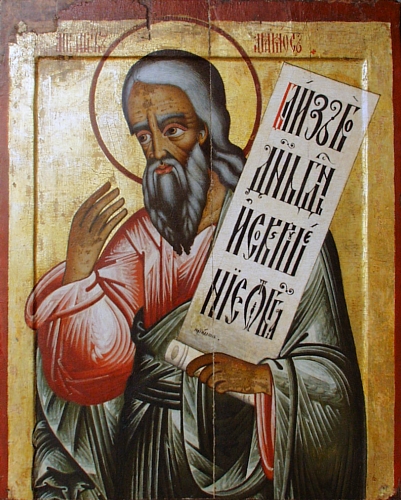
Following is a Russian Orthodox icon of Amos from the 18th century (found in the Transfiguration Church, Kizhi Monastery, Karelia, Russia). The words on the scroll are extracted from Isaiah 13:6: “For the day of the Lord is near; it will come like destruction from the Almighty!”
Orthodox Icons are not drawings or creations of imagination. They are in fact writings of things not of this world. Icons can represent our Lord Jesus Christ, the Virgin Mary, and the Saints. They can also represent the Holy Trinity, Angels, the Heavenly hosts, and even events. Orthodox icons, unlike Western pictures, change the perspective and form of the image so that it is not naturalistic. This is done so that we can look beyond appearances of the world, and instead look to the spiritual truth of the holy person or event. (Source )
The Hebrew, Latin, and Greek that is transliterated as “Joel” in English means “LORD of God,” “the LORD is God,” “the LORD is might.” (Source: Cornwall / Smith 1997 )
In Spanish Sign Language it is translated in two different ways. The first is with a sign depicting “Pentecost flame,” referring to Peter’s speech on Pentecost in which he quotes Joel in Acts 2:16 and following. (Source: Steve Parkhurst)
In Hungarian Sign Language it is translated with a sign that refers to the fact that God’s message, through the prophet, was perceived and proclaimed in the widest possible scope (see Joel 2:28). (Source: Jenjelvi Biblia and HSL Bible Translation Group)
“Joel” in Hungarian Sign Language — note that only the first part refers to “Joel,” the second and third parts refer to “prophet” and “book” (source )
The Hebrew, Ge’ez, and Greek that is transliterated as “Baruch” in English is translated in Spanish Sign Language with a sign depicting “Assistant to Jeremiah,” referring to Jeremiah 36:4 et al. For Jeremiah as the “crying prophet” in sign language translation, see here. (Source: Steve Parkhurst)
The name that is transliterated as “Job” in English means “the persecuted,” “hated,” “one ever returning to God,” “he that weeps,” “a desert.” (Source: Cornwall / Smith 1997 )
In Spanish Sign Language it is translated with a sign for “patience,” referring to James 5:11 and many other passages within the book of Job. (Source: Steve Parkhurst)
The name that is transliterated as “Haman” in English means “alone,” “solitary,” “well disposed,” “a rioter,” “rager.” (Source: Cornwall / Smith 1997 )
The name that is transliterated as “Mordecai” in English means “little man,” “bitter bruising,” “bitterly reduced,” “bitterness of my oppression.” (Source: Cornwall / Smith 1997 )
It is translated in Spanish Sign Language with a sign depicting the tearing of clothes, referring to Esther 4:1. (Source: Steve Parkhurst)